
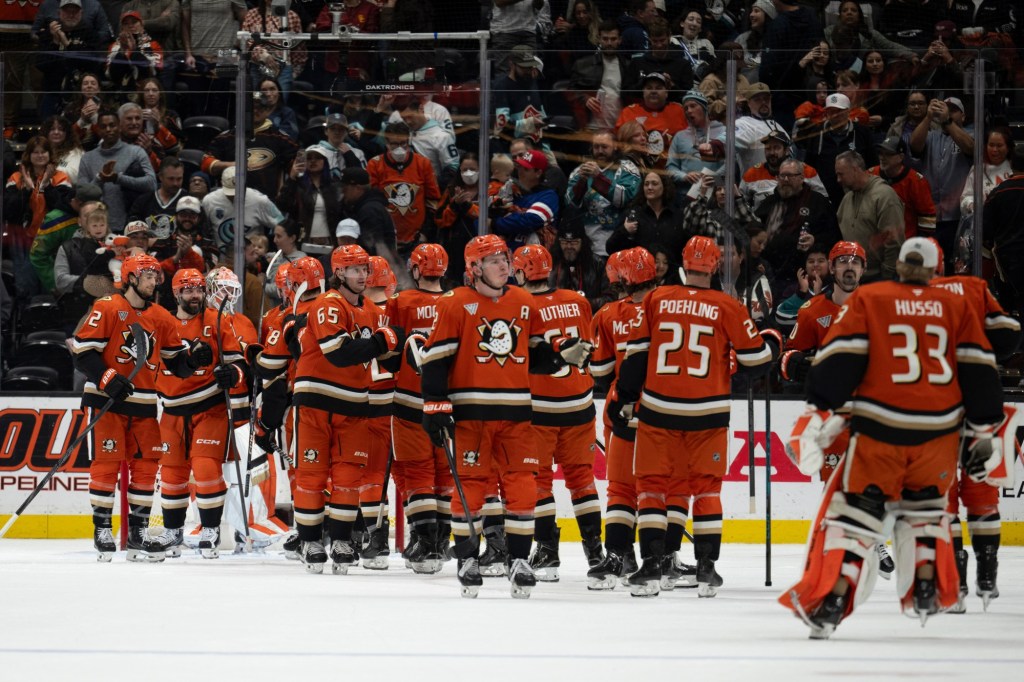
For the first time in a long time at Honda Center, hearts are filled with hope and seats are filled with butts.
Just as the Ducks’ season was imperiled by a nine-game losing streak that included eight regulation defeats, they circled the wagons to take nine of their last 11 decisions before the Olympic break despite injuries to several of their top contributors.
Situated in a playoff position that would end their eight-year postseason drought, the Ducks now face their most critical home stretch in nearly a decade. Here are how all their skaters with 30 or more games played have fared thus far.
Leo Carlsson, center, A-
Carlsson had a superlative start to the season, looking every bit the equal of his most prominent peers like Connor Bedard and Macklin Celebrini in the first two months of 2025-26. Yet a nosedive in his production accompanied lower-body issues that turned out to be a rare thigh injury that required surgery and cost the 21-year-old his first Olympic nod for Team Sweden.
Cutter Gauthier, winger, A-
Like Carlsson, Gauthier is a cornerstone in a contract year, and he has delivered similarly. He’s on track for 38 goals and 72 points, up from 20 and 44 last season. As his spatial awareness and shot selection has improved, his considerable skill and athleticism have dazzled more and more.
Troy Terry, winger, B+
Terry is enjoying the best per-game scoring rate of his career, while possessing an active stick, recovering pucks relentlessly and creating pace in a way that perhaps only Carlsson also does for the Ducks.
Jackson LaCombe, defenseman, B+
LaCombe’s top-line production, underlying metrics and overall responsibility have continued to trend upward. Expectations have increased, too, after he signed a $72 million contract extension in the offseason and was named to Team USA as a replacement.
Lukáš Dostál, goalie, B+
Having re-upped over the summer and also been selected for the Olympics, Dostál’s profile has elevated rapidly. After consistently saving goals well above expected last season and early this year, he had a rough patch that coincided with some teamwide struggles, but he has recaptured top form of late. He remains the team’s most important player on most nights.
Ville Husso, goalie, B-
Petr Mrázek, goalie, D+
The Ducks have an unusual amount of salary cap space, nearly $6.5 million, committed to their Nos. 2 and 3 goalies. For Husso’s part, he has mostly earned his keep, emerging as the backup to the liberally deployed Dostál, while Mrázek has been injured for much of the season and ineffective while available.
Beckett Sennecke, winger, A-
Sennecke was the topic of much debate in the preseason regarding his level of NHL readiness. His response? He leads NHL rookies in goals (18) while placing second in points (44) and assists (26), all while displaying verve and guile that have made seasoned veterans look foolish. As his skating and physique improve, the Ducks might have a quicker version of Corey Perry in their midst.
Mason McTavish, forward, B-
Mikael Granlund, forward, B-
McTavish signed a six-year, $42 million extension during training camp, more than three months after Granlund signed a $7 million-per-year pact of his own as a free agent. A lower-body injury cost Granlund considerable time, but he has delivered in terms of positional and situational versatility. McTavish, now in his fourth season, is still looking for the breakout that his second half of last season hinted at, with defense and overall consistency leaving a bit to be desired.
Chris Kreider, winger, B+
Jacob Trouba, defenseman, B+
Both players were jettisoned by the New York Rangers, who sunk in the standings and have continued selling off after pretending as though their leadership group was the issue. In Orange County, they’ve recuperated nicely, with Kreider starting out the season phenomenally and Trouba being the second most relied-upon blue-liner after LaCombe.
Radko Gudas, defenseman, B
The Ducks’ captain has been healthier and steadier overall this season than last, settling into a role that’s seen him be less visible but arguably more of a net positive than he was in 2023-24, his first season with the Ducks that earned him the “C.”
Ryan Poehling, center, B+
Poehling has used both his swift feet and agile mind to plug gaps and create pace for the Ducks. He has been an opportunistic forechecker, regular penalty killer and a player who can play up the lineup, one who Terry called “the heartbeat of the team” recently. He was the main piece in the Trevor Zegras trade, which remains a bit questionable given the performance of the Ducks’ middle-six centers and Zegras’ career year to date in Philadelphia.
Ross Johnston, winger, B
Jansen Harkins, center, C+
Johnston appeared to be a candidate for a reduced role when the Ducks got deeper up front, but he’s played in 54 of 56 games while providing value beyond that of a pugilist. Johnston’s offensive numbers are the best of his career and he’s contributed to the forecheck and cycle alike. Harkins has done much of the same, albeit less frequently.
Alex Killorn, winger, C+
Killorn heated up in the past month but is still on pace for a paltry 26 points, after notching 73, despite missing 19 games, in his first two years with the club. He’s played fewer and less offensive-oriented minutes this season. As the Ducks look ahead to a summer when they’ll have at least three players with enormous raises, Killorn’s $6.25 million cap hit will be tougher to swallow.
Frank Vatrano, winger, C
Ryan Strome, center, C
It’s tough to evaluate Vatrano and Strome, who formed a trusted trio with Terry last year but have fallen out of favor as the Ducks’ forward depth proliferated. Strome started the year injured and has been a healthy scratch several times. Vatrano was relegated to the bottom six and then broke his shoulder.
Ian Moore, defenseman, B-
Drew Helleson, defenseman, C-
These two young right-shooting defensemen have moved in opposite directions, with Moore gaining the trust of the coaching staff in short order and Helleson proving to be mistake-prone with tepid underlying numbers among a crowded field on the blue line.
Pavel Mintyukov, defenseman, B
Olen Zellweger, defenseman, B
Mintyukov was scratched for a stint and Zellweger has seen his power-play usage halved year-over-year. Yet on balance, both players have continued to enrich and even out their performance, with Mintyukov expanding his role on the penalty kill and Zellweger finding his groove at even strength.
Joel Quenneville, head coach, B
Quenneville has the Ducks on a 92-point pace, a 12-point jump after they were the Western Conference’s most improved team under Greg Cronin (+21 points) a year earlier. He plays a simpler system with more room to roam, but he’s also had more weapons to work with while not ameliorating some fundamental issues from less ambitious campaigns.
Pat Verbeek, general manager, A-
Verbeek was brought in to slice and dice the remnants of the Bob Murray era, which saw the Ducks reach the conference finals in 2015 and 2017. He has aggressively stocked futures while employing an unconventional approach to talent acquisition at times. Notably, he went off the board in the top three for both Carlsson and Sennecke, figuratively sucking down an energy drink and burping in the faces of detractors afterward.