
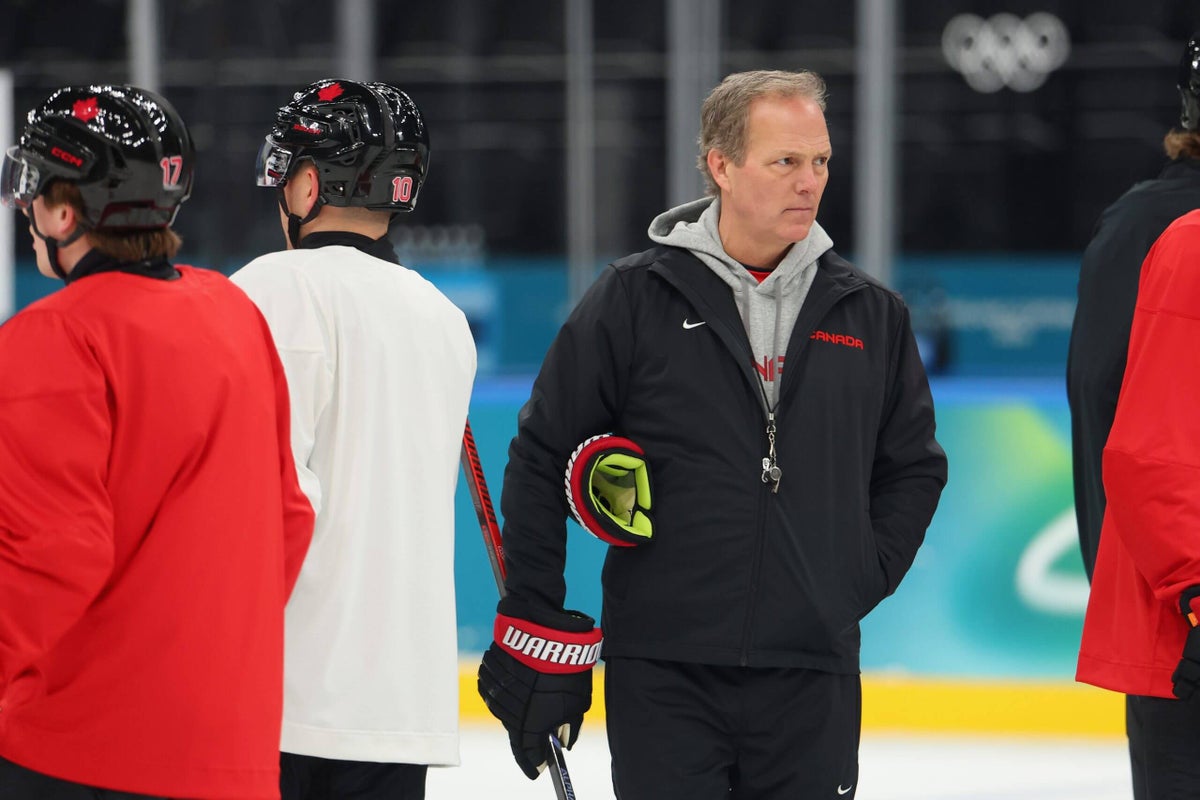
MILAN — The head coaches for the Canadian and Swedish men’s hockey teams broke new Olympic ground Monday when they closed their practices to the media, hiding their systems work and line combinations from prying eyes ready to send that information back home to nations full of fans obsessing over every last detail they can get on their teams.
They were also hiding those details from their Olympic rivals.
When Team Canada coach Jon Cooper was asked why he closed practice, though — something no men’s Olympic hockey team has done since NHL players started participating in the Games in 1998 — he suggested that “closed” was the wrong term.
Canada was skating on the practice rink adjacent to Santagiulia Arena, a temporary facility with flimsy walls and little room aside from the ice surface itself.
“Practice wasn’t closed,” Cooper said. “It was only done because the rink’s too small. It’s just distractions and people — there’s just issues to have so many people here. If you’re asking me, did any lines change? Did anything happen? No, it did not. Nothing changed.”
Everyone, however, will have to take his word for it.
Cooper’s and Sweden coach Sam Hallam’s decisions to get alone time with their players at least temporarily inspired Team USA coach Mike Sullivan to do the same, announcing that U.S. practice would be off limits while the media was waiting to speak to Canada’s players and coaches.
Even NHL officials in Milan were blindsided by the U.S.’s 11th-hour decision. Ultimately, though, the Americans changed course and allowed reporters into practice.
“We talked about it with our practice today,” Sullivan said. “I think any time as a coaching staff — when you have an opportunity to spend alone time with your team, we would all prefer that. But we also understand that this is, to a certain extent, a business, and access to the group is an important element of it.
“But as a coaching staff, we love having alone time with our team and being able to work on things without having to read about it in a tweet 30 seconds later or whatever it may be. But we understand that’s the world we live in.”
Speaking of which, the United States’ forward lines and defense pairs further became clearer Monday.
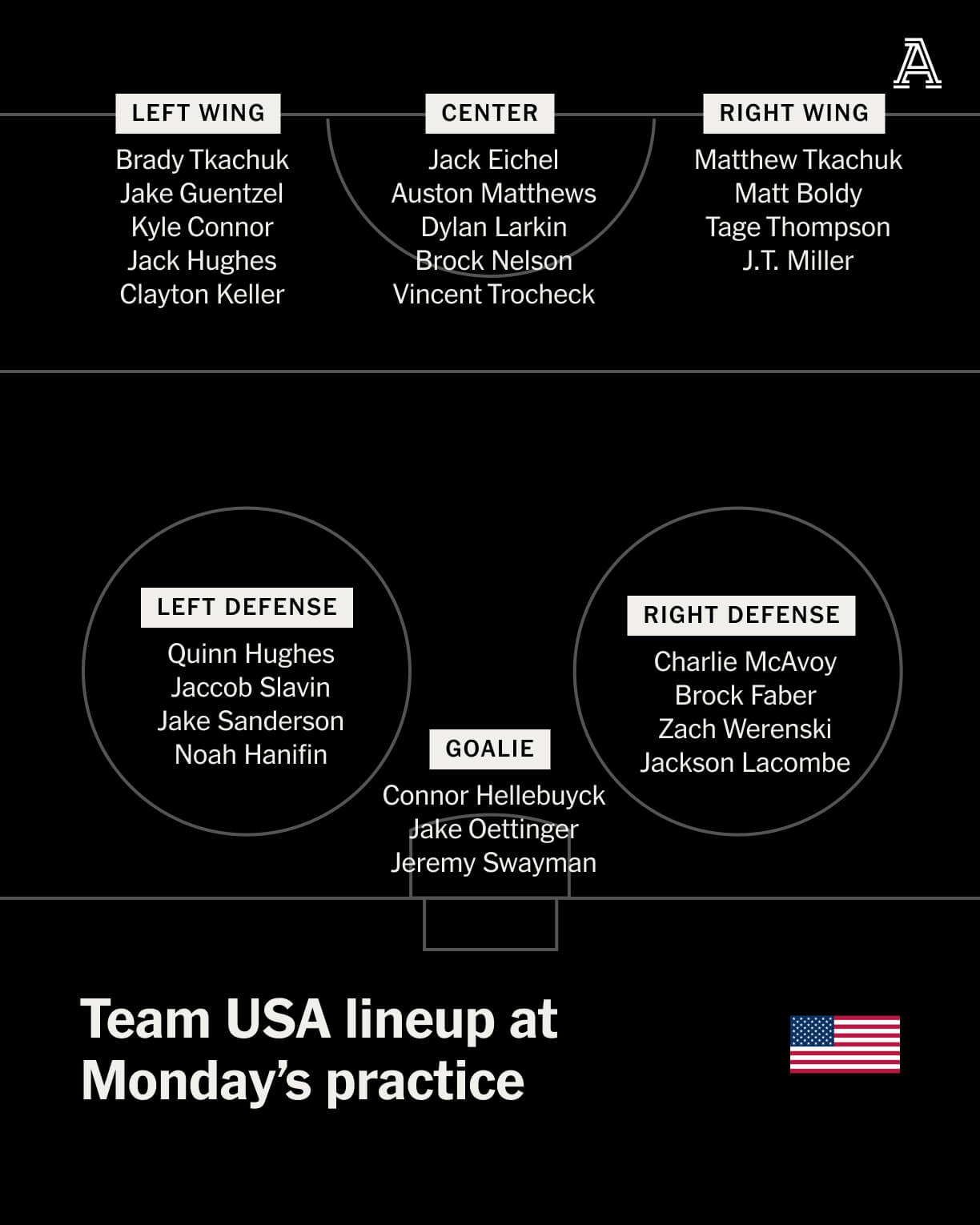
“Not that anything is etched in stone, because I just think that’s the human element of sports,” Sullivan said. “We’ll see how it goes. But there were certain things that we liked (from the 4 Nations). For example, we liked the Tkachuk brothers when we put them together. They’re heart-and-soul guys in a lot of ways. They personify what it means to be an American, with their fierce competitive spirit. And so, I thought they were the catalyst for our team becoming a team in that sense of the word.”
The U.S. also may have provided an inside peek at its power-play units. Quinn Hughes quarterbacked the first unit with Auston Matthews, Kyle Connor, Matthew Tkachuk and Tage Thompson on Monday, and the second unit consisted of Jake Guentzel, Jack Hughes, Brady Tkachuk, Clayton Keller and Jackson Lacombe.
Because Monday’s practice mostly entailed penalty-kill work, though, with Matt Boldy and Zach Werenski practicing with that unit, Keller and Lacombe may have been placeholders for them on the second unit.
Special teams decisions were at least partially why Hallam decided to close his practice, saying he just wanted one day where the Swedes could work on special teams without reporters sending out intel to their opponents. Sweden plans to open its practices in the coming days, Hallam said.
Canada’s Olympic Village stance
Team USA made it clear from Day 1 that it intends to stay in the Olympic Village, with Brady Tkachuk saying the Americans wanted to experience everything the Olympics have to offer.
“Part of the experience is to immerse yourself in the whole Olympic experience, and the village is part of that,” Sullivan said.
Team Canada, however, has largely been evasive on the subject.
Defenseman Drew Doughty was asked after practice on Sunday if Canada would be staying in the village as opposed to using a hotel the NHLPA booked for players.
“Uhhhh, yeah,” he said. “Tonight we are.”
Canada forward Nathan MacKinnon was asked the same question after practice on Monday.
“I don’t know. I think we have both options,” he said. “It’s not up to me.”
Forward Sam Bennett and goaltender Logan Thompson, on the other hand, said their understanding is that Canada will leave the village at some point.
“That’s the plan,” Bennett said.
It’s just not clear if that will be a permanent exit.
One thing MacKinnon did confirm was that the men’s team planned to gather to watch Canada’s women’s team take on Team USA on Tuesday evening, but not in the arena. They will do so on television.
Canada does not play its first game until Thursday, against the Czech Republic. Canada may stay in the village until Wednesday and move to the hotel — where it will have access to meeting rooms and video that are not available in the village — the night before its first game.
However, it’s hard to say for sure. Much like their closed practice Monday, Canada is playing it close to the vest.
Canada, U.S. had homework ahead of the Olympics
When Canada named its Olympic roster on Dec. 31, the players who made the team were given access to an online portal where they could watch videos and get up to speed on systems.
Canada forward Mitch Marner said Sunday that most of the systems remain unchanged from what Cooper ran at the 4 Nations Face-Off, but there are six players on Team Canada who were not at that tournament: goaltenders Thompson and Darcy Kuemper, and forwards Macklin Celebrini, Bo Horvat, Nick Suzuki and Tom Wilson.
For them, that video platform was essential prep work for this tournament. And they knew Cooper was taking attendance.
“For me, as a coach, you want to put your players in the best position to have success,” Cooper said. “So all the information we can give them, the better. You can’t come to this tournament and run through everything in one shot. It was a ton of preparation that went in for players — we would narrate videos and whatnot — and when the team was picked, they had access to watch all this.
“So a little bit of teacher to pupil, and then we had the ability to see who watched it and who didn’t.”
Attendance, according to Cooper, was very high.
Sullivan did much the same thing with Team USA, which welcomed three players who weren’t on the 4 Nations roster: Keller, Lacombe and forward Tage Thompson. (Quinn Hughes also didn’t play at 4 Nations due to injury, though he was on the original roster.)
“Our coaching staff put together some video meetings that we sent to the players where they had an opportunity to watch them on the plane ride over, and then we reviewed it when we got here,” Sullivan said. “But we did the same thing with the 4 Nations experience. Also, we sent them a number of video meetings in advance, where they had an opportunity to look at it more than once. And we just felt like it gave us an opportunity to get ahead of it. It also cut down on some of the information overload that is always one of the concerns when you get in these types of experiences.”
As opposed to taking attendance on the back end of an online platform, Sullivan took the scholastic analogy a step further.
“So far,” Sullivan said, “based on the quizzes we’ve given them, they’ve all passed with flying colors.”
Sweden’s goaltending up in the air
Just like the United States and Canada, Hallam is keeping his starting goaltender quiet — as of now, even to his own goaltenders.
Filip Gustavsson said Monday he doesn’t know yet whether he, Minnesota Wild sidekick Jesper Wallstedt or the New Jersey Devils’ Jacob Markstrom will get the nod in Sweden’s opener Wednesday against Italy.
“We’ve just been rolling all three goalies in practice, and we have two more days, so we’ll see,” said Gustavsson.
Gustavsson is 13-1-3 in his past 17 starts for Minnesota, so he enters the Olympics confident and seemingly playing better than Wallstedt and Markstrom.
“I feel confident, and we’ve been doing well in Minnesota, so I feel like my game is in a good spot,” he said. “Hopefully, (Sweden’s coaches) can see that, too.”