
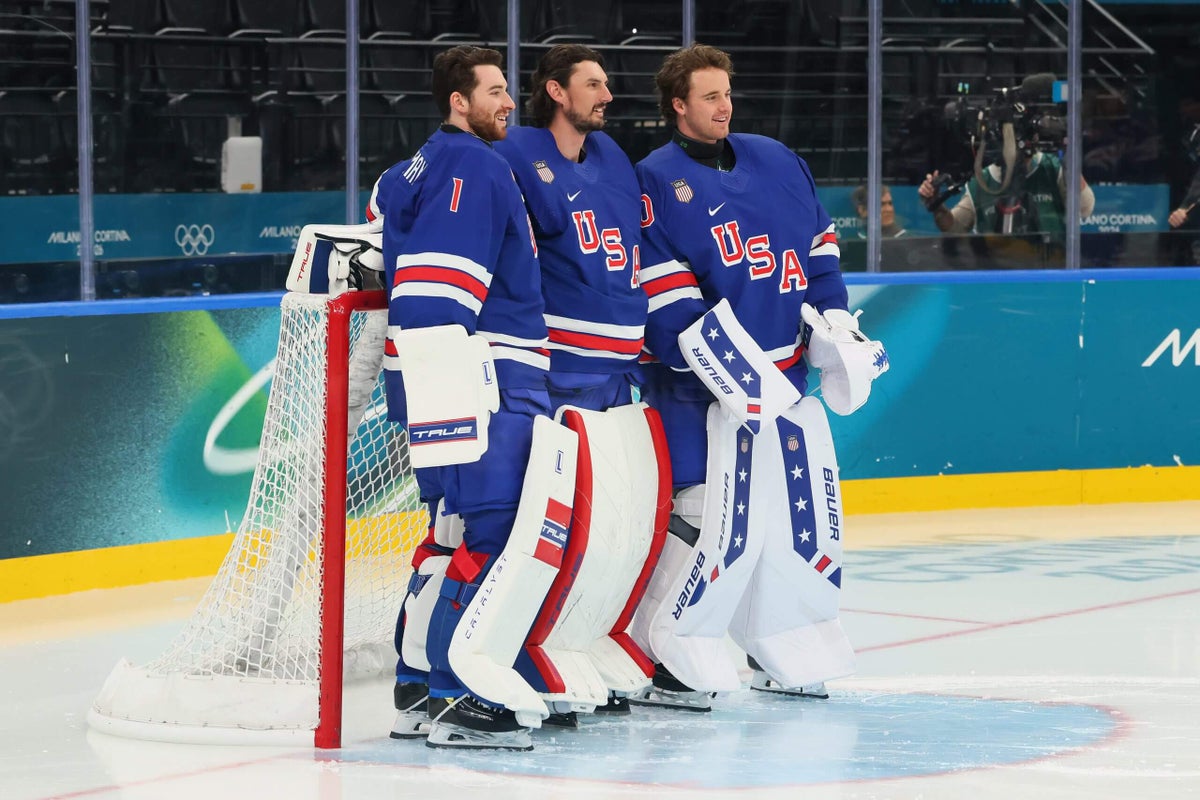
MILAN — The co-favorites for gold in men’s hockey each have a tricky goaltending decision to make.
It is not the same decision, mind you. Team USA needs to pick between three Ferraris. Team Canada has to decide what hot hand will emerge from what the outside world has pinpointed as its weakest link.
But within all that, they’re still equally potentially thorny decisions nonetheless in net for each powerhouse team.
Let’s dive into it:
Team USA
As Brock Nelson said Monday, the United States has a luxury of riches in goal with Connor Hellebuyck, Jake Oettinger and Jeremy Swayman, “but who knows who they go with?”
“I’m glad I don’t have to make that decision,” the veteran center said. “I’m glad they’re behind me though.”
Former NHL goalie Brian Boucher, working the NBC men’s hockey broadcast, said the U.S. may actually have a trickier decision than Canada because all three are upper-echelon goalies.
But judging by Monday’s practice, the net may be Hellebuyck’s to lose after his strong play at last year’s 4 Nations Face-Off and, of course, the fact that he’s the NHL’s reigning Hart and Vezina Trophy winner.
Hellebuyck said, “We’ll know soon enough.”
What makes this a tough call is that Swayman, who didn’t get playing time in the 4 Nations, may arguably be playing better this season than Hellebuyck and Oettinger.
Hellebuyck is 13-16-7 with the Winnipeg Jets with a 2.79 goals-against average and .900 save percentage, and ranks 24th in goals saved above expected at five-on-five at 3.5, according to Money Puck. Oettinger is 23-10-4 for the Dallas Stars with a 2.73 goals-against average and .897 save percentage. He ranks 26th in goals saved above expected at 0.7.
Swayman is 22-12-3 for the Boston Bruins with a 2.92 goals-against average and .903 save percentage but ranks second in the NHL in goals saved above expected at 17.9. And it’s clear Swayman hopes to grab the spot at some point.
“That’s our job, baby: make it hard for them,” Swayman said. “We want that. We want that high competitive environment, and I think it’s only going to raise our own level as well as the team’s level.”
Added Oettinger, “That’s the tough part about being a goalie. I wish all three of us could stand in there at same time. If I get my number called, I just got to be ready to go and try to play my best, and then hopefully they keep calling my number. Obviously it’s out of my control, and until then, I’m just gonna work my butt off and stay sharp and try to be ready to go.”
Goalie analytics are tricky. Sometimes you want to see a big body of work to make a decision. Other times it can be a game of “what have you done for me lately.” Recent trends can be very illuminating, especially when it comes to goaltending decisions for Canada and the USA.
For that, our analytics expert Dom Luszczyszyn looked at a rolling average of a goalie’s last 41 games of goals saved above expected per game.
For Canada, he felt the choice should be obvious. For the United States, the choice looks a lot more wide-open since Hellebuyck came back from injury. He’s only played 22 games since, but has an average GSAx of minus-0.13 during that stretch. Swayman’s return to form this year makes it a legitimate conversation.

Coach Mike Sullivan has not named a starter for the United States’ opener Thursday against Latvia, but he said they have a plan.
“We’ve obviously talked about this stuff at length on what our approach is going to be and how we’re going to go about it,” he said. “The reality is we have three excellent goalies. They’re all very capable. I think at the end of the day, performance will inevitably be the dictator. In a tournament like this, it has to be. And so, we have an idea going in of how we want to go about it and how we want to approach it and we’ll go from there. I do think that performance matters, and so that will be part of it as the tournament evolves.
“What I will tell you is that we feel regardless of which guy we put in, we have three elite goaltenders, all of which will give us an opportunity to win. That we know. We’ll do our best to make the best decisions for the team. That’s a discussion we have with our goaltenders, and that’s how we’ll go about it.”
Hellebuyck still has the inside track because of his play at the 4 Nations.
“I can understand the pace of play and the speed,” he said. “I know what’s expected with the way we play and what’s expected around me. There’s some good takeaways, and other than that I’m just going to enjoy every single day over here.”
Team Canada
Let’s sit back and consider the Canadian goalie history at play when it comes to the NHL-populated Olympics: Patrick Roy in 1998, Martin Brodeur in 2002 and 2006, Roberto Luongo in 2010, Carey Price in 2014.
It’s a lineage that we brought up with Jordan Binnington, Darcy Kuemper and Logan Thompson after practice Monday.
“That’s special,” said Binnington. “I think it’s hit me more and more as I’m here and just how big of a deal it is and what an honor it is, truly, to represent your country. Obviously some great names, great goaltenders have played for this organization and had success. History is such an important part of the game for you to understand what it takes and learn from their experiences and be inspired by moments they’ve had.”
But at the same time, all three Canadian goalies understand that it’s in fact because of that world-class goalie lineage that there’s a narrative now about the drop-off at the position at these Olympics. They get it.
“You know, I think when you’re saying the names that you were saying, those are Hall of Famers, so maybe that’s where it all stems from,” said Kuemper, smiling. “But we’re really confident with the three of us, our union — we know what we’re all capable of. We’re just looking forward to get started here.’’
Thompson said it hadn’t dawned on him the line of Canadian superstar goalies from past NHL Olympics that preceded the current trio.
“Those are all pretty elite goalies. I didn’t even think about that,” he said. “I guess it’s cool to be a part with those names. Just want to make those guys proud.”
There’s no denying no one is fueling the doubters more than Binnington, whose struggles this season have opened him up to that. He ranks dead last in the NHL in goals saved above expected at minus-18.5, while Thompson ranks third at 17.9 and Kuemper 14th at 6.5, according to Money Puck.
Team Canada’s goalie consultant just happens to be the director of goaltending for the St. Louis Blues. So David Alexander knows all too well what the narrative is ahead of the Olympics regarding Binnington — because it was the exact same narrative a year ago before 4 Nations, an event in which Binnington proved the doubters wrong.
“It was the same storyline, yes,’’ Alexander told The Athletic after practice Monday. “That’s one thing Binner and I talk about all the time: when the critics stop, you’re not in a good spot. Because the reality is, any position worth holding, brings criticism. It’s just the reality of it. The criticism is really affirmation, is what it is. When you’re surrounded by noise, it should elevate you. And he’s a guy that’s got a good brain for that and is able to recognize those moments and he’s done a great job handling it.’’
Binnington calmly answered the same old questions Monday. He gets it. And he insists he’s not sick and tired of it.
“No, no. I think that’s what keeps me going in some aspects, is proving myself and seeing what I’m capable of and seeing where I can take it,” he said. “That’s something I’ve used as motivation. That’s just part of sports is people are going to doubt you, and it’s how you handle it. For me, it’s just staying in my own process and building my game and trying to get better every day, every year and seeing where it takes me.”
His performances in Game 7 at Boston in the 2019 Stanley Cup and in the 4 Nations championship game in Boston last February speak to what Binnington can achieve when he channels it. Can he tap into that again here?
“It is experience, right?” said Binnington. “You gain wisdom and knowledge from experience. At the same time, none of that really matters when it comes (to) game time. You’ve got to do whatever you can to be ready for that moment. Just enjoy it, take it all in and leave it all out there.”
Team Canada won’t say yet who will be the Game 1 starter. That’s because the coaching staff hasn’t even told the three goalies what the pecking order actually is, which all three goalies confirmed to be true Monday.
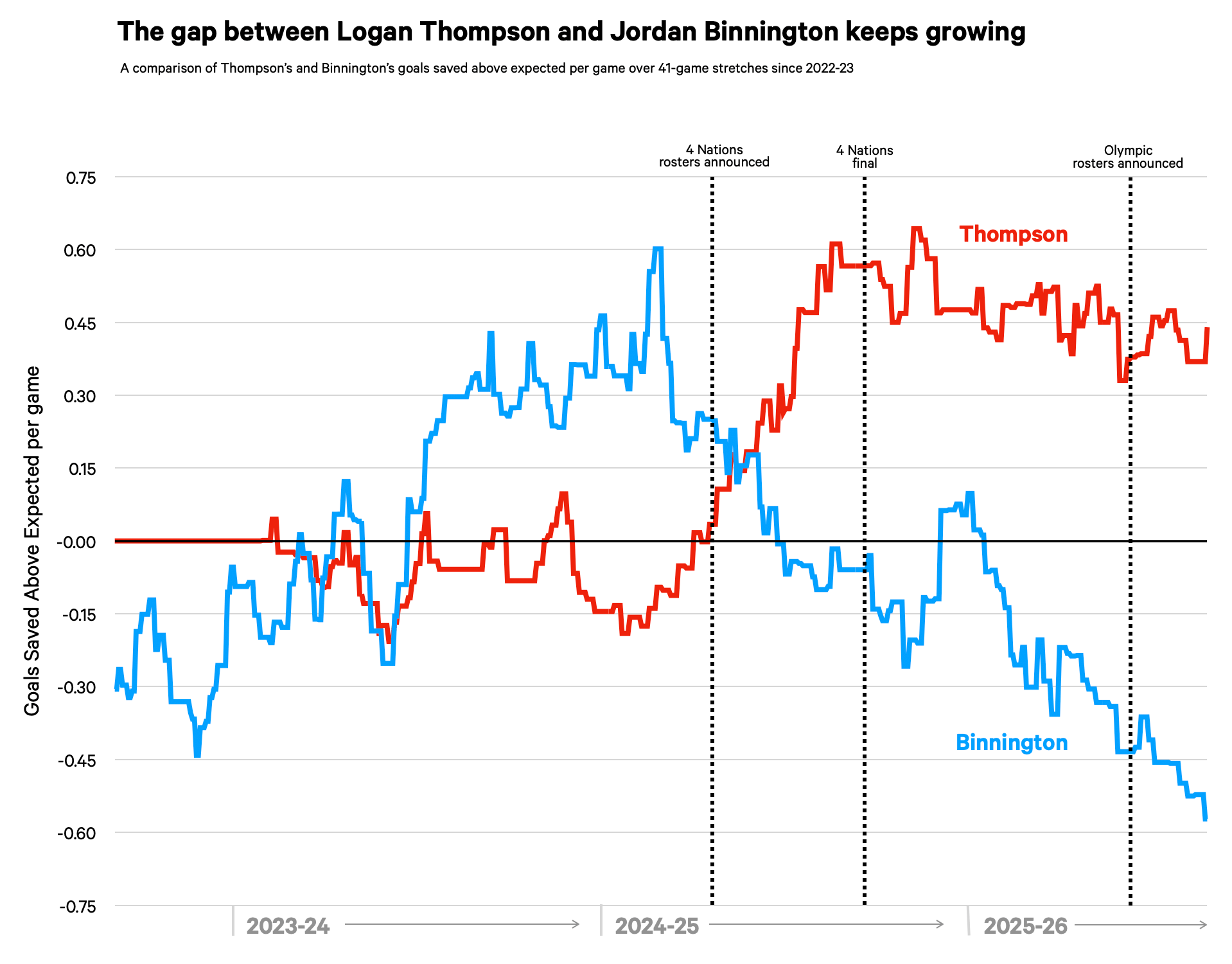
The conventional wisdom is that Binnington starts the tournament but is kept on a short leash. And remember this: even with that Hall of Fame lineage, Team Canada has had some interesting goalie twists in past NHL Olympics. Curtis Joseph started Game 1 in Salt Lake City in 2002, but after the team got blown out in the opener, Brodeur took over and never looked back. Eight years later in Vancouver, it was Brodeur, the NHL’s all-time wins leader, who got replaced in net after a round-robin loss to the U.S. Then Luongo took over for the rest of the tournament en route to gold.
There is absolutely a world in which we see a goalie stitch in this tournament.
Regardless, Alexander — as one would imagine — takes issue with the narrative that’s formed about Team Canada’s goalie weakness.
“I know the outside world thinks there’s a goaltending issue, but the reality is two of these guys are Cup winners. Logan’s name is being tossed around for a Vezina,” said Team Canada’s goalie consultant. “I get the outside perception, it’s great noise, but all three of these guys are deserving to be here and they stack up well against any other goalie in the tournament.”
Boucher also downplayed Team Canada’s perceived weakness in goal.
“You can’t just make it all about goaltending, right?” Boucher told The Athletic on Monday. “They have to understand they have a really good team. Yeah, there were some Hall of Fame goaltenders before them, but they’re all capable guys. Kuemper was a Vezina finalist, Binnington’s won 4 Nations and Stanley Cup, Logan Thompson is having a great year, so I mean, you can’t make it about them. They just got to be who they are, they’re solid NHL goaltenders. It’s not like they have to be all-world. I don’t think it requires that.”
“I don’t think it should come down to that,” Boucher added. “They’re good enough to win just based on their lineup. They just have to do their job. That’s what it boils down to.”
And to Boucher’s point, it is hard to forget the moment in the middle of the gold medal game in Sochi in 2014 when Carey Price yawned during a stoppage. He wasn’t too busy that day. Team Canada was that dominant.
If Team Canada’s deeply talented lineup does its job, it shouldn’t be about Canadian goaltending having to save the day.
“Has Canada had a string of goaltenders that have been exceptional, Hall of Famers? They have,” Team Canada head coach Jon Cooper said Monday. “Have they been a part of this tournament and won? They have. To me, Carey Price goes down as one of the greatest goalies for sure of his generation and of all time. He was a winner. We have those guys. Some of these guys may not go down as generational goaltenders, but they’re Stanley Cup winners. They have championship pedigree. They’ve made the big saves at the times they’ve needed to.
“I watched that in Darcy Kuemper in my own building in Tampa (’22 Cup final). I watched it in Jordan Binnington. I’ve watched Logan Thompson the last two years. Like, they’re as good as anybody, and what they’ve done for us not only last year but as teammates, I mean, we have all the faith in the world in them. I understand people have to write about stuff, but our guys go through a wall for them and they do the same for us. To me, it’s not a story. I don’t know where it comes from.”
Sorry Coop, it’s a story. But Binnington, Kuemper and Thompson have a chance to re-write it for themselves.
“Anyone in this tournament obviously belongs to be here, and it’s fun,’’ Binnington said. “There’s always something to talk about out there. I think for us it’s just sticking together and whoever’s in there is just supporting and pushing each other. It’s been fun so far, just two great guys. We’re just working at it day to day, and we’ll see how it all plays out.”
Kuemper, who can tap into his ’22 Cup run with Colorado to help prepare for this stage, says proving doubters wrong will happen if they play up to their ability.
“You can’t really listen to what people are saying, but we’re all aware of how capable we are and confident in ourselves,” said Kuemper. “Really at the end of the day you just go play your game. If you’re looking to prove people wrong that’s all you’ve got to do. Just go out there and play and not be too worried about what people are saying. Just go do what you do.”
Still, all three goalies know what’s being said.
“I mean, you always hear it. Everyone always just says how they think the goaltending is the weakest part,’’ said Thompson. “I mean, it’s been the word for the last couple of years. I don’t see it that way. I don’t think we see it that way. But for some reason everyone else does.”
Here’s the thing about the biggest stage in hockey: win Olympic gold and the doubters go away.
—Graphics courtesy of The Athletic’s Dom Luszczyszyn