
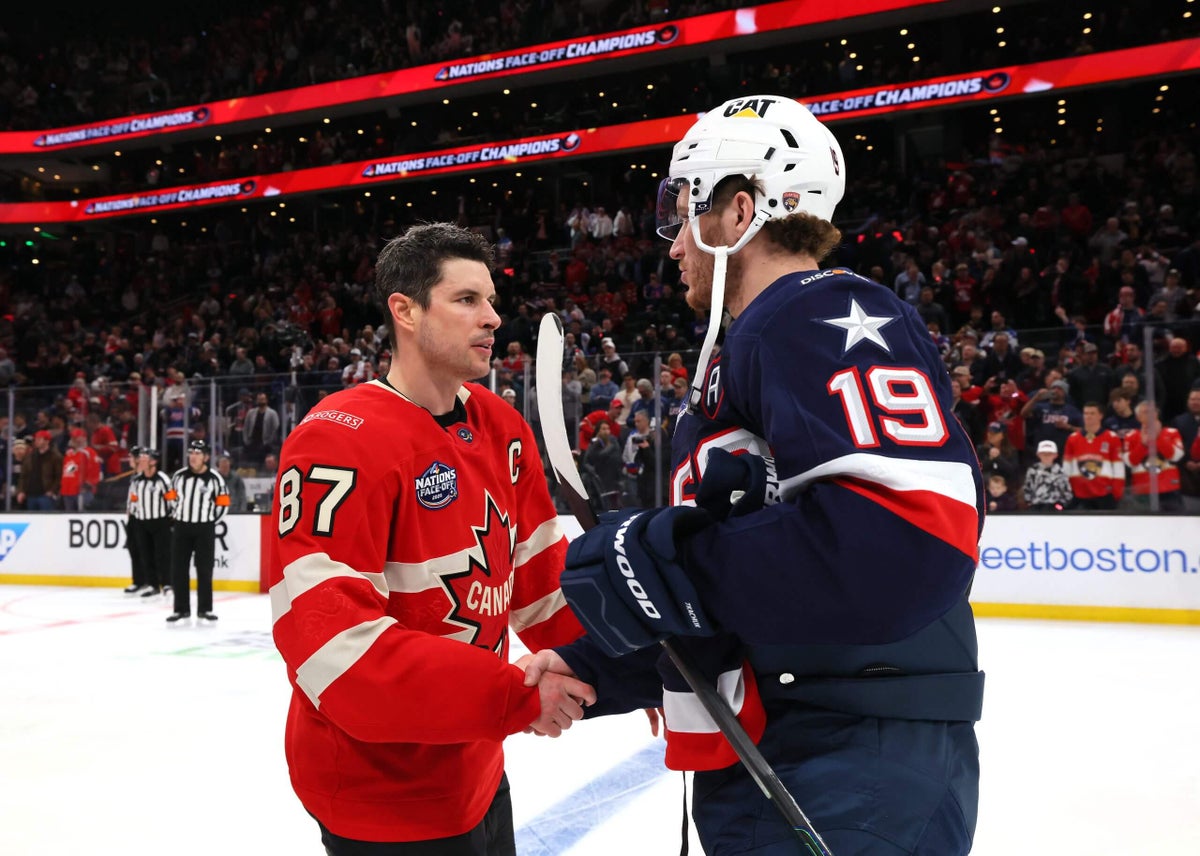
At long last, Olympic hockey featuring the NHL is back. Naturally, the first subject up for debate is who’s going to take home the gold.
In past tournaments, the favorite going in was always obvious: Canada. You could get cute with a contrarian pick, but it was Canada whose expectations were gold or bust with every other country vying to dethrone them.
Those are still Canada’s expectations, but the competition at the top has become more fierce this time around. Canada is no longer the de facto team to beat. The Canadians have company with the arrival of the United States’ strongest generation of talent coming together to make this tournament very interesting.
Our projections have been officially unveiled, with a page that will be updated after every game and within them, Canada and the USA start as co-favorites, with a slight lean towards Canada. Those projections are based on each player’s Net Rating relative to the role they’re expected to play at the tournament. For non-NHLers, we’re using win share equivalencies based on work by Cedric Ramqaj and Thibaud Chatel from NL Ice Data (who also provided the data to make that possible), translated into projected ratings.
Below, we outline exactly why Canada and the USA lead the pack and what to expect from the other 10 teams at the tournament, with roster projections for each nation and a non-NHL player to watch courtesy of Chatel.
May the best country win.
Gold-medal contendersCanada
Gold: 42%
Silver: 23%
Bronze: 17%
Whether or not Canada is the favorite in this tournament depends entirely on one high-leverage decision: who starts in goal when it matters.
There is no bigger gap in goalie options for any other team than the one Canada has between Logan Thompson and Jordan Binnington, given the wide chasm in how the two have performed over the last two years. Canada would be the favorite with Thompson as the unquestioned starter, but for now, we’re going with a slight lean toward Thompson which puts Canada only slightly ahead of USA for medal probability. Binnington being named the knockout game starter would shift things significantly in the United States’ favor.
It’s a testament to the strength of the rest of the roster that Canada would still have such a high chance to win gold, even with the statistically wrong decision between the pipes. That’s thanks to its immense offensive firepower and defensive prowess up front, combined with elite two-way ability on the back end. The Canadians have the highest Offensive Rating from any forward group and the highest Defensive Rating from any defense group.
On the offense side, Canada has a generational branch at the top that goes from Sidney Crosby to Connor McDavid to Macklin Celebrini, with Nathan MacKinnon sprinkled in between. That may be the strongest forward quartet we have ever seen at any Olympic event and may be enough on its own to power Canada to gold. The depth after featuring some of the absolute best two-way players in the game — Sam Reinhart, Mitch Marner, Brandon Hagel, Mark Stone, Nick Suzuki and even last-minute replacement Seth Jarvis — is ludicrous. A few of those guys would be top-three forwards elsewhere. Here, they’re the middle six.
On the defense side, the stopping power across the board is a huge plus. Every single defender can defend with the best of them, which should immensely limit chances before they even get to the net. There’s not one liability here. Having said that, a lot of the offense from the back end hinges on Cale Makar, which feels risky. It helps that it is Makar, the best in the world, but a secondary elite offensive threat might’ve helped.
While there are some choices to quibble with and one major decision in net that can change everything, this is still one of the best teams Canada has ever put together on paper. The only problem is that their North American rival can boast the same thing.
United States
Gold: 37%
Silver: 26%
Bronze: 18%
USA Hockey has come a long way in the past decade. The sheer depth at every position is astounding — enough for the team’s management group to make some downright puzzling choices. Not taking two of the country’s best goal-scorers and one of its best defensemen is the difference between Team USA being the co-favorite with Canada and the team to beat.
Still, just being co-favorite is a big step up from past tournaments, where it was usually obvious who the alpha dog was. This time around, the USA has closed the gap considerably with a roster that is the strongest it has ever brought to the tournament. The Americans have star power and depth at every position and are well-balanced on offense and defense. They’re poised to be a heavy threat to Canada’s reign of hockey supremacy.
That starts at the top with an incredibly strong group led by Auston Matthews, Jack Eichel, and Matthew Tkachuk up front, with Quinn Hughes and Zach Werenski on the back end. It’s the best fivesome the USA has ever had at its disposal and while it’s not quite at Canada’s level, it’s as close as ever. Where the USA really shines is with its depth. It is loaded on the wing, has some strong shutdown depth up front and looks well-situated for any role necessary on the back end. It’s a versatile group that may not have the firepower some hoped, but is still loaded from top to bottom.
The big X-factor for the USA is whether the country’s biggest strength will actually play out that way. Connor Hellebuyck is the reigning best goalie in the world and still projects as such, but he’s notoriously struggled in a playoff setting and hasn’t looked himself since coming back from injury. If he can be his usual unstoppable self, that could be the difference for the United States. If worst comes to worst, turning to Jake Oettinger or Jeremy Swayman is as great a backup plan as any country could ask for. It just wouldn’t be the same advantage as prime Hellebuyck.
Put it all together and the USA has an exceptionally strong team, one that could very well win its first gold since 1980. The only thing standing in America’s way is Canada looking just as good.
Medal threatsSweden
Gold: 11%
Silver: 20%
Bronze: 22%
Sweden has suffered some setbacks due to injury — Leo Carlsson, Jonas Brodin — but the country’s biggest issue would’ve been present regardless: a lack of high-end talent. Relatively speaking, of course. Lucas Raymond, William Nylander and Rasmus Dahlin are really good. But in terms of each country’s Big Three, that trio would probably rank fifth behind Canada, the USA, Finland and Germany. Being closer to the Czech Republic and Switzerland is not the best starting point.
Where Sweden makes up ground is its depth, especially with defensive stoppers throughout the lineup. What the Swedes lack in game-breaking skill, they make up for in shutdown ability up and down the roster. A center spine featuring Joel Eriksson Ek, Mika Zibanejad, Elias Pettersson and Alex Wennberg should be able to handle the best other countries throw at them. Ditto on defense with Dahlin, along with shutdown experts Gustav Forsling and the rising Philip Broberg.
Goaltending should be fine in the hands of Filip Gustavsson as the likely starter. He tends to perform strongly in Minnesota’s vaunted defensive system and Sweden should be able to create a similar support structure around him. He is closer to an average starter than a world-beater, but in this tournament, that may be enough. Depending on what Canada does in net, Sweden should have the third- or fourth-best goaltending at the tournament.
Sweden’s depth at every position makes it the biggest threat for bronze, but the lack of oomph could hold it back from a higher podium finish.
Finland
Gold: 7%
Silver: 15%
Bronze: 18%
It is a real shame that Aleksander Barkov, Finland’s best player, won’t be at this tournament. His presence would’ve pushed Finland’s medal chances from 40 percent to 44 percent. Even without him, this is still arguably the best Olympic roster Finland has ever had on paper, as the nation has seen a real rise in star talent.
Up front, Mikko Rantanen, Sebastian Aho and Roope Hintz are a feared trio that stacks up well to the best-of-the-best at the tournament. The continued emergence of Artturi Lehkonen and Anton Lundell adds some needed support behind them with a secondary layer Finland has often lacked. On the back end, stout defense will be at the forefront of Finland’s identity with Miro Heiskanen leading the way as one of the game’s very best. He’s aided by a trio of sturdy options — Esa Lindell, Niko Mikkola and Rasmus Ristolainen — that will make life very difficult for opposing teams. Finland’s plus-21.2 Defensive Rating from its defensemen trails only Canada at the tournament.
For Finland to win a medal over the three better teams, though, it will need a vintage all-world performance from Juuse Saros. At the top of his game, he can go head-to-head with anyone, but that’s hard to bet on when we haven’t seen it in a while. Some still revere Saros in that way, but he’s been outside the top 25 in GSAx in three straight seasons. During that stretch, he ranks 46th among goalies to play 50-plus games. Unless Saros steps up, goaltending could be Finland’s Achilles’ heel.
Dark horsesCzech Republic
Medal probability: 19%
The Czech Republic’s lack of NHL depth is concerning — especially now with Pavel Zacha out. It’s the main thing holding them back from the next tier with Sweden and Finland. It’s a major problem on the back end where they have two players who could no longer stick at the NHL level (Radim Simek and Jan Rutta) and another (David Spacek) who struggled in a two-game call-up this season. If the Czechs bow out early, that will likely be why. This group is not close to the golden generation that were a legitimate power from 1998 to 2006.
With that being said, the Czech Republic, also known as Czechia, is a nation on the rise and has the power to upset one of the Big Four with a return to its winning formula: offensive star power and elite goaltending.
With the way he’ll likely be used, David Pastrnak could be one of the most impactful players at the tournament and he’ll have his fair share of help with Tomas Hertl and Martin Necas. The rise of Necas in particular is a big deal for the Czechs. Combine that with a genuinely strong tandem of Lukas Dostal and Karel Vejmelka (or even Dan Vladar for that matter) that projects to be the second best at the tournament, and the Czech Republic suddenly looks a lot scarier than it would’ve in 2018 or 2022. The Czechs might be back.
Non-NHL player to watch: Matej Stransky
“Stransky is the leading scorer in the National League. The HC Davos captain is a massive, do-it-all power forward who uses his size and skills to either beat defenders off the rush or win pucks along the boards. Owning an NHL-level shot, he will fit nicely in the Czech bottom six and fill any role thrown at him.”
Switzerland
Medal probability: 13%
The Swiss have come a long way in men’s hockey and that’s thanks mostly to a trio of star forwards at the top of the lineup. Back in 2014, Switzerland had just two NHL forwards to play a meaningful amount of games, neither of which were impact players (though Nino Niederreiter eventually grew into one). This time around, the Swiss have an entire top six, headlined by a trio of star players expected to carry a lot of the load.
Nico Hischier is one of the main reasons to be optimistic about Switzerland’s chances as a do-it-all forward, and he’ll have some potent help next to him in Kevin Fiala and Timo Meier. The team’s biggest strength, though, might be a blue line with a strong defensive identity. Roman Josi can still bring the heat offensively while J.J. Moser’s breakout this season gives the Swiss another valuable option to eat minutes. With Jonas Siegenthaler and former Blue Jacket Dean Kukan, the Swiss have a strong collection of shutdown options at their disposal. That’s felt up front too, where only Canada, USA and Sweden have a stronger group of defensive forwards.
Switzerland’s main concern could be in net, where there’s some separation with Czechia, Switzerland’s chief Group A rival for the second seed. While the skaters are miles better than past iterations, the lack of an NHL-caliber starter such as Jonas Hiller or Martin Gerber to tie everything together is notable. Goalie Leonardo Genoni, who Chatel calls “the GOAT of Swiss hockey,” could be a real wild-card given how strong he is annually at the World Championships. He posted a .953 en route to winning silver last spring. Genoni has serious big-game pedigree with a .936 save percentage over 191 playoff games in the NL and is the best non-NHL goalie here; it’s just hard to be sure how strong he can be in an Olympic setting at 38 years old.
Non-NHL player to watch: Dean Kukan
“After six seasons with Columbus, Kukan chose to come home to play for his hometown Zurich Lions. Kukan secured two national titles and one Champions Hockey League title in recent years and is the best all-around defenseman in the National League. At 32, he can skate, move the puck, support the rush and will fit nicely alongside the three NHLers on the Swiss blue line.”
Germany
Medal probability: 8%
It’s hard not to be bullish on Germany with the way some of the country’s best players are playing. Leon Draisaitl was a Hart finalist last season and remains a top-five player in the world. Moritz Seider has seriously elevated his game this season and looks like a Norris threat as arguably the best two-way defenseman in the NHL. And Philipp Grubauer has had a dramatic comeback this season, where he ranks top 10 in GSAx. That’s an incredibly strong trio to lead each position, bolstered further by Tim Stützle scoring at an 88-point pace and JJ Peterka being a five-on-five beast.
Germany’s sudden collection of high-end talent gives it a real shot against any team and it has an advantageous path in Group B to make some noise. I expect Germany to lean heavily on its superstar quartet, which is one driver of higher-than-expected ratings for Draisaitl, Stützle, Peterka and Seider. But don’t overlook the country’s collection of non-NHL talent, where the German league has a strong defensive reputation. What the group lacks in offense it more than makes up for defensively.
The recipe for victory is there: tough defense, a goalie who can steal games again and some high-end offense at the top. Germany may be unlikely to win a medal, but the Germans are still going to be a really tough out along the way.
Non-NHL player to watch: Leon Gawanke
“Gawanke is one of those gifted European players — big, right-handed defenseman, skates well, drives offense — who, despite a few productive AHL seasons, didn’t make the NHL. He went back home in 2023-2024 and became one of the best defensemen in the DEL. Gawanke could see some decent depth action behind Seider, bringing some much-needed offensive help to potentially push Germany toward a historic upset.”
MinnowsDenmark
Medal probability: 3%
The good news for Denmark is Group B is fairly soft. The bad news is star goaltender Frederik Andersen has struggled this season.
Everything hinges on Andersen returning to form. He was top-10 in GSAx per game over the last three seasons, but ranks 49th out of 70 goalies (minimum 10 games) this season.
The Danes have some weapons up front in Nikolaj Ehlers and Oliver Bjorkstrand. But if Andersen can’t steal games, Denmark will likely have a short tournament. Even then, its medal chances are low.
Non-NHL player to watch: Mikkel Aagaard
“Aagaard is a late bloomer, having been through the ECHL, AHL, USports, and Swedish second level before finally reaching the SHL at 27. While he rarely drives his line, he’s good at everything. Aagaard is a master of finding open spots to be given the puck, making space for the others, being around the net and getting shots and chances.”
Slovakia
Medal probability: 2%
Slovakian hockey has seen a major fall from grace since finishing fourth in 2010. That team had 13 NHLers, led by some serious superstar talent in Marián Hossa, Marián Gáborík, Zdeno Chára, and Jaroslav Halák.
With Juraj Slafkovský as the only real needle-mover, the 2026 version isn’t close. For Slovakia to win games, it will need big performances from up-and-comers such as Pavol Regenda, Dalibor Dvorský and Simon Nemec. Regenda, with 1.37 goals per 60 and a strong five-on-five impact in the NHL, is the best bet for that if he can translate that play to a bigger role as the model suggests.
The non-NHL group performing well defensively is a necessity given Slovakia’s biggest issue in net. The lack of an NHL goalie is what separates it and the seven nations with realistic medal hopes.
Non-NHL player to watch: Martin Gernát
“Gernát should see plenty of ice time on the Slovakian blue line as one of the best defensemen in Europe. The 6-foot-4, 203-pound defender is an all-around asset, a decent skater and an offensive weapon who chose the KHL in recent years after a few seasons in Czechia and Switzerland.”
Latvia
Medal probability: 1%
How successful Latvia can be depends on how successfully its NHL depth players can handle other nations’ best and whether the goaltending duo of Elvis Merzlikins and Arturs Silovs can steal wins.
Latvia is set up well to defend and keep things tighter than expected, with Zemgus Girgensons being particularly strong in that regard this season. But scoring will be extremely difficult to come by if the country’s best weapons are Sandis Vilmanis and Teddy Blueger.
Non-NHL player to watch: Rudolfs Balcers
“Some NHL fans may remember Balcers for his five seasons spent between the big league and the AHL before he chose the comfort of Switzerland. As one of the best forwards on the Zurich Lions, the 2025 European champions, Balcers is a skilled winger with slick transition skills and is capable of generating chances in tight spaces. As a playmaker and shooter, Balcers is the perfect do-it-all complement that Latvia will desperately need to survive.”
France
Alex Texier will get a feature role for France that boosts his rating, but he would still be one of the least impactful ‘best’ players at the tournament. His presence alone isn’t enough to carry France to relevance, especially in a difficult Group A.
Non-NHL player to watch: Stephane Da Costa
“Da Costa has been nicknamed ‘The Magician’ by French fans, having been their best playmaker for over a decade, and scored some life-saving goals at World Championships. The former Senator, deemed too small for the NHL, has been one of the best players in the KHL ever since.”
Italy
With zero NHLers on the roster, Italy likely struggles all tournament as even its non-NHL skaters stack up poorly with those on other rosters. Of Italy’s 22 skaters, none rank in the top 40 and 18 rank in the bottom half of the non-NHL group.
Non-NHL player to watch: Damian Clara
“Clara will carry most of Italy’s hopes for a miracle, being a goaltender and the first Italian-born player drafted in the NHL (Anaheim, 2023). He trained in Austria as a teenager and has been a starter in the SHL for two seasons now despite his youth. This is a huge opportunity for him to shine against the best in the world.”