
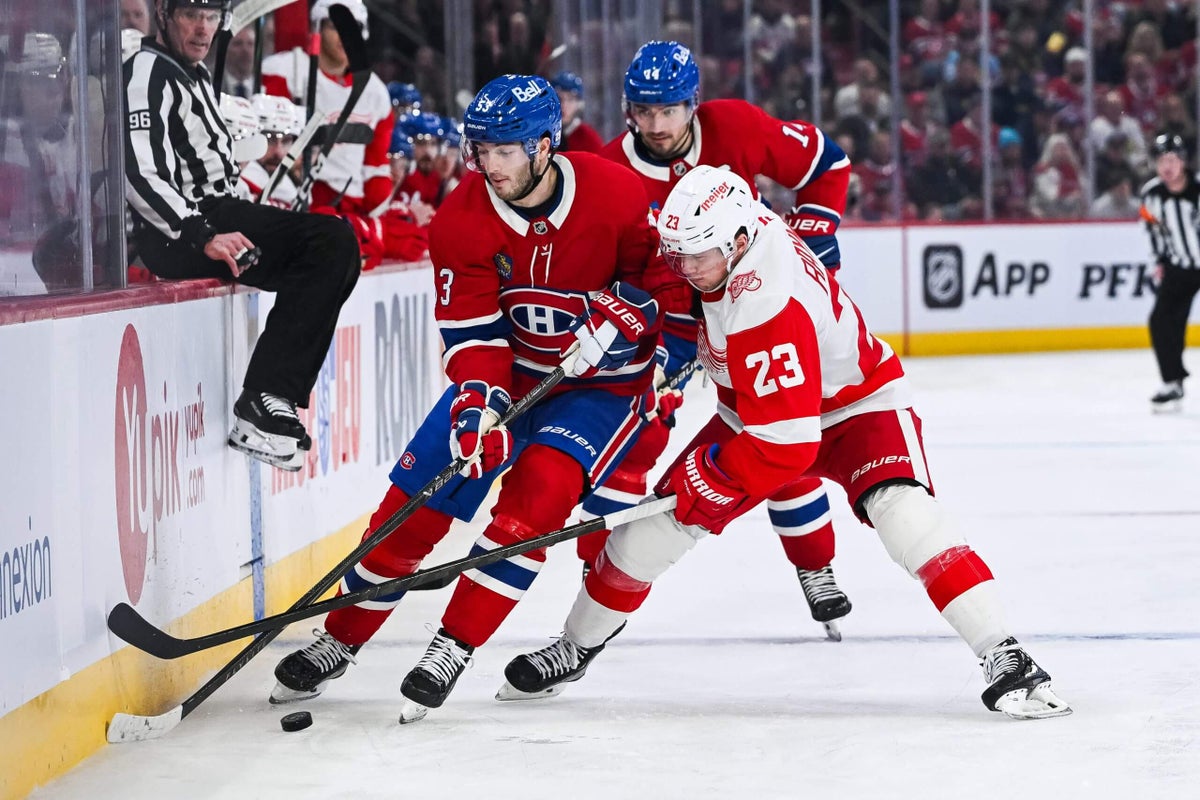
The NHL’s Olympic break came at a good time for the Detroit Red Wings, who limped into some much-needed rest.
Best-on-best international hockey will be a good way to pass the time for the next two weeks, but in the background, the stakes for the home stretch are in full view. The Red Wings have a real chance to snap a nine-year playoff drought. They just have to do what the last two years have proven easier said than done: hold onto a playoff spot for the season’s final six weeks.
Naturally, then, that’s where the intrigue starts for this edition of the mailbag.
Note: Questions have been lightly edited for clarity and length.
Does 24 points in the 24 remaining games after the break get Detroit into the playoffs? The playoff cut line this year seems like it will be higher than years prior, but is 96 points enough? — Noah C.
The line certainly seems like it’s going to be higher than each of the past two seasons, when the final Eastern Conference wild-card team had 91 points, or the year before that (2022-23) when the line was 92. Right now, the eighth-place Boston Bruins are on track for 99.
The Red Wings’ main job, though, is staying ahead of the team currently in ninth: the Columbus Blue Jackets, whose 65 points in 56 games puts them on track for 95 by season’s end. So 96 would be cutting it awfully close.
With 72 points through 58 games, the Red Wings are on pace to finish with 102 points, so ending up at 96 would require them to fall notably off the pace they’ve set through the first two-thirds of the season. In that sense, Detroit’s sights should really be set higher than the wild-card cut line, as the team currently sits as the No. 3 seed in the Atlantic.
But slumps in March have been a theme for this Red Wings core, and losing four of their last five into the break certainly didn’t inspire confidence. There will be a microscope on how the Red Wings fare coming out of the Olympic break — especially with Columbus having recently caught fire and winning seven straight.
Mathematically, though, Detroit is in a good position. And while a .500 finish would likely make things too close for comfort, it shouldn’t take much beyond that to get the job done.
Who do the Red Wings match up best against in a playoff series, and who would you not want to see in the first round? — Frank Y.
Given that the Red Wings aren’t likely to win the Atlantic (in which case they would face a wild-card opponent) the realistic pool of potential opponents is the Montreal Canadiens, Buffalo Sabres, Boston Bruins, Tampa Bay Lightning or Carolina Hurricanes — the first three if Detroit is a divisional two or three seed, the latter two if the Red Wings end up a wild-card.
The only team from that group Detroit hasn’t beaten at least once this season is Buffalo, and Tage Thompson has been a thorn in the Red Wings’ side for years, with 23 points in his last 15 games against Detroit. But the playoffs are a different animal, and I think the Sabres and Canadiens are probably the ideal matchups out of that group. Both are young teams who don’t play smothering defense and have less certainty in goal.
They’re also both fast, and exposed the Red Wings’ early-season game management issues in October. But a lot has changed for Detroit since then (both with goaltender John Gibson and the team defense in front of him), and for a Red Wings team that struggles to score at five-on-five, playing against less-seasoned rosters would help.
Tampa and Carolina would be the least desirable matchups because of their talent, playoff experience and style. The Hurricanes can be miserable to play against with a relentless, heavy forecheck. And while their blue line may not be quite as stifling as some past iterations, it still boasts plenty of big, mobile stoppers who can make life hard on opponents. Meanwhile, the Lightning are built around a core of highly dangerous forwards who have won multiple Stanley Cups, with one of the best goalies in the league behind them. They’re the Eastern Conference favorites.
Boston would be somewhere in the middle. The Bruins have a very strong goalie in Jeremy Swayman, a well-rounded blue line and plenty of physicality, but perhaps the least overall roster talent of the group. I’d put them closer to Buffalo and Montreal than to Carolina or Tampa.
Given the nosedive this team is in and the complete lack of 5v5 scoring, do you expect Steve Yzerman to deviate from the precedent he set last year, which was standing pat or making non consequential moves? — Chris M.
It wasn’t a pretty finish before the break, with the Red Wings losing four of their last five and five of their last seven.
And yes, the five-on-five scoring is a real issue: Detroit ranks 27th in the league with just 2.11 goals per 60 at five-on-five. The Seattle Kraken (26th) and New York Islanders (23rd) are the only other teams in the bottom 12 that are currently in playoff position. But to me, that speaks more to a need to be addressed than it does a reason not to add.
I do get the reference to last season: after 58 games, the 2024-25 Red Wings were in a wild-card spot with 66 points. But after a losing streak going into the March 7 trade deadline, Yzerman made only two small moves at the roster fringes, adding Craig Smith and Petr Mrázek.
The biggest difference from that campaign to this one, though, is that the Red Wings have been in it the whole way this year. Last year, their start was so bad they had to make a coaching change at Christmas. A hot run after bringing in Todd McLellan got them back into the mix, but the streakiness made them a much tougher team to fully trust.
This time around, the Red Wings have been much more consistent. Even with the recent skid, they haven’t gone consecutive games without a point since late November.
For that reason — and that there’s a real path to not just a wild-card but a divisional seed — I do expect Yzerman to take a different tack this time around and add either a second-pair RHD or a top-nine forward who can help alleviate their five-on-five scoring issues (or maybe both). This group has earned that.
What criteria makes a trade the right one right now for where the Wings are in their trajectory? — Paul S.
This topic could be a whole article. While I certainly think the Red Wings should add at this trade deadline, I don’t think they are established enough contenders to be trading premium assets (first-round picks and top prospects) for true rentals.
But if the player has some term, even if only an extra year or two, and projects to play in the top half of their lineup (think 20-plus minutes as a defenseman, or a top-six role up front), I do think the Red Wings could justify that kind of move. There’s a real chance their first pick in 2026 comes in the 20s, where the caliber of prospect tends to drop off, and the timeline for their arrival can lengthen. For a team that has real incentive to contend in the next four years, with Dylan Larkin entering his 30s, that matters.
Granted, that timeline is also why Detroit should be a little more cautious with its top prospects, who are already near-NHL ready — though they may have to listen on them, too, if they pursue a true impact player with longer-term control, such as the St. Louis’ Blues Robert Thomas.
The point is, it’s a fine needle to thread. The Red Wings could add rental depth if it’s cheaper, but players with some term should be the most attractive this early in a competitive window.
Is Trey Augustine not signing with Detroit a serious concern? It seems like he would clearly be the starter in Grand Rapids next season but have seen lots of chatter among fans saying that he won’t sign because of Sebastian Cossa. — Josh S.
I’ll put it like this: it’s hard for me to imagine 2025 first-round pick goaltender Joshua Ravensbergen recently committing to Michigan State if he thought Augustine would be be back in East Lansing. Cossa’s entry-level contract will be up after this season, and I fully expect him to be in Detroit next fall after playing more than 100 AHL games in Grand Rapids. That should create a clear path to a major role in the AHL for Augustine, assuming he signs.
There will always be that “assuming” caveat until the Red Wings have a signed contract in hand. The path to playing time is there, though, and Augustine is a local product. That all should work in Detroit’s favor. But we’ll have to see what Augustine decides at the end of his season.
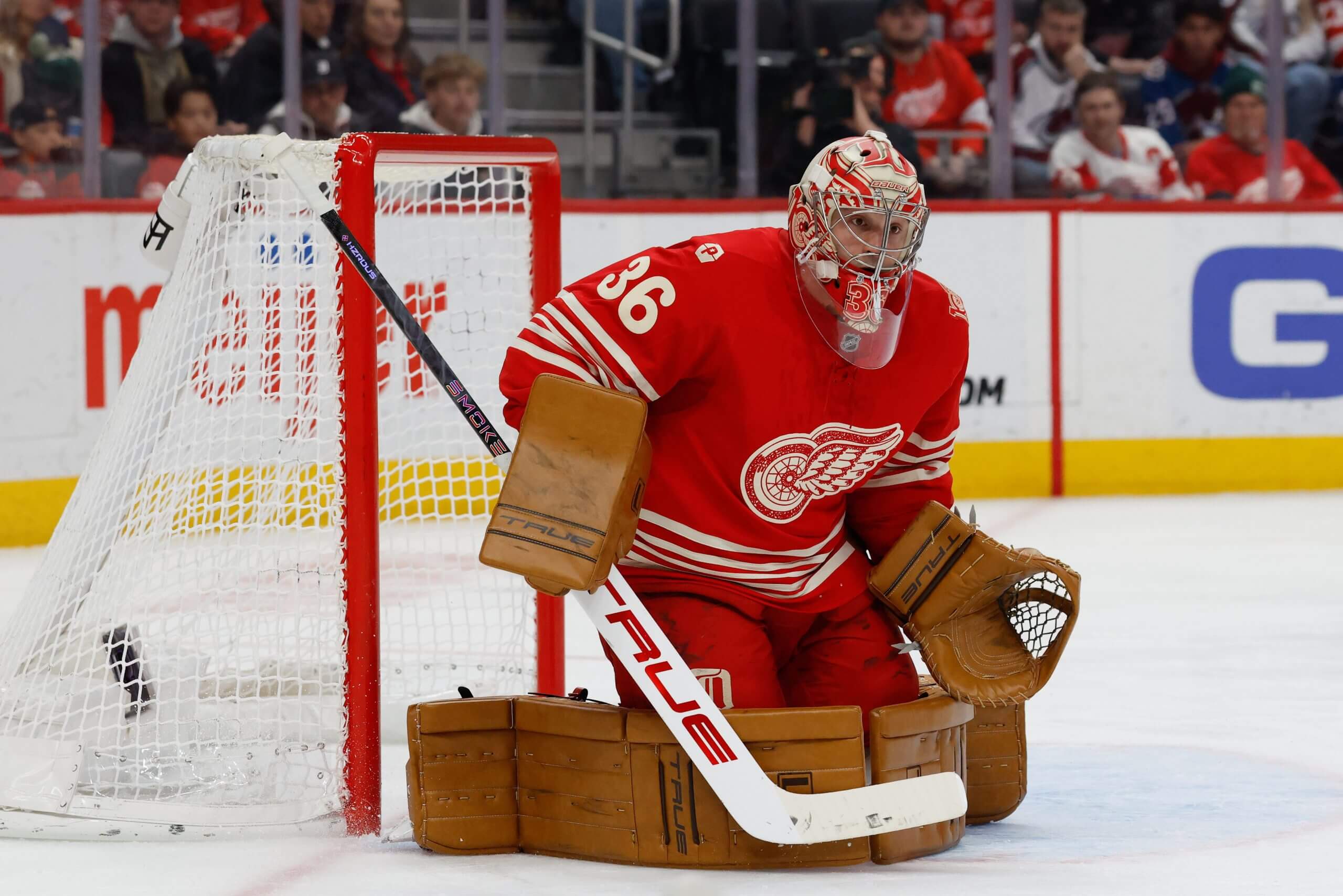
John Gibson has played phenomenally well after a rough start in Detroit. (Rick Osentoski / Imagn Images)
Do we extend John Gibson for two more years, when eligible? If so, what does his next contract look like? — Ramsen K.
To me, this is the goalie question that underpins the whole picture for the Red Wings.
Gibson has been a rock since the start of December, and while the intense workload seemed to catch up with him going into the break, he’ll get a full reset now before the home stretch. If he remains as good as he’s been, there’s definitely a case to be made to extend him when he becomes eligible July 1. He’s shown he has good hockey left in him, and while he certainly has logged a lot of miles at age 32, he isn’t too old by goalie standards. It’s worth exploring.
The flip side has to do with what the contract would look like. While a two-year extension would certainly be ideal for Detroit, I doubt Gibson would have to settle for just two years on the open market. Linus Ullmark got a four-year extension in Ottawa at age 31. He was coming off back-to-back top-six Vezina finishes, including winning the award in 2023, so I’m not saying Gibson will get the same average annual value as Ullmark’s $8.25 million. But the point is, proven goalies are generally still able to get real term into their 30s.
Partly for that reason, the best play might be get through the end of Gibson’s current contract before doing an extension. That would give the Red Wings as large a sample as possible before locking in longer-term, and more time to see how Cossa and Augustine continue to develop, too. If all three are performing well, that’s a good problem to have.
Why won’t the Red Wings bring up one of the three defensemen we have in Grand Rapids: Antti Tuomisto, Shai Buium or William Wallinder? I know one or two of these players will have to come up next year anyway because they will be out of time in Grand Rapids. So why not see what you have now? — James H.
I would have liked to have seen Wallinder called up when Edvinsson was out. It felt like a perfect window for the Red Wings to see how he looked in a small, defined sample.
But they didn’t, and probably for the same reason I wouldn’t expect them to after the break: they’re in a playoff race, and adding true rookies to the mix in your most important games of the year is risky.
When Edvinsson was out, I felt it was at least worthwhile to see if Wallinder’s skating could make a difference on the breakout. When you see how much Detroit is sheltering Axel Sandin-Pellikka right now, though, it’s clear they’re not making lineup decisions based on getting players experience for the future. That’s instructive when it comes to those defense prospects.