
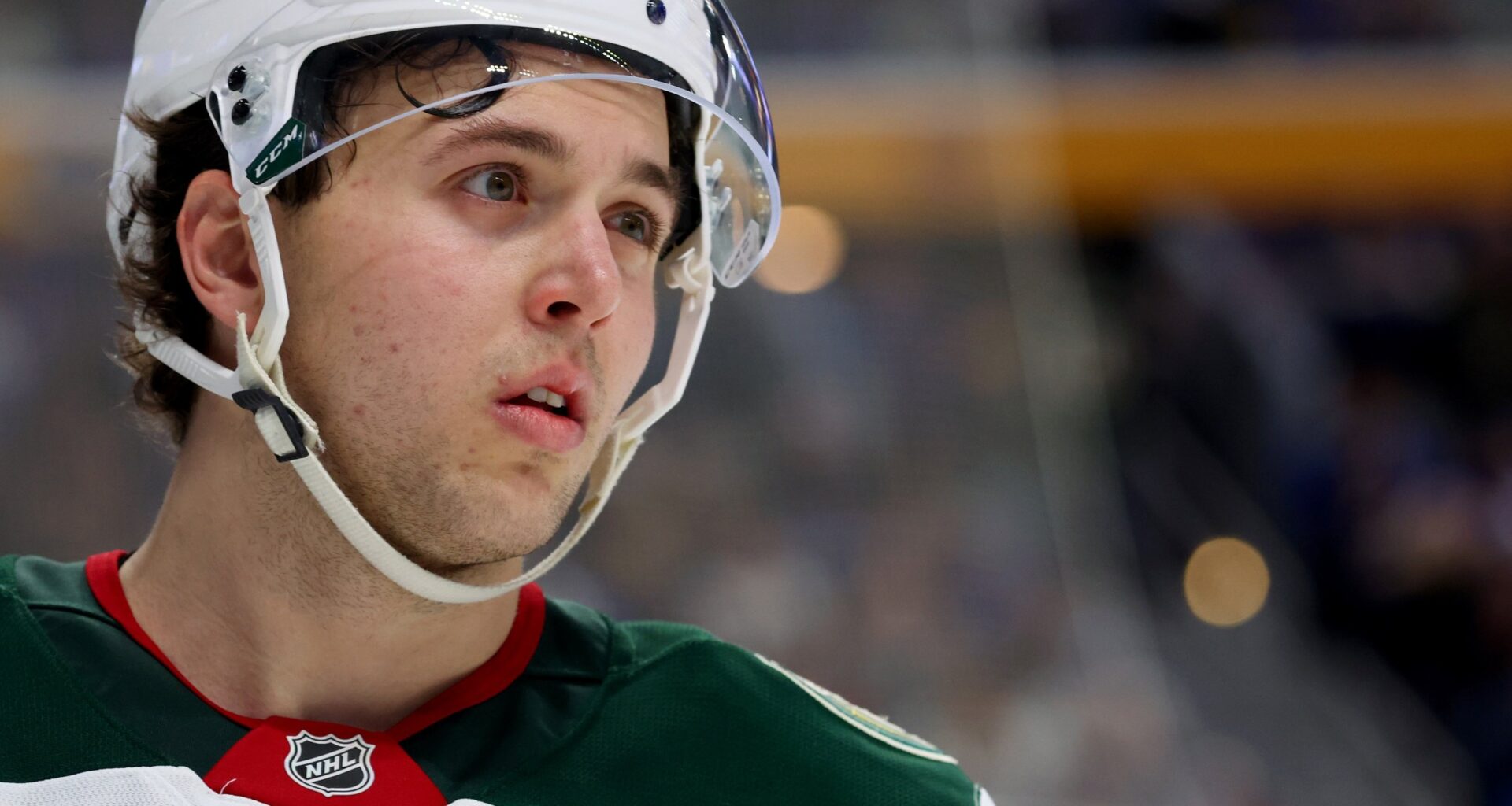
The Minnesota Wild are entering the Olympic break on a tear. They’ve won 5 straight games and are going 8-1-1 in their last ten. While it’s unfortunate the break is coming during Minnesota’s hot streak, the Wild faithful won’t have to wait the entire break to see their stars compete.
Minnesota’s best will have the chance to represent their country while competing for an Olympic gold medal, one of the most legacy-defining achievements for a hockey player.
The Wild have several representatives vying for their moment, with eight Wild players on Olympic rosters. Winning a gold medal would certainly be a huge achievement in any of their careers, but it comes at an especially critical moment for Brock Faber.
Faber has been a franchise cornerstone for the Wild since they acquired him as a prospect from the Los Angeles Kings. He had an excellent rookie season. The Wild immediately slotted him into the lineup as a minute-crunching defender who contributed on the offensive end, and he finished second in Calder Trophy voting.
The Wild rewarded that season with a blockbuster contract extension with hopes that he could raise his profile into the upper echelon of NHL blueliners, but that didn’t really come to fruition in his sophomore season. Faber’s scoring numbers worsened, as did key metrics like expected goals against/60 (2.27 in 2023-24 and 2.6 in 2024-25).
Faber was still one of the Wild’s top defenders. Still, it was natural to worry whether Faber’s season was an indication that he may have already hit his ceiling, or if it was just a hiccup in development. Concerns worsened when he had a slow start this year.
The worries about his 2025-26 performance are behind him because Faber has completely turned around his season. He’s already reached a career high in goals (13) and is on pace (.67) for the best points-per-game season in his career.
While Faber has been excellent recently, much of it is due to the Quinn Hughes trade. Hughes has played with Faber since arriving in Minnesota, and his debut directly coincided with Faber’s offensive turnaround.
Brock Faber’s development has taken a winding path, making the timing of these Olympic Games so important. The tournament offers the blueliner a chance to shape his narrative. Is he a very good NHL defender, and that’s the ceiling? Or is he a superstar?
Let’s take a look at how Faber can use a strong Olympic tournament performance as a launchpad into the league’s elite echelon.
One of Faber’s assets for these Olympics is that he has the chance to be a leader on the team. On a team filled with elite NHL All-Stars, it seems unlikely. Still, Faber is one of only two players with Olympic experience, the other being Jake Sanderson.
Faber represented the USA at the 2022 Beijing Olympics while he was at the University of Minnesota. This year’s Olympic Games will be different with NHL representation for the first time since 2014. The rink won’t even be the same size as in 2022.
Still, Faber has played in the format before. That’s more than you can say for most players in the tournament. He’ll know how to prepare, be ready for the experience, and lead the team because of it.
All of that is valuable, but it’s a bit abstract. What Faber accomplishes on the ice will be of much higher importance. One of Faber’s biggest assets to Team USA will be his versatility, because he’s an asset in both zones of the ice.
Brock Faber’s offense has significantly improved since the Wild have paired him with Quinn Hughes. Any defender around the league is likely to see some progress offensively with a player like Hughes, but it’s unfair not to give Faber any of the credit. To play with great players, you have to be able to keep up and match their greatness. That’s a test Faber has passed with aplomb.
To see Faber’s offensive impact, all you have to do is look at his last ten games.
In the Wild’s last ten matchups, Faber has produced three goals and six assists for nine points. Of his six assists, four of them are primary assists, meaning that of Faber’s nine points, seven of them came on plays where he either ended with a goal or made a pass directly leading to a goal. A player who is more of a “passenger” on offense can wrack up secondary assists, but Faber is helping drive the bus.
Much of Faber’s success has come from his offensive aggressiveness over his recent stretch of games. In that ten-game sample, Faber has registered 20 shots on goal and has shown a genuine willingness to lead the play at opportune times. That was on display during his recent goal against the Edmonton Oilers.
The most noticeable part of the play is Oilers defender Evan Bouchard‘s fairly miserable defensive effort. Still, it’s important to note that Faber took an opportunity he didn’t have to take. Both teams are changing lines, leaving Faber with a 1-on-1 with Bouchard. It would be easy to dump the puck in and get back.
Faber sees an opportunity worth pursuing, which results in a nice goal for him. He also showed his hockey IQ during his goal against the Montreal Canadiens.
Joining the play as a defender is always a risky proposition. If you don’t score, it could lead to a great chance at the other end. The best defensemen in the NHL know when the time is right to take that risk, and that’s matured in Faber’s game.
If he can bring his recent offensive firepower and distributing ability to the Olympics, it’ll be a huge asset to the Team USA lineup.
Of course, Faber is just as valuable to teams in his own zone. The USA could deploy him in a shutdown role, as they did during the Four Nations Faceoff. Faber’s pairing with Jaccob Slavin during the Four Nations tournament drew praise despite having the most difficult matchups in the tournament against opposing teams’ top lines.
The pair’s most impressive outing came in Team USA’s first game against Canada, a 3-1 victory. Slavin and Faber played by far the most in the game, logging 20:48 of 5-on-5 play, 10 minutes longer than any other pairing.
Team USA brass was so pleased with the Faber and Slavin pairing that they’ve reunited them at Olympic practice. If Faber can successfully shut down the other team’s top players, the United States will be difficult to beat.
That’s where Faber can offer the most value to Team USA. America has so many good players, but Faber has natural pairings with some of its top D-men. If the team is struggling to score, they can always reunite him with Hughes. If they need to shut down a game, he can play with Slavin.
Suppose Faber succeeds at the Olympics in myriad roles. That can dispel the narrative that he’s only turned things around since playing with Quinn Hughes. A performance in which Faber plays shutdown defense and contributes offensively will serve as a full coming-out party.
If Faber impacts games in every role the Olympics demand, it could cement his status as a genuine superstar.