
MILAN — Montreal Canadiens forward Juraj Slafkovský was walking through the bowels of Climate Pledge Arena in Seattle earlier this season wearing a T-shirt bearing a scene from the movie “Scarface,” which came out 21 years before he was born.
Complimented on the garment, Slafkovský smiled, pointed to his right cheek, and kept on walking.
That right cheek has a scar on it, the result of a near-disaster in the preseason when Philadelphia Flyers center and former Slafkovský teammate Christian Dvorak’s skate came up on a hit and sliced Slafkovský’s cheek.
Not long after that hit, Slafkovský tried wearing a neck guard at practice. It didn’t last long.
“I tried it once, and I was sweating too much,” he said back in October. “It was too thick.”
When reminded how close Dvorak’s skate came to slicing his neck — how, if it had hit maybe two or three inches lower, it could have been far worse than a scar — Slafkovský shrugged it off.
“Yeah,” he said, “but it’s on my face.”
Slafkovský’s cut was just a bit higher than the one Casey Fitzgerald, son of New Jersey Devils general manager Tom Fitzgerald, suffered while playing in the AHL in December 2024. That scare led Tom Fitzgerald to give a presentation at the NHL GMs’ meetings last March, imploring them to encourage their players to use cut-resistant equipment.

Juraj Slafkovský shortly after the preseason cut to his face — before it turned into a scar. (David Kirouac / Getty Images)
A new provision in the NHL and NHLPA’s new collective bargaining agreement will make cut-resistant neck protection mandatory for all players entering the league beginning next season, but — similar to the introduction of mandatory helmets in 1979 and visors in 2013 — existing players will have the option of continuing without neck protection if they so choose. Though the players’ union educates its members on the different options for cut-resistant equipment and encourages them to use it, the equipment will remain optional for all players who are already in the NHL.
Nearly 13 years after visors became mandatory for new NHL players, there are still four players — Jamie Benn of the Dallas Stars, Ryan O’Reilly of the Nashville Predators, Zach Bogosian of the Minnesota Wild and Ryan Reaves of the San Jose Sharks — who do not wear one today. If history follows, we’ll likely still see players without neck protection in the NHL for a long time.
Slafkovský, for his part, did not discount the possibility of wearing a neck guard in the future; he just needed an opportunity to get used to it.
“I don’t like switching things during the season,” he said. “Maybe try it in the offseason and everything will be fine.”
That was three months ago. Now, Slafkovský, 21, is preparing to represent Slovakia in the Olympics in Milan, where every player will be forced to wear neck protection.
That mandate could be seen as an annoyance by the game’s best players. Or, it could — and perhaps should — be seen as an opportunity.
Slafkovský’s Canadiens teammates Brendan Gallagher and Mike Matheson were staunchly against wearing neck protection. Like Slafkovský, they found it restricting, cumbersome and, most importantly, too hot and sweaty.
When American hockey player Adam Johnson was killed in an Elite Ice Hockey Game in England by a skate blade cut to his throat on Oct. 28, 2023, one of Gallagher’s closest childhood friends, Josh Nicholls, was playing for the Sheffield Steelers alongside teammate Matt Petgrave, the player whose skate cut Johnson.
The tragedy shook Nicholls, and not long afterwards, Gallagher practiced with a neck guard with the Canadiens, but he never tried it in a game, and quickly abandoned it at practice as well.
“For me, it was too tight,” Gallagher said. “It’s almost like a claustrophobia.”
He never tried it again until this past offseason, when a major life event changed Gallagher’s perspective.
“In the summer, I became a dad; there are just other things on your mind,” Gallagher said. “So, I just skated with it throughout the summer and got used to it. Now, it’s something that you don’t think about; it’s fine. But originally, it was different. It’s something you don’t want to be thinking about on the ice. It’s just something you want out of your mind.
“Now that I’m comfortable with it, I’m happy I made the switch.”
After spending the summer experimenting with different products, Gallagher has worn cut-resistant neck protection from the first day of training camp. He finally settled on the Aycane Blade Evo base layer long sleeve because it was the best combination of protection and comfort, and he estimates it took roughly a month’s worth of summer skates before the neck protection simply became a normal part of his equipment.
“At a certain point, it’s not something you think about,” Gallagher said. “It wasn’t too long.”
The most important part of getting used to the neck protection is will — a genuine desire to wear it instead of being forced. At least that was Gallagher’s experience: His wife and the mother of his newborn daughter was asking him to do it, as was his father, who trains elite hockey players outside Vancouver and had a near-tragic experience with one of his players recently.

Mike Matheson, right, who wears a neck guard, jokes around with Canadiens teammate Cole Caufield, who does not. (Steph Chambers / Getty Images)
The same is true of Matheson, who had resisted wearing neck protection his whole career because it made him too hot on the ice. But Matheson has a 4-year-old son who is obsessed with hockey, and he had reached an age where he was asking his dad some questions that were difficult for him to answer without looking like a bit of a hypocrite.
“I think just the simple fact my son’s getting older and playing, and at that age he has to wear one, but he’s already asked why certain guys don’t wear helmets in warmups and stuff like that,” Matheson explained. “So, he notices that stuff. And so I decided I should be wearing one, too.
“It wasn’t really an ‘I’ll see how it feels’ sort of thing. It was, ‘I’m wearing one now.’”
Matheson wears the same model of neck protection as Gallagher and benefited from his teammate’s trial-and-error process in the summer.
“It was the first one I tried,” Matheson said.
And though it took some getting used to, Matheson got there because he wanted to get used to it — needed to get used to it — because he had decided to wear one for reasons more important than preference.
“I think it’s just one of those things that’s a personal decision,” Matheson said. “I don’t know if it’s the sort of thing you can force on somebody; it’s really whether they want to or not. And they’ll, quite simply, live with the consequences if they make that decision or not.”
Gallagher’s next-door neighbor in the Canadiens’ locker room is captain Nick Suzuki, a member of Team Canada at the Olympics.
Will Suzuki consider keeping the neck protection after the Olympics? After playing the biggest games of his life with it?
“I don’t know. I’ll see if I play well,” Suzuki said. “It’s not really something I’ve thought about.”
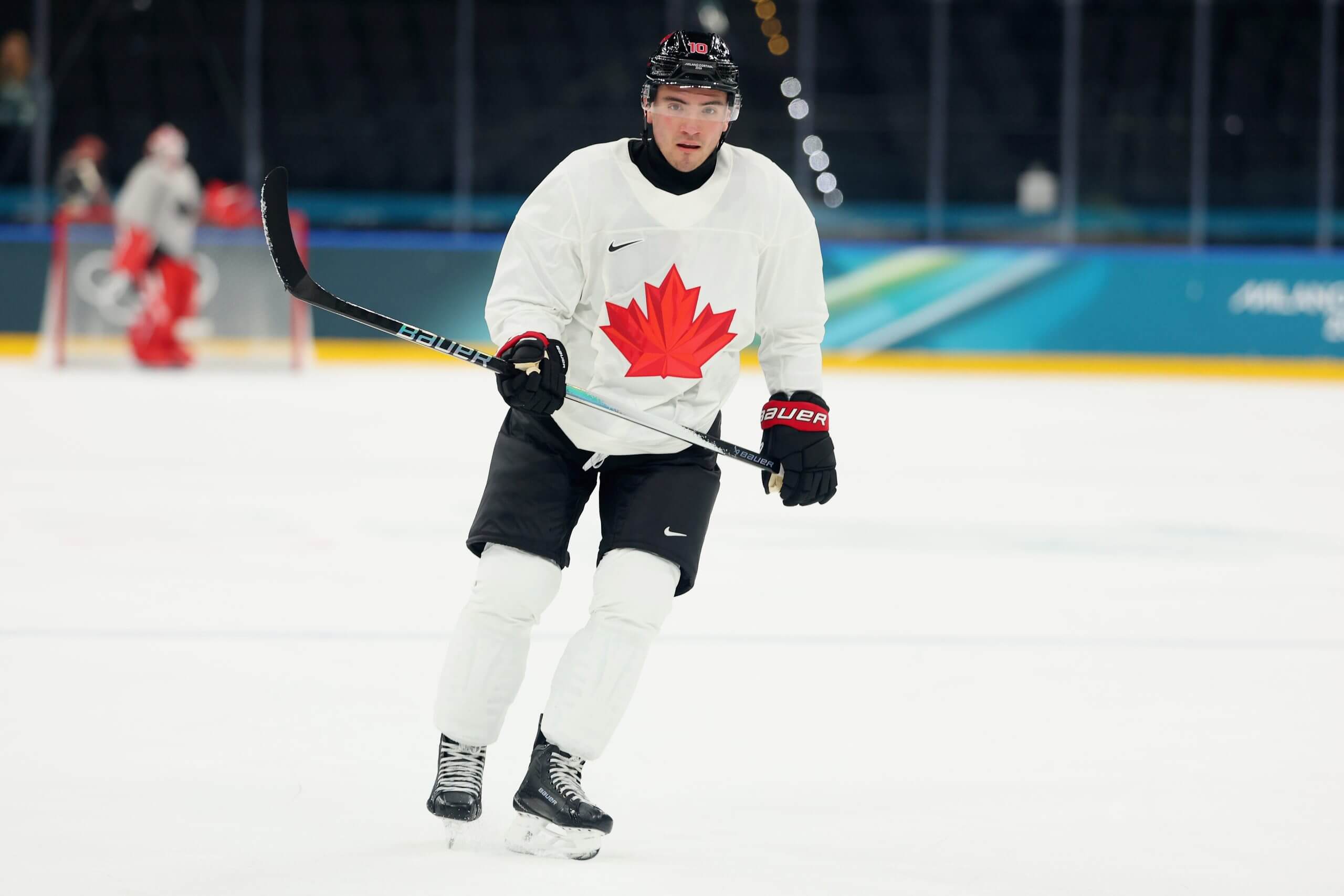
Nick Suzuki practices on Sunday in Milan while wearing a neck guard. (Gregory Shamus / Getty Images)
All of the NHL players who arrived in Italy for the Olympics on Sunday morning have had an opportunity to get on the ice. Most have practiced with a neck guard on to get used to it. Some are still waiting until they are absolutely forced.
And some, such as Team Canada veteran Brad Marchand, are wearing the least intrusive — and least protective — equipment they can find.
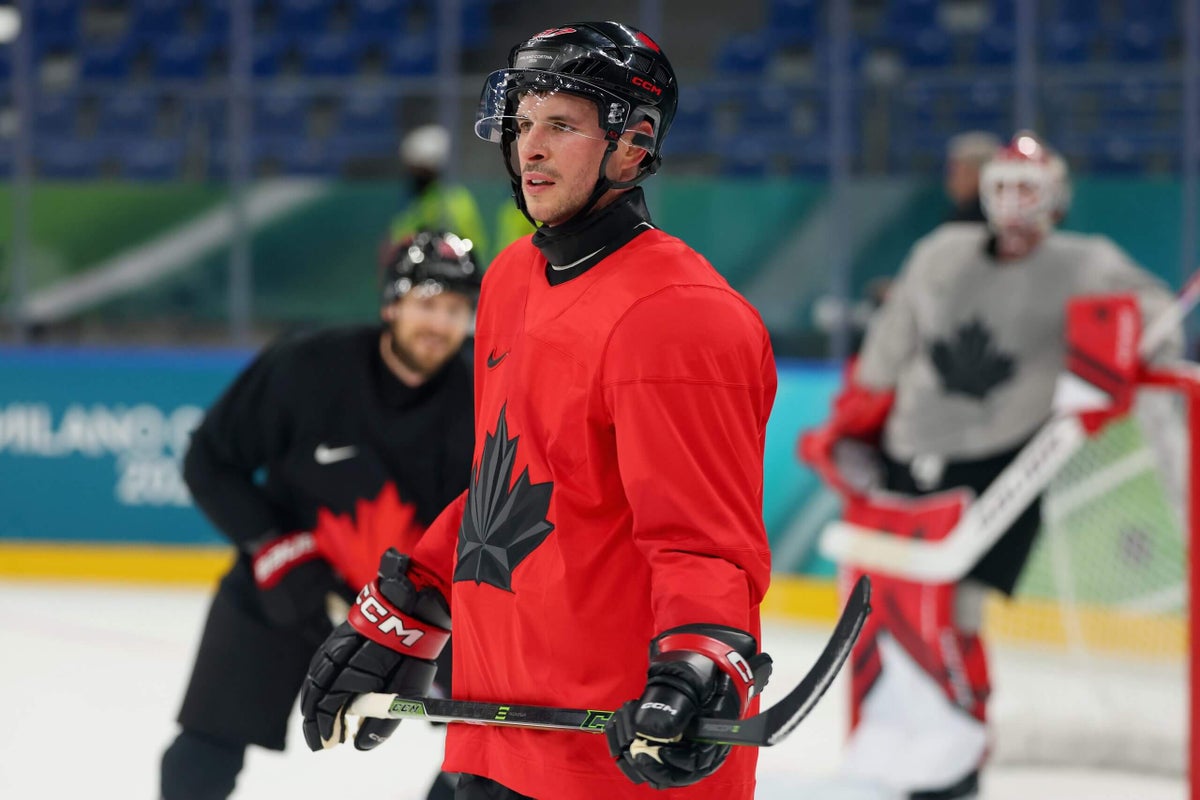
“Mine’s small, so I don’t notice it very much,” Marchand said after his first practice. “Some guys got the big ones out there — Sid (Crosby)’s got a whole goalie neck guard, it’s disgusting. Some guys have it with the shirt built in. It’s a bit different, but you forget about it pretty quick.”
Marchand, 37, has played in the NHL for more than 16 years. If he’s able to forget about it in about an hour on the ice, perhaps after two weeks of wearing one, he might consider wearing one permanently?
“No, absolutely not,” he said immediately. “But I forgot it was even on.”
Why not keep it then?
“It’s weird,” Marchand said, tugging at the tiny piece of equipment hanging very loosely around his neck. “Plus, it doesn’t protect anything. It’s just hanging there.”
But for New Jersey Devils captain Nico Hischier of Switzerland, it is something he considered before even arriving in Milan.
“I honestly was thinking a little bit about it, and it’s a very dangerous area up there,” he said. “You hear of these freak accidents and you never really want to be part of it, but you don’t want to think too much about it. I honestly wouldn’t mind either if, at some point, like they do overseas, they make it mandatory too, because in a lot of leagues it is already. But I don’t know. I haven’t thought about if I’m going to keep it or not.”
As for Slafkovský, Scarface himself, he had not given the neck guard a trial run before leaving for Milan. He last wore one in his draft year, playing in Liiga in Finland because he was under 18, and it was therefore mandatory, unlike junior hockey in Canada, where it is not. That was only four years ago.
At Monday’s practice in Milan, Slafkovský had a neck guard that went all the way up his neck, stopping maybe an inch or two shy of that scar on his cheek. Team Slovakia had a long, hard practice, and Slafkovský kept the neck protection on the whole time. But as soon as Slovakia broke away from the practice-ending huddle with the coach — as soon as he was allowed — Slafkovský undid the neck guard on the back and let it hang loose in the front as he continued taking shots and messing around on the ice after practice for another 15 or 20 minutes.
He was clearly uncomfortable.
“It’s not bad, I was just sweating a little more,” he said. “It’s good. I’m going to make some corrections so it fits even better.”
Perhaps, when Slafkovský and his fellow NHL Olympians have had the time they need to make the necessary adjustments and get mentally accustomed so it’s no longer a thought, the NHL’s players might realize that wearing neck protection is not a nuisance and that they can perform at the highest level while also protecting their throats from potentially lethal cuts.
And perhaps they will then also realize that if the world’s best hockey players can adapt to a new piece of equipment, the rest of the world’s players will be more likely to follow suit.