
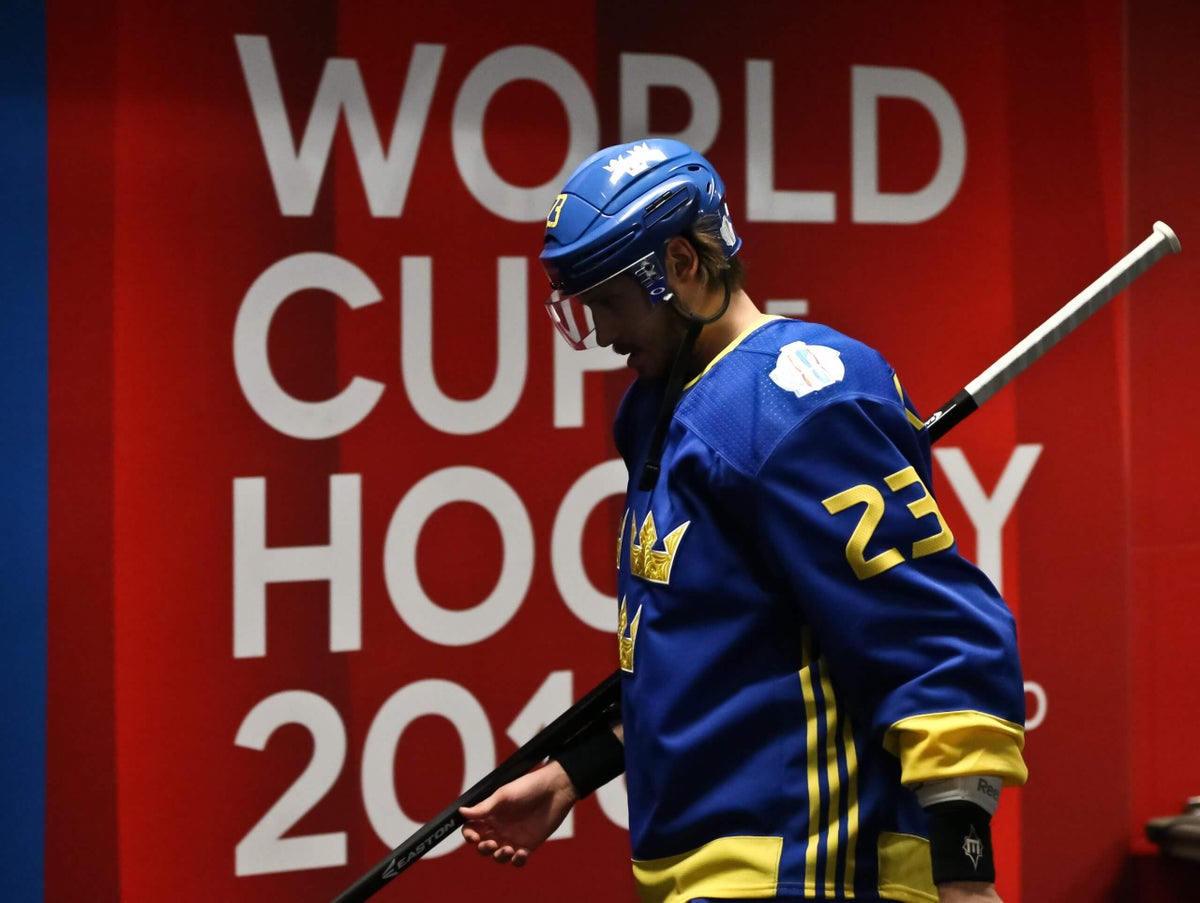
When Oliver Ekman-Larsson pulls his phone out of his locker after every game, he doesn’t need to thumb through his notifications to know what will be there.
Whether he won, lost, played well or poorly, there will be an encouraging text from a former member of Sweden’s Olympic hockey team: his grandfather, Kenneth Ekman.
“It’s special, sharing that with the people you love,” Ekman-Larsson said. “I’m so happy with the support I have around me. When you go through rough patches, that’s what I lean on.”
He leaned on his grandfather to help get him to Milan. Of all the players on the men’s Olympic hockey team rosters, Ekman-Larsson’s inclusion on Team Sweden is one of the most surprising choices.
At 34, Ekman-Larsson is one of Sweden’s oldest players and one of seven players not on the Sweden’s 4 Nations roster to make the Olympic team. His build is thinning after years of logging heavy NHL minutes at both ends of the ice. His beard is scragglier than ever.
“We like that he plays like a grumpy old man,” Sweden GM Josef Boumedienne said with a chuckle. “He’s always been a very loyal member of the national team.”
Of course, loyalty alone isn’t enough to earn a spot on one of the best Olympics rosters in the world.
Getting to Milan just three years after being bought out by the Vancouver Canucks reveals the extent of Ekman-Larsson’s late-career resurgence. Though there are many elite Swedish defenceman in the NHL, Ekman-Larsson is not always considered among them. This season, however, he’s been undeniably in that group. Ekman-Larsson is 12th in the NHL in five-on-five points among defenceman (25) and tied for first among Swedish blueliners. And he has mixed plenty of snarl and leadership into his game this season.
After years of service for Sweden, Ekman-Larsson has returned to the Olympics. And, in what could be his last international tournament, his surprise Olympic journey will be as much for the people close to him as it will be for himself.
Ekman-Larsson was just a boy in Karlskrona, sitting on the floor of his grandparents’ home, when Kenneth would lean back in his chair and regale him with stories of his Swedish team tying the mighty Soviet Union at the 1972 Winter Olympics.
Family members told Ekman-Larsson about his grandfather’s work ethic. About how he would wake up at 5 a.m., hit the ice, then go to work before returning to the ice to practice with his team. They’d also talk about him as an intelligent defender.
Ekman-Larsson knew as much. Kenneth, now 80, always had small pointers to offer after watching his grandson’s games.
“I wish I got to see him play,” Ekman-Larsson said.
If Ekman-Larsson asked his grandfather about his play specifically in 1972, the topic would change. Kenneth preferred to talk about teammates rather than what he could do on the ice.
“It goes by fast,” is what Ekman-Larsson remembers his grandfather saying.
As invites to Swedish youth national teams came at an early age, the stories from Kenneth waned. The two developed at the same club team, Tingsryds, but Ekman-Larsson became a regular for Swedish youth teams the way his grandfather never did. Ekman-Larsson was drafted sixth by the Phoenix Coyotes in 2009 and became their franchise defenceman.
But something changed when he slipped on the Tre Kronor jersey. In 2010, Ekman-Larsson played on both Sweden’s World Junior and World Championship teams. He became a natural leader in yellow and blue. Sure, Ekman-Larsson’s voice never commanded a room. But teammates gravitated to him.
“Low-key funny but not in a way that he needs to be heard in the locker room. A very calm soul,” said Carl Klingberg, who played on multiple Sweden national teams with Ekman-Larsson.
In Sweden’s camps, Ekman-Larsson became the first to check in on teammates. He would ask whether they needed anything to play better.
Ekman-Larsson was acting like his grandfather.
“What spoke to me was his kindness and generosity,” Klingberg said. “When I’ve been with him in Sweden teams, I’ve always wanted to hang out with him.”
When David Rundblad, another longtime Sweden teammate, was traded to Phoenix in 2011, his phone buzzed. Ekman-Larsson was offering him a pickup at the airport and a bed in his home while Rundblad found his footing. Rundblad believes he’ll bring the same attitude to the Swedish Olympic team in 2026.
“He likes to take care of people,” Rundblad said. “Now that he’s older, he probably feels a responsibility to be a good guy and show younger players the way.”
For so long, he did.
Between 2006-07 and 2018-19, Ekman-Larsson represented Sweden in all but three years. He won an Olympic silver medal in 2014 and two gold medals at the world championships in 2017 and 2018, among other medals. Those gold medals were Sweden’s last at a major senior men’s tournament. Only three players were on both teams. Ekman-Larsson was one of them.
“Winning that, you are forever in the history books in Sweden. People remember the players who have won,” Klingberg, a teammate on the 2017 gold medal-winning team, said. “When you grow up, all you’re talking about when you play street hockey is taking the final shot in the World Championships.”
And yet for all his games for Sweden, Ekman-Larsson was very rarely mentioned in the same breath as the best Swedish defenders of his era.
“(Ekman-Larsson) is a guy who isn’t talked about as much compared to, say, Erik Karlsson and Victor Hedman. He’s been a little undercover,” Rundblad said. “If you know about hockey, you know who he is.”
Perhaps Ekman-Larsson’s reserved personality kept him out of the spotlight. He never wanted to be in it, anyway.
The 2022 World Championships were Ekman-Larsson’s last tournament for Sweden. They lost in the quarterfinals.
“He wasn’t a guy who talked the most in the locker room,” said Carl Grundstrom, a teammate in 2022. “During that tournament, he let it show on the ice what it takes.”

Oliver Ekman-Larsson and William Nylander celebrate at the 2017 World Championships. (Ina Fassbender / AFP via Getty Images)
One year later, disaster. The lowest point in Ekman-Larsson’s career made a lengthy NHL future — never mind the Olympics — hard to fathom.
Just two years after the Canucks traded a high first-round pick among other assets for Ekman-Larsson, they bought him out. The Canucks wanted salary cap space. Once a cornerstone of the Coyotes franchise with an eight-year deal to prove it, Ekman-Larsson was without a team.
Ekman-Larsson was in Sweden, unsure of his next steps. The world of salary cap-influenced buyouts was foreign to Kenneth Ekman, but he still texted his grandson every day. Kenneth spent his entire 22-year professional career in Sweden, split just between three teams.
His grandson’s career spiral was irrelevant. When they spoke, he only reaffirmed to his grandson what a tremendous player he was.
“I don’t think I’ve played a bad game in his eyes,” Ekman-Larsson said.
Sometimes, Ekman-Larsson admits, he would get frustrated with his grandfather’s ceaseless positivity. Professional hockey is ruthless. Didn’t he remember that?
But his grandfather’s attitude proved vital. After being bought out, the Florida Panthers signed Ekman-Larsson to a one-year contract, albeit at about a quarter of the cap hit he had in Phoenix and Vancouver. Just over a year after being cast aside, Ekman-Larsson won something Phoenix and Vancouver had not: a Stanley Cup.
Ekman-Larsson’s five hits and 67 percent five-on-five Corsi for rate were both the highest among Panthers in a Game 7 Stanley Cup Finals win.
When he checked his phone after winning the Stanley Cup, thinking of so many people around him in Sweden who believed in him, even through his low points, there was a text from his grandfather, supportive as always.
“That’s how grandparents should be,” Ekman-Larsson said.
Ekman-Larsson was 33 when he signed with the Leafs after his Stanley Cup win. He had not played for Sweden for two years. The odds of a mid-30s defenceman, in a sea of talented blueliners, making Sweden’s Olympic team were low. But what most people did not see was what was driving Ekman-Larsson into this season. He wanted to prove his worth to the entire hockey world after being cut loose by a Canucks team that has since stumbled into the NHL’s basement.
“I knew I was still a good player,” Ekman-Larsson said.
And so Ekman-Larsson elevated his game and played some of the most physical and composed hockey of his career as the Leafs stumbled. He has been one of Toronto’s most valuable players. Just like his grandfather said he was.
Sweden saw it, too. They selected Ekman-Larsson because of his relentless competitive attitude.
“That’s something that you can never have enough of,” Boumedienne said. “What we like is his versatility. He plays both sides and he plays on both ends of the ice. And his leadership, certainly. He was a long-time captain, and he’s been a captain on the Swedish national teams for the world championships. And there’s not many holes in the game just for him.”
After Ekman-Larsson was announced as an Olympian, he beamed with pride. It was a rare look for the normally reserved veteran. And when his grandfather learned he would return to the Olympics, the positive texts came once more.
How monumental are the Olympics in Sweden? Ekman-Larsson was 14 when Sweden won their last Olympic gold medal in the men’s tournament in 2006.
“I remember laying on the floor, being so happy I cried,” he said. “What that team and those players meant for hockey in Sweden was special. It’s something I always reflect on.”
For years, many people did not appreciate Ekman-Larsson the way those in Sweden did. Kenneth Ekman gave his grandson some simple advice about what will likely be his last Olympics: “You never know when you’ll get this chance again. Be there, be present.”
For Ekman-Larsson, that means being there for his country, his teammates and the people who send him the texts he never forgets.
“As a player you represent your family and everyone that helps you,” Ekman-Larsson said. “That’s something I carry every single day.”