
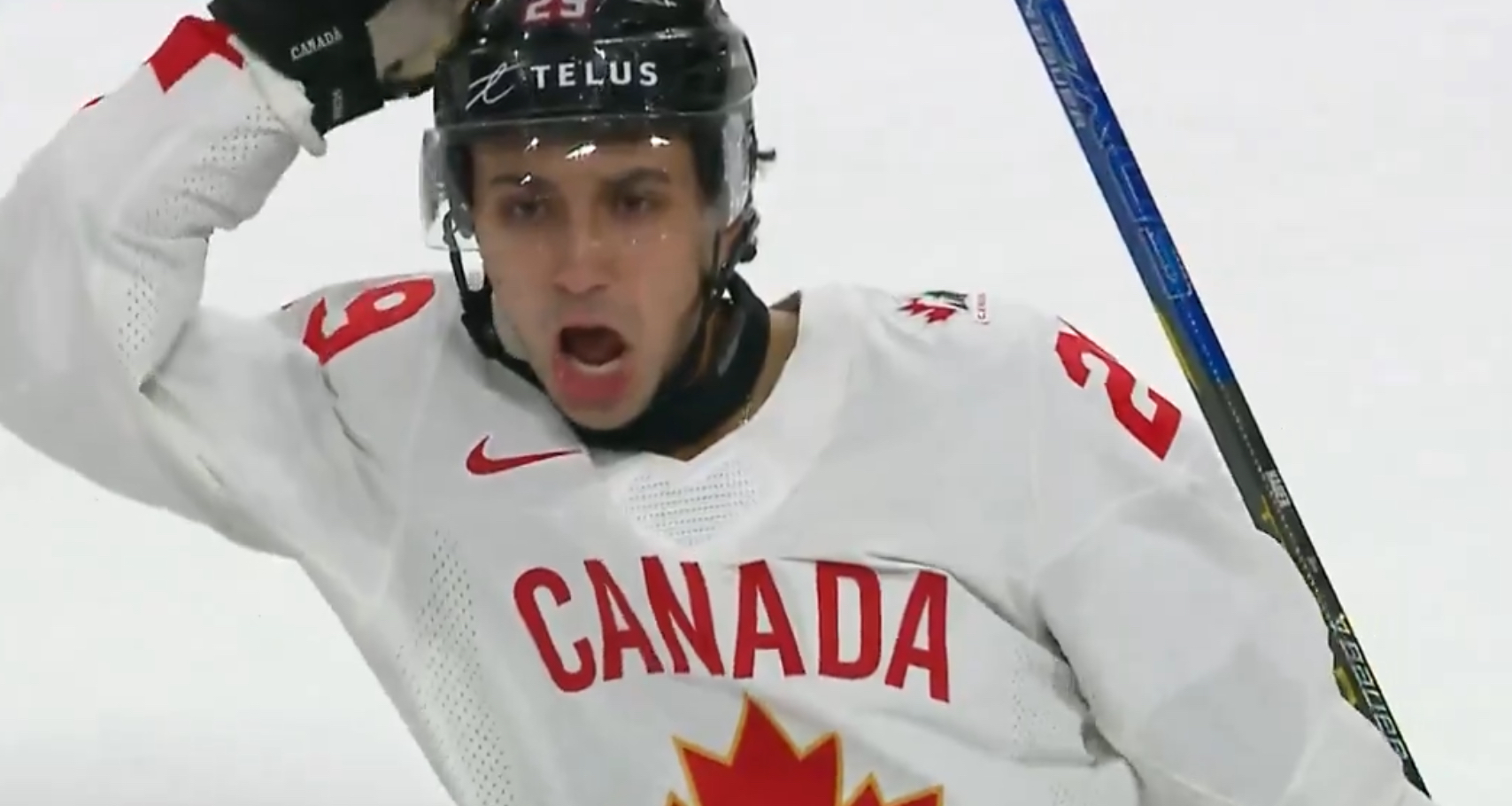
This week, in Lapointe’s Echos, we turn our attention to the top 10 prospects of the Montreal Canadiens. There are some intriguing debates surrounding the future of the Habs at the top of their prospect pool, including David Reinbacher and Adam Engstrom, Alexander Zharovsky and Michael Hage.
The Prospect Pool Is Thinning Before Our Eyes
That’s a very good thing. Each year, Canadiens prospects climb the ladder toward the NHL and establish themselves there. That will be the case again next season, and the one after that as well. With draft picks having been used to acquire Alex Newhook, Kirby Dach, and Noah Dobson, it’s only natural to notice that the pipeline is much less deep than it was two years ago. The current headliners are Jacob Fowler, Michael Hage, Alexander Zharovsky, David Reinbacher, and Adam Engstrom.
That’s entirely acceptable when you consider the young core of this team, which aims to improve in the standings every season. As early as training camp in 2026–2027, we could see Michael Hage, Jacob Fowler, and Adam Engstrom removed from this list. It would hurt the prospect pool, but that’s an easy price to pay to add talent to the pro lineup.
David Reinbacher and Adam Engstrom
Last week, Mat and I shared our top 10 Canadiens prospects based on our observations and evaluations. We did so during an episode of the TSLH Podcast, which you can listen to here. One of the discussions that interested me the most during the recording was the ranking of David Reinbacher and Adam Engstrom. We both reached the same conclusion: Adam Engstrom sits one spot behind David Reinbacher… for now. This ranking is not necessarily a criticism of either player. It’s more about projection and their respective progression, shaped by injuries in the Austrian’s case and a lack of data. For now, we’re waiting before placing the left-shot defenseman ahead of his counterpart despite everything we’ve observed since his selection.
One must handle a ton of pressure due to expectations tied to his draft position, while the other, a later pick, continues to surprise season after season. David Reinbacher has experienced ups and downs since the start of the season, but the progression is clearly there. Of course, we’d like to see him in the NHL honoring his draft status, but that’s not his burden to carry. He needs to block out the noise and focus on his game. He’s a defenseman projected as a dominant presence in his own zone while also possessing clear puck-moving ability with a touch of physicality. The AHL is the appropriate place to refine those aspects in an optimal development environment.
Personally, I just want to see him finish the season healthy. After that, we’ll see whether the Canadiens give him a shot at the next camp or whether he becomes trade currency. We must never forget that every asset within an organization has a price. If a prospect is the missing piece to complete a deal involving a top-six center or a significant winger, I’m certain Kent Hughes won’t hesitate. The same applies to Adam Engstrom. I absolutely see him in Montreal as early as next year, potentially taking the spot of Jayden Struble or Arber Xhekaj. However, if the price to acquire an impact player is the Swedish defenseman, it shouldn’t require much hesitation.
I don’t dislike having both players in the Canadiens’ depth chart. I think they coexist well. Adam Engstrom is a highly versatile player who can be competent on both sides of the puck. His progression in his own zone and in the speed of his execution are what stood out most during his two seasons with the Rocket. If it weren’t for the logjam on Montreal’s blue line, the lefty would already be there. As for David Reinbacher, the pressure on him continues to decrease as the pro lineup fills out. He could indeed become surplus, but if he remains with the organization, he could quickly log meaningful minutes on the third pairing next season (if he stays healthy).
Michael Hage and Alexander Zharovsky
Alexander Zharovsky has drawn attention since the beginning of the season. No matter which podcast you listen to, the prospect receives heavy praise due to his performances in the KHL. Whether it’s Simon Boisvert placing him in his top 25 under-23 players drafted by NHL teams, or Marco D’Amico mentioning that scouts have whispered to him that the Russian would be in their top 10 of the 2025 NHL Draft if they could redo it, the positive comments are coming from everywhere. Mat and I aren’t necessarily skeptical about him. In our eyes, he remains the Canadiens’ third-best prospect behind Michael Hage and Jacob Fowler, two very high-level prospects.
However, we do have some doubts, mainly—like most observers—about his skating, physical strength, and defensive play. The good news is that these are areas that can be improved during a prospect’s development. What Alexander Zharovsky does with the puck, on the other hand, cannot be taught. The fakes, the no-look passes tape-to-tape, the anticipation—you either have it or you don’t. His offensive production hasn’t slowed down, and consistency from a primarily offensive player is a crucial element in professional hockey. That’s one of the main indicators to consider when projecting him toward the NHL.
Fans are right to be excited, but we shouldn’t get carried away by all the praise. The transition to North American hockey won’t be easy for him due to the flaws in his game. No matter what some may try to suggest elsewhere, he is not Ivan Demidov. Could he surprise people and adapt quickly to the NHL within the next two seasons (he still has one year left on his contract in Russia)? Yes. But I preach patience in his case. There’s no rush. The Canadiens will be able to insert him gradually into a low-pressure role once veterans like Josh Anderson and Brendan Gallagher move on (summer 2027).
It once again appears to be an excellent selection by management. Since development has become a strength of the organization, I believe the odds are in his favor to progress properly, even if the team aims for the Cup starting in 2027 (in my opinion). The same assessment applies to Michael Hage. However, the young Canadian is closer to the NHL than his Russian counterpart. The forward is faster, more responsible, and generally more engaged on the ice with or without the puck. On top of that, he plays center (regardless of whether he ultimately remains at center in the pros, the versatility is there).
His evaluation and short-term projection to the NHL are somewhat easier because of that—and because his context is less exceptional than Zharovsky’s, who plays top-six minutes in the KHL. That’s why Michael Hage ranks ahead of Alexander Zharovsky in our respective lists. Both young players are high-end pieces within the Canadiens’ organizational depth chart, and we should expect them to reach the NHL. We just need to remember that getting swept away by social media one-liners—whether positive or negative—serves no purpose.
Top 125 Under-23 Players – Podcast La Relève
To wrap things up, I invite you to watch the Podcast La Relève video ranking the top 125 players under the age of 23 belonging to an NHL organization. Building such a ranking is a risky exercise. In my opinion, it definitely deserves a click! Martin Therriault delivers his analysis as he always does, and even if certain rankings may seem questionable (depending on your preferences), he’s never afraid to answer questions.