
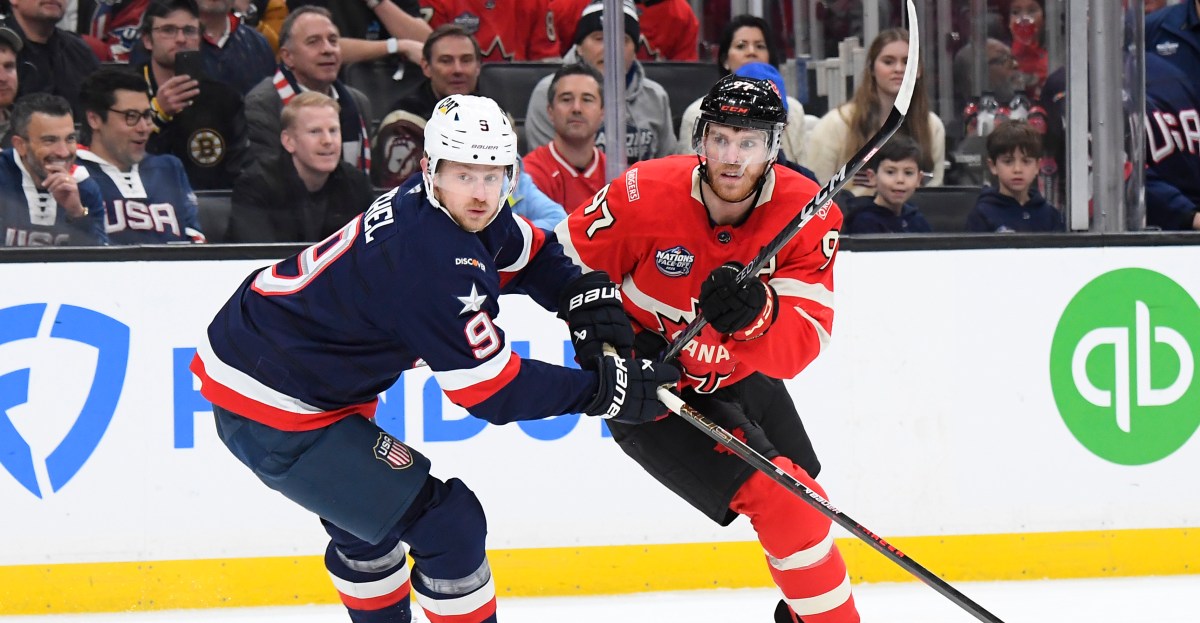
Welcome to Olympic hockey! While our focus at All About the Jersey remains largely on the Devils, some of us will be tuned into the international affairs in these two weeks. Before we do that, though, we need to look at each of the teams and what they bring to the table.
The toughest group of the Men’s tournament in these Olympics, this group features the powerhouse Team Canada, the ever-competing Team Czechia, the new threat of Team Switzerland, and the respectable outsider Team France. Let’s start with Team Canada.
After winning the Four Nations Face-Off last season, Team Canada looks for Gold on a larger scale in the Olympics. However, they will have two opponents in the Czechs and Swiss who were on the outside of Four Nations and will be looking to bring it to this year’s event. Captained by Sidney Crosby with assistants in Connor McDavid and Cale Makar, Team Canada’s strength lies most in their far superior forward group, especially at center. This is how Team Canada should be lined up:
Macklin Celebrini — Connor McDavid — Tom Wilson
Mitch Marner — Sidney Crosby — Mark Stone
Brad Marchand — Nathan MacKinnon — Nick Suzuki
Brandon Hagel — Bo Horvat — Sam Reinhart
Extras: Sam Bennett and Seth Jarvis
Devon Toews — Cale Makar
Josh Morrissey — Colton Parayko
Travis Sanheim — Shea Theodore
Extra: Drew Doughty
Darcy Kuemper
Logan Thompson
Jordan Binnington
As long as this team gets decent goaltending, they are by far the favorite for Gold. Could they have made better choices on the blueline? Yes. Could they have pulled one of Colorado’s goaltenders to replace Binnington? Yes. Even so, it will be very, very difficult to topple a team that features McDavid, Crosby, and MacKinnon on separate lines.
Team Czechia was dealt a brutal blow when they learned that former Devil Pavel Zacha will be unable to play in the tournament due to injury. Still, the Czechs have some very, very good forwards and a respectable defense, so they should be in a good position to push on to the playoffs. They are captained by one-time NHLer and longtime Czech Captain Roman Cervenka, with assistants in David Pastrnak and Radko Gudas. Here is how they are lined up:
Martin Necas — Tomas Hertl — David Pastrnak
Ondrej Palat — David Kampf — Ondrej Kase
Roman Cervenka — Lukas Sedlak — David Tomasek
Matej Stransky — Radek Faksa — Dominik Kubalik
Extras: Filip Chlapik, Jakub Flek
Radim Simek — Filip Hronek
Michal Kempny — Radko Gudas
Jan Rutta — David Spacek
Extras: Jiri Tichacek, Tomas Kundratek
Lukas Dostal
Karel Vejmelka
Dan Vladar
The loss of Zacha really stings the Czechs down the middle, but they still have the advantage of mostly carrying players who have played or are currently playing in the NHL. Former NHLers include Sedlak, Tomasek, Kempny, Rutta, Simek, and Kundratek. Jiri Tichacek is an undrafted defenseman in the Finnish Liiga, while Matej Strasnky was drafted in 2011 but never played in the NHL. They will have to wear opposing teams down to open up ice for that top line to score.
Finally, we are getting to our New Jersey Devils at the Olympics. Team Switzerland features three New Jersey Devils, who should all be getting top minutes in this tournament. I look at Switzerland as a bit of a dark horse in this tournament, featuring some really high-end players and a national program that really wants to prove their worth. They are captained by the Swiss legend Roman Josi, and his assistants will be rotated between Kevin Fiala, Nico Hischier, Nino Niederreiter, and Andrea Glauser. Here’s how Team Switzerland is lining up.
Kevin Fiala — Nico Hischier — Timo Meier
Nino Niederreiter — Pius Suter — Philipp Kurashev
Sven Andrighetto — Denis Malgin — Christoph Bertschy
Simon Knak — Calvin Thurkauf — Damien Riat
Extras: Ken Jager, Sandro Schmid
Jonas Siegenthaler — Roman Josi
JJ Moser — Tim Berni
Dean Kukan — Michael Fora
Extras: Andrea Glauser, Chirstian Marti
Akira Schmid
Reto Berra
Leonardo Genoni
Unlike the Czechs, the depth of the Swiss team is made up entirely of European professionals, with no NHLers or former NHLers beyond their third line or second pairing. It will be interesting to see how much of an impact coaching and team leadership can make here. For Devils fans, however, all eyes will be on Hischier alongside Timo Meier and Jonas Siegenthaler. Nico is feeling it going into the Olympics, despite his recent illness, while Jonas Siegenthaler and Timo Meier have had very difficult seasons. If they play well here, how might they carry that into the rest of the NHL season?
Captained by former NHLer Pierre-Edouard Bellemare, the French team is not expected to advance past the group stage. In addition to the awesome defensive center Bellemare, the French defense is led by 35-year old former New Jersey Devil Yohann Auvitu. Up front, the French have current Montreal Canadien Alexandre Texier on the wing and former NHLer Stephane Da Costa at center behind Bellemare. Their hopes will largely hinge on keeping games low-scoring, though I do not expect them to pull off any wins against the other Group A teams.
A bit of a weaker group than A, Group B’s most talented roster comes from Team Sweden. They are joined by a regional national rival in Team Finland, who has a lot of NHL talent but really wins these kinds of tournaments through discipline, cooperation, and grit. Eyes should also be on Team Slovakia, who medaled for the first time ever in 2022 with the help of some youngsters who now find themselves rising in the NHL. The hosting Team Italy rounds out the group. Let’s start with the Swedes.
The Swedes are captained by Gabriel Landeskog, joined by veteran defensemen Victor Hedman and Erik Karlsson. Two Devils, Jesper Bratt and Jacob Markstrom, are on the team. However, it is unclear how much of a role either will take, as it seems that their national team has noticed their struggles this season. Bratt interchanged rushes in practice with Filip Forsberg, so we’ll see how the actual lineup shakes out.
Adrian Kempe — Joel Eriksson Ek — William Nylander
Jesper Bratt / Filip Forsberg — Elias Lindholm — Lucas Raymond
Elias Pettersson — Mika Zibanejad — Rickard Rakell
Gabriel Landeskog — Pontus Holmberg — Alexander Wennberg / Marcus Johansson
Gustav Forsling — Rasmus Dahlin
Victor Hedman — Rasmus Andersson
Phillip Broberg — Erik Karlsson
Extras: Oliver Ekman-Larsson, Hampus Lindholm
Filip Gustavsson
Jesper Wallstedt
Jacob Markstrom
Team Sweden is the first team here that I take real issue with in terms of lines. Namely, is Pontus Holmberg really holding down a lineup spot here? Alex Wennberg can easily play center, and I even wonder whether Zibanejad should be centering a line over Elias Pettersson for the third line. Still, these lines can shift around depending on whether Jesper Bratt ends up dressing, as he would presumably shift some players down the lineup. If Bratt was not playing his personal worst hockey in five seasons, he’d be an easy lock for the top line over Adrian Kempe.
Captained by Mikael Granlund, the Finns have one of the most well-rounded, two-way teams in the tournament, though they lack some of the high-end scorers (aside from Mikko Rantanen) that other nations bring. This team does not feature any Devils, though it does have a recent one in Erik Haula. Let’s look at their lines:
Mikael Granlund — Roope Hintz — Mikko Rantanen
Artturi Lehkonen — Sebastian Aho — Teuvo Teravainen
Eetu Luostarinen — Anton Lundell — Kaapo Kakko
Joel Armia — Erik Haula — Eeli Tolvanen
Joel Kiviranta, Kasperi Kapanen
Essa Lindell — Miro Heiskanen
Olli Maattaa — Henri Jokiharju
Niko Mikkola — Rasmus Ristolainen
Mikko Lehtonen, Nikolas Matinpalo
Juuse Saros
Joonas Korpisalo
Kevin Lankinen
Team Finland is a solid group, never to be underestimated. I have them as a solid second-best behind Team Sweden in Group B, but they cannot be counted out of the medal hunt. If Mikko Rantanen scores a ton of goals, or if Miro Heiskanen plays 30 minutes per match at the top of his game, and Juuse Saros turns back the clock a little bit, they can go far.
Headlined by the rising NHLers Juraj Slavkovsky and the Devils’ very own Simon Nemec, the Slovaks are looking for their first medal with NHLers present at the tournament. They are captained by former New Jersey Devil Tomas Tatar (who probably still would have been a better choice for our bottom six than most of his replacements this season), and I expect them to take nothing for granted, bringing the battle to their opponents. Let’s look at their lines.
Juraj Slafkovsky — Adam Ruzicka — Tomas Tatar
Adam Liska — Dalibor Dvorsky — Libor Hudacek
Milos Kelemen — Martin Pospisil — Pavol Regenda
Samuel Takac — Matus Sukel — Oliver Okuliar
Extras: Peter Cehlarik, Lukas Cingel
Martin Fehervary — Simon Nemec
Martin Gernat — Erik Cernak
Martin Marincin — Peter Ceresnak
Extras: Michal Ivan, Patrik Koch
Adam Gajan
Samuel Hlavaj
Stanislav Skorvanek
Slovakia should at least play some good hockey in the tournament, but they are not very likely to medal. Still, I have high hopes that Simon Nemec gets some confidence from getting a ton of ice time and a top scoring role for the team. And, if I do happen to see them play, it’s always good to see Tomas Tatar on the ice.
The players on Team Italy are certainly excited to play in front of their home country, but, like France, they are not expected to advance. Unlike France, they have no players who have played in the NHL, though some have been drafted by NHL teams. Their key to upsets will be purely through opponents underestimating them, but it will be hard to beat a stacked Swedish team, a super-disciplined Finnish team, and a rising Slovak team.
By far the weakest group of these Olympics, Group C is headlined by Team USA. They are joined by Team Latvia, who have a handful of NHLers but are not quite as strong as they may have been in the past. Perhaps rising above Latvia this season could be Team Germany, who feature the best individual player in the group, while Team Denmark makes their second-ever appearance in Olympic hockey. Let’s start with our very own team.
My takes on Team USA this year are bathed in cynicism and doubt. After leaving Jason Robertson and Cole Caufield behind, I have had little faith in national GM Bill Guerin, whose choices have largely seemed to revolve around appeasing head coach Mike Sullivan and the New York Rangers. Let’s take a look at their lines.
Jake Guentzel — Auston Matthews — Matt Boldy
Brady Tkachuk — Jack Eichel — Matthew Tkachuk
Kyle Connor — Dylan Larkin — Tage Thompson
J.T. Miller — Brock Nelson — Jack Hughes
Extras: Clayton Keller, Vincent Trocheck
Quinn Hughes — Charlie McAvoy
Jaccob Slavin — Brock Faber
Jake Sanderson — Zach Werenski
Extras: Jackson LaCombe, Noah Hanifin
Connor Hellebuyck
Jeremy Swayman
Jake Oettinger
There is no world in which J.T. Miller is a better player at this moment than Clayton Keller. Miller and Trocheck should not have even sniffed the national team with their play this season. And if they give a perennial underperformer in Connor Hellebuyck starts in goal, this could be a very disappointing year. They are already missing two of their best goal scorers due to bad roster decisions, so they will need to hope that their still-great defense (though without Adam Fox, who is injured and could not replace Seth Jones) just controls the puck for entire games. Quinn Hughes can do that for you.
Jack Hughes, however, is returning from his lower-body injury after playing some rough games with a compromised hand after the Devils’ Chicago steakhouse accident. I would certainly prefer him at center, but Guerin and Sullivan are valuing size first for this team despite the Olympics’ stricter rules on fighting and physicality. Hopefully, the no-backcheck J.T. Miller and the still-very good Brock Nelson can finish more of Jack’s passes than Auston Matthews did last year at Four Nations.
Team Latvia has a great chance to advance to the playoffs this year because of the weakness of this group. They are Team USA’s first matchup, and they have a few NHLers to lean on in the tournament. Let’s take a look at those lines:
Sandis Vilmanis — Zemgus Girgensons — Eduards Tralmaks
Rihards Bukarts — Teddy Blueger — Rudolfs Balcers
Renars Krastenbergs — Dans Locmelis — Kaspars Daugavins
Roberts Bukarts — Oskars Batna — Martins Dzierkals
Kristians Rubins — Uvis Balinskis
Kristaps Zile — Janis Jaks
Roberts Mamcics — Alberts Smits
Arturs Silovs
Elvis Merzlikins
Per the team itself, a player to watch is the young Alberts Smits, who is 2026 Draft Eligible as the second-ranked international skater by NHL Central Scouting. The veterans of this team, Girgensons, Blueger, and Merzlikins, will be looking to build Smits up and put the team in a position to win by bringing their experienced games to the ice. From the linked NHL.com article:
“Our young kids are growing and they’re doing good things and we’re putting our name on the map,” Columbus Blue Jackets goalie Elvis Merzlikins said. “Now opponents like Canada, the Americans or others like Sweden, Finland, they look at us with another perspective, and they know we can win. We battle and we’re going to fight until the end.”
Team Germany might have the best player outside of Connor McDavid, and their roster does not end there. The Germans bring an offense-first roster, built largely around NHL forwards. They have Leon Draisaitl, Tim Stutzle, JJ Peterka, Lukas Reichel, Nico Sturm, Tobias Rieder, Dominik Kahun, bringing a solid mix of NHLers and former NHLers to the table. However, they only have one NHLer on the blueline in Moritz Seider, presenting a potential weakness. In net, they will have Philipp Grubauer, carrying two European professionals as backups in Maximilian Franzreb and Mathias Niederberger.
So far, Team Germany’s lines have not been reported. If I see them, I will insert them here. But expect to see some fun hockey from Draisaitl, Stutzle, and Peterka.
Perhaps the weakest team of the group, Team Denmark features only four NHL forwards and no current NHLers on the blueline. They are led by Nikolaj Ehlers and veteran center Lars Eller. Up front, they also have Oliver Bjorkstrand and Oscar Fisker Molgaard, though the 20-year old Molgaard has only played three NHL games this season. Their best hopes will be in net, led by Frederik Andersen and Mads Sogaard. Denmark is the team I do not expect to advance out of the group stage, but maybe they have some surprises in store.
Like with the Germans, I have not seen any Danish lines posted online. If I see them, I will pass them along.
The Group Stage Procedures
If you are confused about the four-team, three-group format, do not worry. In total, eight teams will pass through to the playoffs. The top four teams — the three group winners and the top second-place team —will receive byes into the elimination bracket. The next eight teams will play qualification games. These teams will be reseeded. So, if Denmark, France, and Italy have no wins, they will likely be the 12th, 11th, and 10th seeds, with the fifth seed being the team playing against the 12th for qualification, and so on.
The schedule for Group Stage is as follows:
Slovakia v. Finland, 10:40 AM EST (local time 16:40)Sweden v. Italy, 3:10 PM EST (local time 21:10)Switzerland v. France, 6:10 AM EST (local time 12:10)Czechia v. Canada, 10:40 AM EST (local time 16:40)Latvia v. United States, 3:10 PM EST (local time 21:10)Germany v. Denmark, 3:10 PM EST (local time 21:10)Finland v. Sweden, 6:10 AM EST (local time 12:10)Italy v. Slovakia, 6:10 AM EST (local time 12:10)France v. Czechia, 10:40 AM EST (local time 16:40)Canada v. Switzerland, 3:10 PM EST (local time 21:10)Sweden v. Slovakia, 6:10 AM EST (local time 12:10)Germany v. Latvia, 6:10 AM EST (local time 12:10)Finland v. Italy, 10:40 AM EST (local time 16:40)United States v. Denmark, 3:10 PM EST (local time 21:10)Switzerland v. Czechia, 6:10 AM EST (local time 12:10)Canada v. France, 10:40 AM EST (local time 16:40)Denmark v. Latvia, 1:10 PM EST (local time 19:10)United States v. Germany, 3:10 PM EST (local time 21:10)
The playoffs will run from February 17 through February 22. The Bronze Medal Game will run at 2:40 PM EST on Saturday, February 21 (local time 20:40), while the Gold Game will be played at 8:10 AM EST on Sunday, February 22 (local time 14:10).
What do you think of the teams this year? Are you excited for Olympic hockey? Leave your thoughts in the comments below, and thanks for reading.