
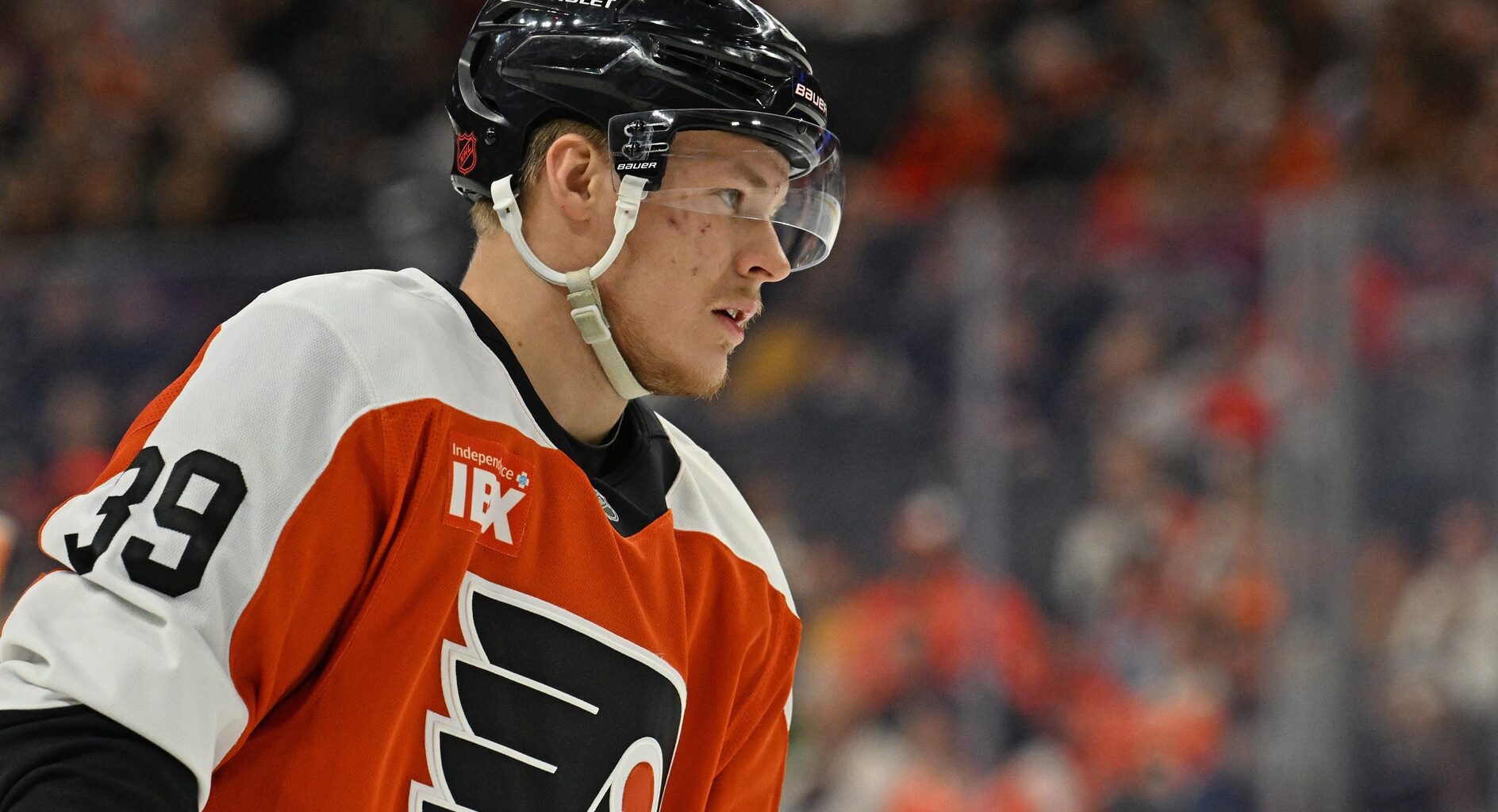
Despite Danny Briere and Rick Tocchet’s comments on how this is a ‘young team’, the Flyers’ reluctance to consistently play their young prospects shows that they might be more focused on short-term stability than long-term growth.
The Philadelphia Flyers have undoubtedly been struggling — losing 12 of their last 15 — and during a skid like this, you’d expect the young guys to be getting heavy minutes, right? Well, that hasn’t been the case.
The kids aren’t alright
With The Offspring reference out of the way, it’s important to establish who the ‘young guys’ are that the Flyers coaches and front office refer to. The Flyers currently have nine players under 25 on their roster. 25-year-old Cam York. 24-year-olds: Bobby Brink and Trevor Zegras. 23-year-olds: Jamie Drysdale, Emil Andrae, and Tyson Foerster. 22-year-old Nikita Grebenkin and 20-year-olds Matvei Michkov and Denver Barkey.
Head coach Rick Tocchet has taken a liking to Cam York, Jamie Drysdale, and Trevor Zegras. York and Drysdale rank second and third on the team in average time on ice, while Zegras sits second among Flyers forwards — trailing only Travis Konecny. Bobby Brink has also been a solid piece for Tocchet, particularly on the first power-play unit. Tyson Foerster was playing extremely well, too, averaging just under 18 minutes a night before going down with an injury in November.
However, on the flip side, Nikita Grebenkin, Emil Andrae, Denver Barkey, and – especially – Matvei Michkov have all been on the negative end of Rick Tocchet’s usage this year, even amid the team’s slide in the standings. Denver Barkey and Nikita Grebenkin rank tenth and twelfth, respectively, in average time on ice for Flyers forwards this season, and Emil Andrae has seen extended periods as a healthy scratch over the last few weeks. And that brings the focus squarely to Matvei Michkov — the most high-profile example of Tocchet’s deployment decisions and the one with the most significant long-term implications.
Matvei Michkov
The Matvei Michkov drama has been a hot topic on Flyers fan pages over the last few months, ever since it was announced that he came into camp out of shape by Rick Tocchet, and his ensuing offensive struggles.
Michkov has been averaging around 14:34 of ice time this season, down from 16:41 last season. 14:34 ranks him ninth in Flyers forwards’ average time on ice, sitting just behind Bobby Brink who averages 15:17. While his offseason ankle injury and conditioning issues could be factors in his limited usage, it’s notable that despite Michkov looking sharper and more like himself from last season, Tocchet still gave him only 10 minutes of ice time on January 31 versus the Los Angeles Kings.
Tocchet then went on the PHLY Flyers podcast at the Flyers Charity Carnival and was asked about Michkov’s usage as of late, and Tocchet fought back on the idea of Michkov getting more minutes, saying that he “came into camp out of shape” and went on to talk about players missing treatments. This spiraled into a national media backlash over the situation, with fans on social media openly criticizing Tocchet’s response to the question. The social media storm ultimately led Danny Briere to have to hold a press conference on February 3 before the Flyers’ game against the Washington Capitals to address the situation.
The Michkov situation has not been sorted out just yet – and it likely won’t be until the start of next season – but as many online fans understand, Michkov’s success is extremely important for the Flyers’ future, and if it comes down to keeping Michkov or the head coach, I think we know which direction the Flyers will lean.
Denver Barkey
Denver Barkey has been a bright spot for the Flyers this season, emerging as a young prospect who has stuck at the NHL level. According to MoneyPuck, the tenacious 5-foot-10 forward leads the Flyers in On-Ice Shot Attempt percentage with 59 percent, two percent ahead of the next closest Flyer, Trevor Zegras – who has been having a career year. He also leads the team in On-Ice Expected Goals percentage at 68.3 percent. He has been one of the Flyers’ best play drivers, and at 20 years old, it’s really impressive.
Denver Barkey is a Philadelphia Flyer. #PHIvsEDM | #LetsGoFlyers pic.twitter.com/7MIGtZvsTu
— Philadelphia Flyers (@NHLFlyers) January 3, 2026
Despite his underlying numbers ranking at the top of a Flyers team that has struggled over the last few months since Barkey’s call-up, the rookie prospect ranks tenth in average time on ice, sitting at just 13:33 per game. Barkey is still young, so sheltering your young players is normal in the NHL, but for a guy whose underlying stats blow everybody else out of the water, it might be smart to play him in a more extensive role.
In the two games the Flyers played in February against the Washington Capitals and the Ottawa Senators, Denver Barkey played 11:06 and 9:44. Considering this team currently sits eight points out of a playoff position, Barkey’s lack of ice time is head-scratching, especially considering how well he has played since being called up from Lehigh Valley.
Nikita Grebenkin
Nikita Grebenkin – who was acquired last year at the trade deadline in exchange for long-time Flyer Scott Laughton – has been in an interesting situation to start this season. He made the team out of camp but began the season in and out of the lineup. As of recent, however, his role has been up and down the lineup, playing some games on the first line with Christian Dvorak and Travis Konecny, or falling all the way down the lineup, playing with guys like Garnet Hathaway and Carl Grundstrom.
The 6-foot-2 winger has also seen his minutes reduced in the last two games of February, playing 13 minutes against the Capitals on February 3 and then only 10 minutes against the Senators on February 5. Grebenkin has played really well this season, despite his limited usage. He’s shown git and toughness – something this Flyers team lacks – and has been really effective working along the boards and using his 6-foot-2 frame to win puck battles.
NIKITA GREBENKIN GETS REWARDED FOR HIS GREAT GAME#LetsGoFlyers pic.twitter.com/KHGmiHt4Pp
— Flyers Clips (@Flyers_Clips) January 30, 2026
Grebenkin’s usage this season continues to be up and down, but his play in limited minutes has stood out at times. At only 22 years old, the Russian winger is looking to establish himself as a full-time NHLer, and his play this season – in limited usage – has impressed.
Emil Andrae
Last but not least is defenseman Emil Andrae, who has been the brunt of Rick Tocchet’s recent healthy scratchings. The 5-foot-9 defenseman has missed five straight games as a healthy scratch, his last appearance being in the Flyers’ 4-0 loss against the Islanders on January 26.
Andrae, who turns 24 in just a few weeks, is in a precarious spot in the organization. The Flyers are looking to get bigger as a team, and with him being lower on the depth chart than two other smaller defenseman in Jamie Drysdale and Cam York, I’m not sure where he fits in on the team long-term. His play this season has been fine; he’s played third defensive pairing minutes, occasionally jumping up the lineup to play with Jamie Drysdale on the second pairing. But with Rick Tocchet making him a healthy scratch for five consecutive games before an almost month-long break, it’s hard to see a world where he’s in Tocchet’s good graces.
Could Andrae be moved at the trade deadline? Possibly. The 23-year-old is an RFA come season’s end, and with the Flyers’ priority in signing other RFAs – particularly Trevor Zegras and Jamie Drysdale – I could see him being one of the odd men on this roster. It wouldn’t be a shock to see Emil Andrae’s name mentioned if the Flyers were to make a big swing deal, either at the trade deadline or during the offseason.
What’s the solution?
The solution shouldn’t be to simply hand all the young kids extensive minutes, as Rick Tocchet has expressed; they need to earn their ice time. So where are those extra minutes going to come from?
One way to get the young guys more minutes is by utilizing them on the power play. The Flyers currently rank 28th out of 32 teams in power play percentage, a position this team has known all too well. A move like this could give guys like Denver Barkey, Nikita Grebenkin, or Emil Andrae an extended look on the power play to see if they could help give it a much-needed spark. Veteran presences haven’t helped, so maybe move Christian Dvorak off the top unit, put Trevor Zegras at center, and let Nikita Grebenkin be a net front guy — a la Wayne Simmonds when he was here. Or by moving Noah Cates off the second unit and putting Emil Andrae with Cam York.
There are other ways to utilize your young guys in positions that benefit them, specifically, like using a guy like Matvei Michkov in overtime, a situation where he proved last year that he can thrive. In 80 games played last season, Michkov had 3 overtime game winners. That ranks third all-time on this team behind veterans Sean Couturier, who has seven, and Travis Sanheim, who has four. Obviously, you don’t want to put your rookies in positions that won’t benefit them, and the team — such as putting Michkov on the penalty kill — but you have to be able to find ways down the stretch to give them more minutes without downgrading a player in the lineup who’s more established in this league.
As the Flyers inch closer and closer to missing the playoffs for a sixth consecutive season, all eyes should be on the young guys — because their usage will say a lot about whether this rebuild is actually moving forward, or just spinning its tires.