
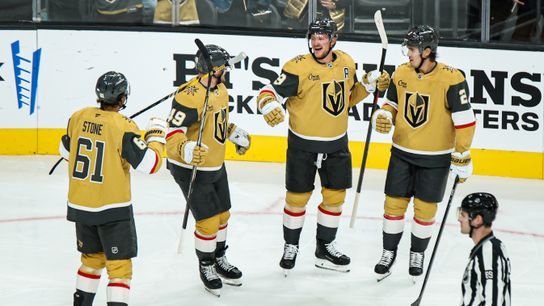
The NHL schedule is on pause, and for the first time since 2014, the Olympics return to a true best-on-best format. When the puck drops in Milan, the Golden Knights will be well represented. Eight Vegas players are set to compete in the tournament, beginning Wednesday night with Sweden vs. Italy — meaning a Golden Knight will be on the ice just in time for brunch for fans back home.
Here’s what to expect from each of them.
Jack Eichel enters the Olympics as the centerpiece of Team USA and arguably the most important Golden Knight in the tournament. He’s producing at an elite rate this season and continues to drive Vegas offensively, controlling pace and creating offense off the rush and in-zone. Now he’ll be asked to do the same on a bigger stage. Eichel is expected to center a top unit for the Americans and play in all situations, including on the top power play. In a tournament where margins are thin and stars decide outcomes, the United States will lean heavily on him to generate offense against the deepest rosters in the field. If Team USA reaches the gold medal game, Eichel will almost certainly be one of the primary reasons why.
Noah Hanifin’s role is less defined but still important. The American blue line is deep, which could limit his minutes early in the tournament. Still, his mobility and ability to move the puck cleanly fit the international game well. Hanifin has handled a heavier workload in Vegas this season and remains a steady presence defensively. Whether he begins in a regular rotation spot or rotates in based on matchups, he gives Team USA a reliable option on the back end.
Vegas will have three representatives on Team Canada, while none may headline the roster, all three bring skill sets that translate well in tournament play.
Mark Stone’s game is tailor-made for international competition. He anticipates plays defensively, wins battles in tight spaces and capitalizes on turnovers. In shorter tournaments, details matter. Defensive reliability matters. Timely scoring matters. Stone checks all three boxes. Even if he slots into a depth role, he’ll likely see important defensive assignments and late-game minutes when protecting leads.
Mitch Marner adds a different dimension. His pace and vision can change a shift instantly, and surrounded by elite finishers, his playmaking becomes even more dangerous. Canada doesn’t need him to carry the offense, but it will benefit from his ability to create space and find seams against structured defensive teams. If Canada’s depth lines begin to tilt games, Marner’s creativity will be a factor.
Shea Theodore provides mobility from the blue line. Canada’s defense corps is stacked, but Theodore’s skating and transition ability give the team flexibility. He has taken on increased responsibility in Vegas this season and has quietly been effective in all three zones. If he finds the right pairing early, his role could grow as the tournament progresses.
One of the largest roles of any Golden Knight in Milan may land on forward Tomas Hertl. He is projected to center Czechia’s top line and anchor the top power-play unit, putting him in prime position to drive offense for his country. Hertl has been productive in Vegas, particularly around the net and on the man advantage, and his direct style translates well to international play.
Czechia will rely on its top players heavily, and Hertl is firmly in that category. He’s strong on the puck, difficult to defend below the hash marks and capable of finishing from high-danger areas. In a tournament where elite teams can sometimes neutralize each other’s depth, strong top-line play becomes critical. Hertl should see significant ice time and will be central to any offensive success Czechia generates.
Rasmus Andersson will be the first Golden Knight to take the Olympic ice when Sweden opens the tournament Wednesday night. Recently acquired from Calgary, Andersson has already settled into a steady role with his new club and now joins a Swedish blue line known for its structure and depth.
Sweden traditionally leans on disciplined defensive play and efficient puck movement, and Andersson fits that mold. He projects into a middle-pair role where he can contribute in transition and support special teams. He doesn’t need to dominate the puck to be effective; instead, his value lies in clean exits, strong positioning and minimizing mistakes. If Sweden makes a deep run, it will be built on its defensive foundation, and Andersson will be part of that equation.
Akira Schmid enters the tournament as perhaps the most under-the-radar Golden Knight participant. He may not begin as Switzerland’s starting goaltender, but he is the only one of the group currently playing regularly in the NHL. That experience matters.
Schmid has been steady for Vegas this season, handling meaningful minutes and keeping the team competitive during uneven stretches. He hasn’t relied on flash. Instead, he’s been composed and technically sound. In a short tournament, goaltending can shift momentum quickly. One strong performance can redefine roles and alter a team’s ceiling. If Schmid gets an opportunity and delivers, Switzerland could become a more dangerous opponent than expected.
Eight Golden Knights will skate in Milan across five different national teams. Some will play top-line minutes and headline their country’s push for gold. Others will fill specific roles within deeper rosters. All of them, however, represent the growing influence of Vegas on the international stage.
With best-on-best hockey finally back at the Olympics, the Golden Knights won’t just be watching. They’ll be in the middle of it.