
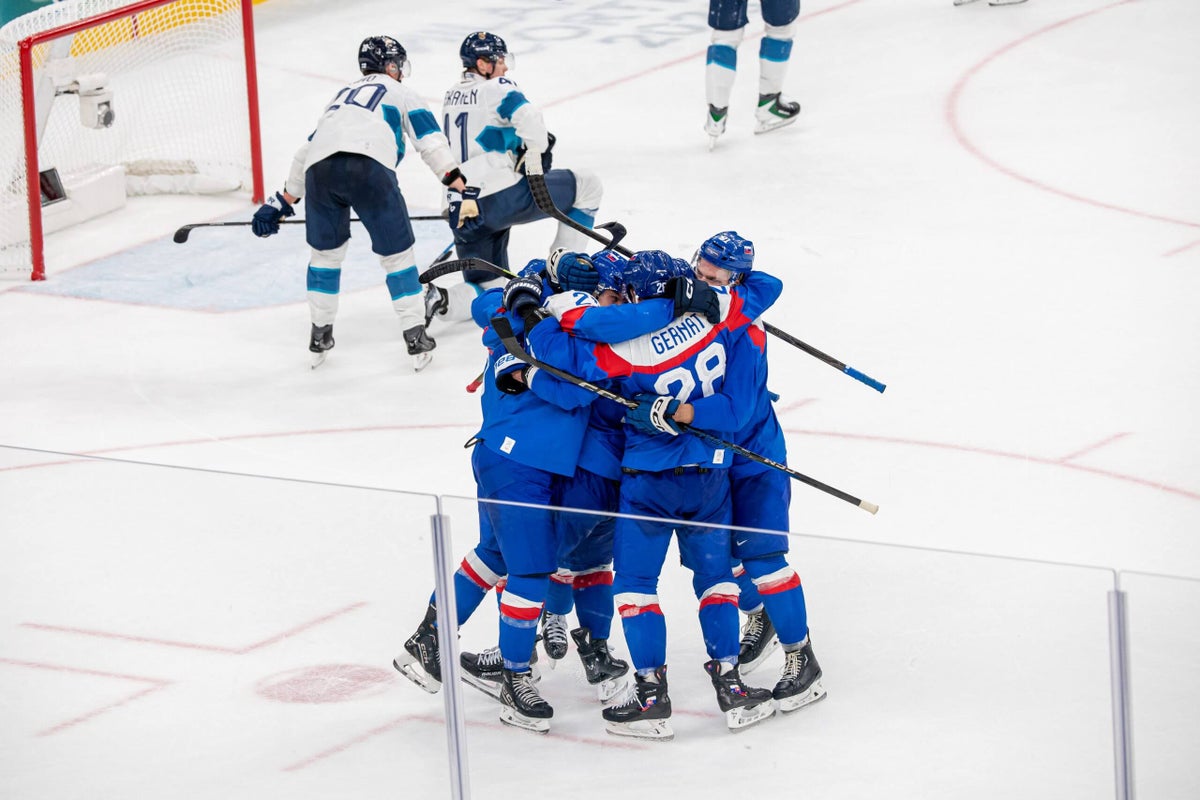
MILAN — It’s not that Slovakia didn’t think it could beat Finland. It’s just that the Slovaks really had no way of knowing for sure. Of course they believed in themselves and the talent they had, but they also weren’t ignorant of the roster math.
Every Finnish player but one is in the NHL. And the one that isn’t used to be.
“They have an NHL roster, and we don’t have,” said forward Oliver Okuliar, who plays in Sweden.
What Slovakia does have is Juraj Slafkovský, the 2022 No. 1 overall pick of the Montreal Canadiens. And now they also have something else: proof of concept.
Slovakia opened the Olympic men’s hockey tournament with a bang on Wednesday at Milano Santagiulia Ice Hockey arena, upsetting Finland 4-1 and setting the stage for what could be a wild tournament in an age of increasing international parity.
Slovakia entered the Olympics ranked ninth in the world, just below Denmark. But after bottoming out following the 2014 Olympics, the Slovaks have slowly been on the rise. Wednesday’s win was a statement to the hockey world.
“It feels amazing,” said defenseman Eric Černák, one of just seven NHLers on the Slovak roster. “We know now we can play against the top teams. Obviously, we don’t really have that many players from the NHL. But as you can see, it doesn’t really matter when you put the team effort into it, and when you play the right way, and when you’re listening to the coaching staff. You can beat any single team in this tournament.”
Slafkovský had two goals and an assist in a virtuoso performance, and Iowa Wild goaltender Samuel Hlavaj was sensational, stopping 39 of 40 shots, including an 18-save first period that gave his team belief that the improbable was possible.
Hlavaj was having such a rough year in the American Hockey League that he actually got briefly demoted to the ECHL — where he promptly gave up four goals in his only appearance. But in international play, Hlavaj has been tough as nails. He put up a .929 save percentage in three games to get Slovakia into the Olympics, and averaged fewer than two goals against per game in five World Championship appearances.
“This was probably the toughest and best game of my life so far,” Hlavaj said. “I love my country. I love playing for this team. And I’m enjoying every moment.”
Slafkovský, the biggest athlete in Slovakia, burst onto the scene as a 17-year-old in the 2022 Olympics, scoring seven goals in seven games to lead his country to a surprise bronze medal.
Against Finland, he first beat Finnish goalie Juuse Saros on a beautiful move across the crease. Then, three minutes after St. Louis Blues forward Dalibor Dvorský gave Slovakia a 2-1 lead in the third period, Slafkovský uncorked a spectacular rising shot that beat Saros over the right shoulder.
Clearly, the world’s biggest stage agrees with him.
“I have no idea (why),” he said. “Honestly, I try to play like this. I wish I could have two goals every game. Sometimes, it’s not going to happen. But yeah, I was in a good spot at a good time, and I was shooting the puck, so that’s good.”
Slafkovský’s teammates were quick to praise him, but even quicker to credit the whole team for buying into its structure and not being intimidated by the Finns. Now the goal becomes to prove this was no fluke. After facing Italy on Friday, Slovakia gets an even bigger test Saturday against Sweden.
“I don’t remember when we won against Finland last time,” said defenseman Šimon Nemec of the New Jersey Devils. “So it was a big game for us, the first game of the Olympics. We showed that we are here to do something — not just play, but do something big.”
‘No panic’ from stunned Finns
As if one of hockey’s greatest rivalries needed more spice, that Finland-Sweden game on Friday suddenly takes on even more spice — or at least more urgency.
The Finns’ loss was one that very few people could have seen coming, not for a team arguably as talented as any Suomi Olympic roster from the past.
Were they as surprised as the rest of us? You bet.
“Yeah, well, disappointed,” Dallas Stars superstar Mikko Rantanen said after the game. “It was not the way you want to start.”
The Finns outshot Slovakia 40-25 and certainly controlled play in the first half of the game. But that shot total was misleading as far as the kind of quality looks Rantanen feels his team will need moving forward.
“I think there was some good things we did. We created a lot of O-zone time but we got to get more pucks to the net and we got to be more direct,” said Rantanen, who had three shots on goal. “It looks good when you play on the outside but we have to try to get more inside and more dangerous that way.”
The Finns were bronze medalists in Sochi in 2014 the last time the NHLers participated in the Olympics. Despite losing superstar center Aleksander Barkov to injury in September, the expectation coming here to Milan was absolutely to medal again.
So by any measure, the loss to a Slovakia team ranked ninth in the IIHF rankings was nowhere in the cards.
“Ah, yeah, it was a tight game but we just couldn’t capitalize really,” said Dallas Stars stud defenseman Miro Heiskanen, who led Finland in ice time at 27:11. “We had enough chances to score and win the game but you know, they defended really well and their goalie played really well. It was a tight game. Losing sucks. Hopefully we can get the next one.”
That next one is against their No. 1 rivals in Sweden. Having said that, the format for this tournament allows for an 0-3 team to still win gold if they win out. And Finland will be playing Italy, so it won’t be 0-3. But no team gets eliminated in the round robin. There’s a qualifying round for teams ranked 5-12 after the preliminary round; the winners of those four games move on to the quarter-finals along with the top four teams from the preliminary round.
In other words, Finland has plenty of time to recover from this stunning result and recover its form.
“There’s a lot of games left and the most important ones are ahead of us,” said Finland captain Mikael Granlund. “We all know that. Obviously it wasn’t the start we wanted. But yep, now we have another chance Friday against Sweden. But we all know the most important games are ahead of us. No panic.”
There’s no panic, but Finland didn’t look organized at times in this game. There’s some white noise around Finnish head coach Antti Pennanen as far as the amount of pressure he is under in his country. Some Finnish hockey observers aren’t convinced he’s the guy who should have coached this team. Losing an opener to Slovakia doesn’t exactly quell that level of doubt, and one wonders what it does for the NHL stars on the team as far as their level of confidence in the coach.
“Everybody is working hard today but that’s the least you can do,” said Rantanen, pointing out there’s another level in their game to get to. “Offensively we have to try to find a way to be more direct. If we can get a couple of goals, we can defend well and win games.”
For now, it’s just one game.
“Oh yeah, obviously we’re going to bounce back,” said Granlund. “We got to play better, obviously. We got to bury some of those chances we’re getting. But like I said, sometimes it doesn’t go your way and that was tonight. We have another chance on Friday.”
Landeskog’s return
Gabriel Landeskog’s back, alright. Playing in his first game since a rib injury knocked him out Jan. 4 in Florida, the Sweden captain smoked Italian defenseman Alex Trivellato with a thunderous hit on his very first shift of the Olympics.
“That’s the only way to get into it,” he said after the game, smiling. “I feel great.”
It set the tone for the Colorado Avalanche captain to mark his return to play, the veteran then scoring Sweden’s first goal of the Olympics with a one-time blast from the point on a power play 9:06 into the first period en route to a 5-2 win by the Swedes.
It was touch-and-go for Landeskog right up to the final days as far as feeling healthy enough to get on the plane to Milan. He returned to practice with the Avs on Jan. 27 and then it was about ramping it up enough to be here, all of which required trust and transparency with the Avs.
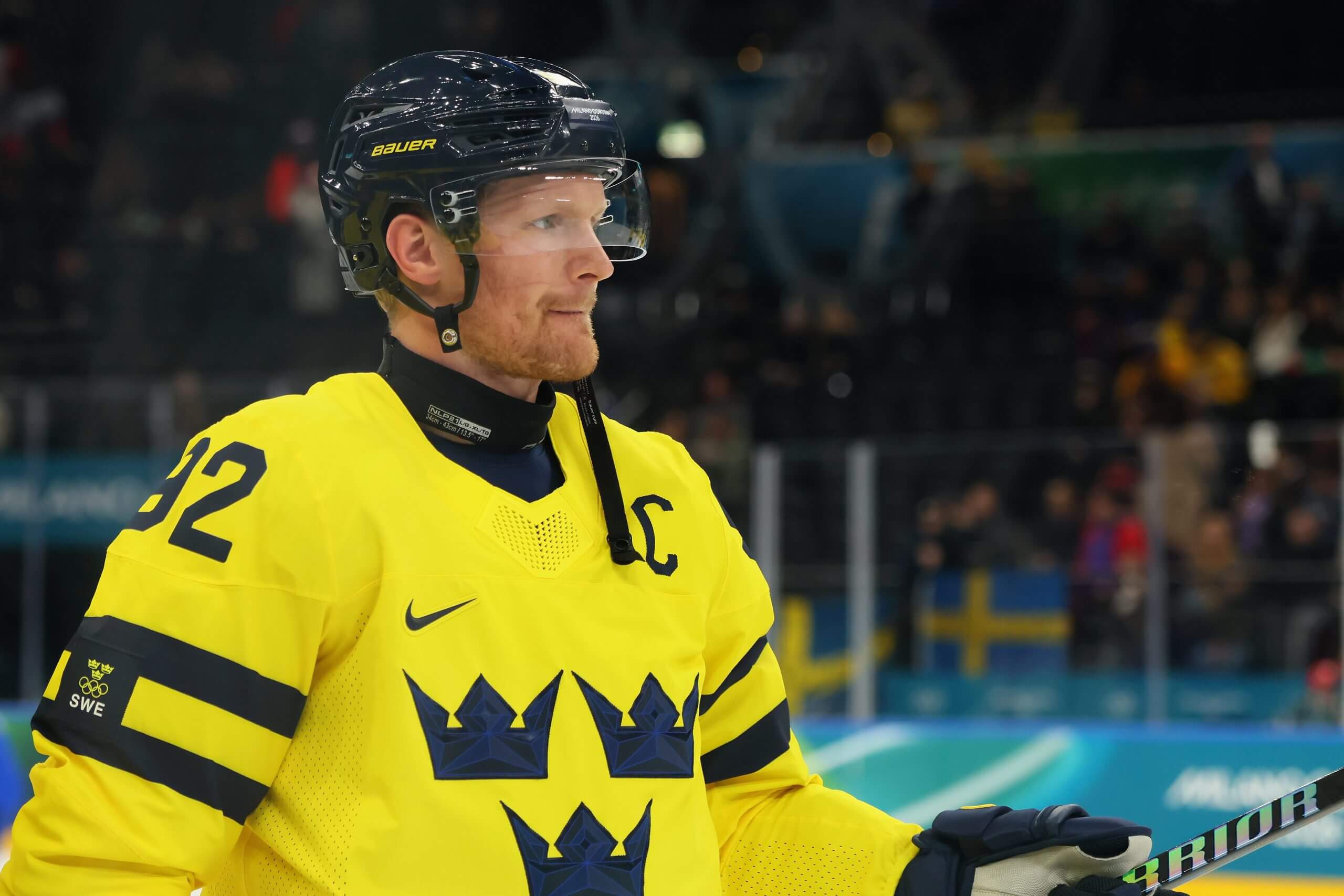
Landeskog was a teenager when Sweden won Olympic gold in Torino. (Bruce Bennett / Getty Images)
“Yeah, I think they know they can trust me, I think I know I can trust them with their support,” Landeskog said Wednesday. “Everything I’ve been through, they’ve always been there as an organization. I’m straightforward with them and they’re the same back to me. At that time (two weeks ago), I don’t think we were really convinced it was going to work. But we were trying.
“But complete opposite to my knee injury, once my ribs started feeling better, they felt better progressively every single day. It was big steps. Whereas with the knee, you could go months without feeling much improvement. So that was exciting, and things just kind of fell into place quickly.”
The journey back for his second career Olympics is a significant moment for the veteran. And for the sport, he says.
“It means a lot,” said Landeskog. “Obviously it’s very exciting that we’re here finally. It’s another chance to compete against the best in the world, that’s what is so exciting about it. And having some core memories from 2006 when the Swedes won (in Torino), I mean, that fueled me and I’m sure the rest of our group in there that was growing up at the time and the next generation. That’s what is so neat about a tournament like this. You know, we get a lot more eyes on a tournament like this than normal in NHL playoffs. And us being over here in time zone, people who maybe wouldn’t normally watch hockey but can easily fall in love in it at a tournament like this. For us it’s about inspiring the next generation of hockey players as well.”
Landeskog was a 13-year-old teenager watching the Torino gold medal game in his living room in the Stockholm suburbs. The memory is clear as day for him.
“Watching the time slowly tick down, the Swedes were diving for loose pucks and blocking shots; and (Henrik) Lundqvist made a crazy save at the end,” he vividly recalled. “And I remember thinking that an Olympic gold medal, all bets were off the table, so I got up on my feet on the couch and started jumping up and down. My dad said, ‘Hey, hey, you’re going to break the couch.’” Landeskog smiled. “So I guess not everything was off the table. But yeah, I got very exciting memories of that and those are the guys I idolized growing up: Mats Sundin and Forsberg and the Sedin brothers were young, but Lidstrom and Kronwall and Zetterberg, those are the guys you just grew up idolizing.”
The Swedes could absolutely win gold here 20 years later. What does Landeskog allow himself to envision when he contemplates the opportunity ahead here?
“I mean, I think probably the same as the guys who are here, you got your helmet off and you put your head down for somebody to wrap a gold medal over your neck,” said Landeskog. “That’s probably what we’re all envisioning. That’s always good to have a goal and it’s always good to know where you want to go, but you can’t look too far ahead, you’ll trip. One thing I’ve learned is to be right here, right now.”
And there’s probably no one who has learned the value of living in the moment more than Landeskog.
Italy surprises
Nobody knew what to expect from Italy coming into this tournament. Least of all the Italians.
“I haven’t been in this position before,” said Team Italy coach Jukka Jalonen. “It’s a European team against the best NHL players. It’s very difficult to anticipate what’s going on, or what would happen.”
What happened exceeded everyone’s expectations. And while Italy came up short in a 5-2 loss, the fact it was tied 2-2 through two periods and was still a one-goal game with less than five minutes to go was a monumental achievement for the home team. When Matt Bradley scored to tie the game in the second period, it suddenly felt like something historic might happen.
“To score a goal for my Nonna back home — once-in-a-lifetime, amazing feeling,” Bradley said. “Overjoyed with emotions for that.”
Bradley said the Italians weren’t intimidated by the stars on Sweden’s side, that “we all lace up our skates the same way.” An early goal by Luca Frigo gave the Italians a jolt of confidence.
“We got together in the locker room and said, ‘Hey, we can play with these guys,’” Dustin Gazley said.
But it did take a Herculean effort from goalie Damian Clara — an Anaheim Ducks second-round pick in 2023 — to keep the game within reach. Clara finished with 46 saves on 49 shots before leaving the game with apparent leg cramps, exacerbated by a terrific sprawling save on an Elias Pettersson short-handed breakaway. Backup Davide Fadani will start against Slovakia on Friday, Jalonen said, but the general sense is that Clara will be fine.
Swedes survive opener
It wasn’t a thing of beauty, but the Swedes survived a scare and held off host Italy 5-2 before a lively home Italian crowd, launching 60 shots on goal.
At 2-2 in the second period, the unthinkable was playing out. But on a veteran team, there was no panic on that star-studded bench.
“No, we didn’t panic at all,’’ veteran leader Victor Hedman said after the game. “Their goalie played unbelievable. We knew that coming into the game, Anaheim has a good prospect there. He’s been playing really well good in the Swedish League. He’s big and tall and he played unbelievable. But at the same time, maybe we can be a little more direct. We were talking about it after the second period that maybe we could have more of a shooting mentality. Still we had 45 shots after two periods.
“Getting 60 shots usually wins you a game,” he added with a smile. “But these tournaments, they’re so fun because there’s so unpredictable. But we stuck with it. We have to move forward and play against a Finnish team that’s going to be out for revenge after losing the first one. We got to re-focus quick here.’’
Sweden head coach Sam Hallam credits his team for keeping its composure but wondered how his team could only receive one power-play opportunity on the night.
“We started the first period really well, played the way we wanted,’’ Hallam said. “We didn’t convert it into goals. But I also think that we should have had a couple of more power plays, that could have killed this game early. So I don’t know how we managed to get just one power play in a game like this. But we managed it, we got to play that was tight, which probably gives us more for the tournament in the long run. And I’m happy that we stuck to it and held our composure.’’
Forsberg the 13th forward?
The most surprising news saw Nashville Predators star Filip Forsberg down in the lineup as the 13th forward. He played only one shift Wednesday night and it was in the first period.
No one saw that coming. Forsberg politely declined to talk after the game.
Sweden is super talented, so there are hard decisions to be had by the coaching staff.
“It is hard,” Hallam said when asked about the decision. “We’ve seen, our forward discussion, Team U.S., Team Canada, for us coaches and management, we’re looking at dividing into roles, players that can handle different kind of ice times, different kind of situations. Filip on the ice today would’ve been great. He can be on the ice much more next game.
“But if we want to go deep in this we’re gonna need everyone. I think a story that’s good to remember sometimes, last time I was at the Olympics here in Italy it was 2006 and the Swedish team won it. That’s not why I’m talking about it. It’s that it was two brothers, the Sedins, played on the third line. Didn’t play power play. So we have ambition to go deep into this tournament. We need good players from one to 25.”