

The family of a skier who died from a backcountry avalanche has filed a wrongful death lawsuit against the guides and cat-skiing company. According to the filing, the family is seeking $14.5 million in “economic damages” and $10 million in “non-economic damages”, plus attorney fees.
On March 13, 2025, Brian Thomas Roberts, a 51-year-old ski coach was buried in an avalanche during a commercial cat-skiing trip on Mt. Bailey. The incident was initially reported to the Colorado Avalanche Information Center (CAIC). Read the full report here, written by Gabriel Coler from the Central Oregon Avalanche Center and Simon Trautman from USDA FS National Avalanche Center who wrote the original report.
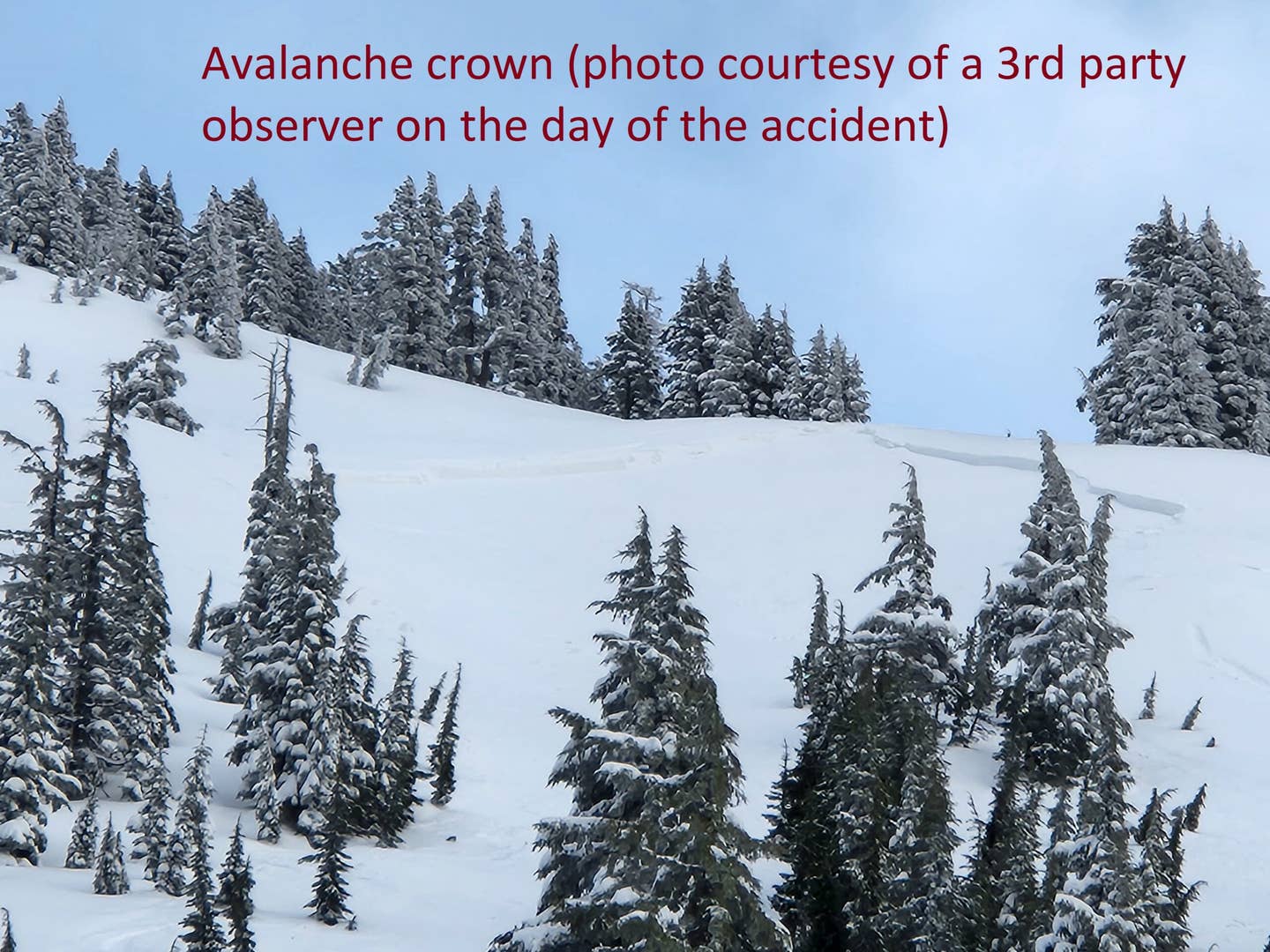 Photo Courtesty: CAIC / Third PartyNegligence vs Implied Risk
As reported in the Central Oregon Daily, the lawsuit alleges negligence on behalf of the cat-skiing company, owned by Diamond Lake Improvement Company, the three guides, and their employer, Sierra Wilderness Seminars Inc.
The complaint alleges the guides lacked prior experience guiding on Mt. Bailey, dismissed regional avalanche warnings, and continued operating in dangerous conditions.
According to the filing, weather events including high winds, freezing rain, and heavy snowfall had created unstable snowpack conditions. Although there is no dedicated public avalanche forecast specific to Mt. Bailey, one guest reportedly raised concerns after seeing a report warning of high avalanche danger in the Central Oregon Cascades. The complaint alleges guides told guests to “ignore” the report because it was irrelevant to Mt. Bailey and assured them they were “resident experts.”
After digging a test pit and determining conditions were safe, the group proceeded with runs throughout the day. Around 3 p.m., on a run known as the “North Wall,” two guides descended first, followed by guests spaced roughly one minute apart. Roberts was the fifth skier to drop in. Shortly after the sixth skier began their run, the avalanche released.
Roberts was buried for approximately 10 minutes. According to the complaint, guides and guests located and dug him out, and two nurses in the group attempted life-saving measures. The filing states the group did not have an automated external defibrillator on hand. Roberts later died from his injuries.
All guests had signed liability waivers releasing the defendants from claims of negligence, the complaint acknowledges.
The case now heads into a legal arena that Oregon lawmakers and recreation operators have been debating for months. Given the current state of liability law in Oregon, there’s a relatively solid chance the lawsuit will hold ip.
A System Already Under Strain
As TGR previously reported, Oregon’s outdoor recreation industry has been grappling with an insurance affordability crisis. Premiums have climbed sharply in recent years, and some carriers have pulled back from the market entirely, citing unpredictable liability exposure and rising claims costs.
At the heart of the debate is a familiar tension. Outdoor recreation carries inherent risk. Avalanches, rockfall, weather, terrain variability. Those risks are part of the experience participants knowingly assume.
Sign Up for the TGR Gravity Check Newsletter Now
Reinvent your morning scroll with the TGR Gravity Check Newsletter — your source for exclusive stories, breaking news, and first looks at the content you actually care about. Everything action sports and outdoor culture, all in one place. Welcome to Gravity Check.
100% Free.No Spam.Unsubscribe any time.
But commercial operators also owe clients a duty of care. Where that line sits legally is often determined after an accident, in court.
Mechanized backcountry skiing operations, such as cat-skiing, occupy a particularly complex insurance category. They involve remote terrain, variable snowpack, paid guides, and paying guests. For insurers, that combination can read as layered exposure.
A $14.5 million claim tied to a fatal avalanche certainly adds fuel to the fire.
Waivers, Gross Negligence, and the Gray Zone
Oregon law generally allows participants to assume risks inherent in recreational activities, and liability waivers are commonly used across the industry. However, waivers typically do not protect against claims of gross negligence or reckless conduct.
The complaint, in this case, alleges more than inherent risk. It argues the guides knew or should have known about dangerous avalanche conditions and had a duty to warn guests. It also alleges that replacing locally experienced guides with an outside company lacking specific Mt. Bailey experience contributed to the outcome.
Those claims will need to be proven in court. But the distinction matters.
If a court ultimately finds that the case falls within assumed risk, it could reinforce the legal framework operators rely on to secure coverage. If the court finds conduct that rises to gross negligence, insurers may reassess how they price or even offer coverage to similar operations statewide.
That uncertainty is exactly what recreation businesses say is destabilizing the outdoor industry in Oregon.
