
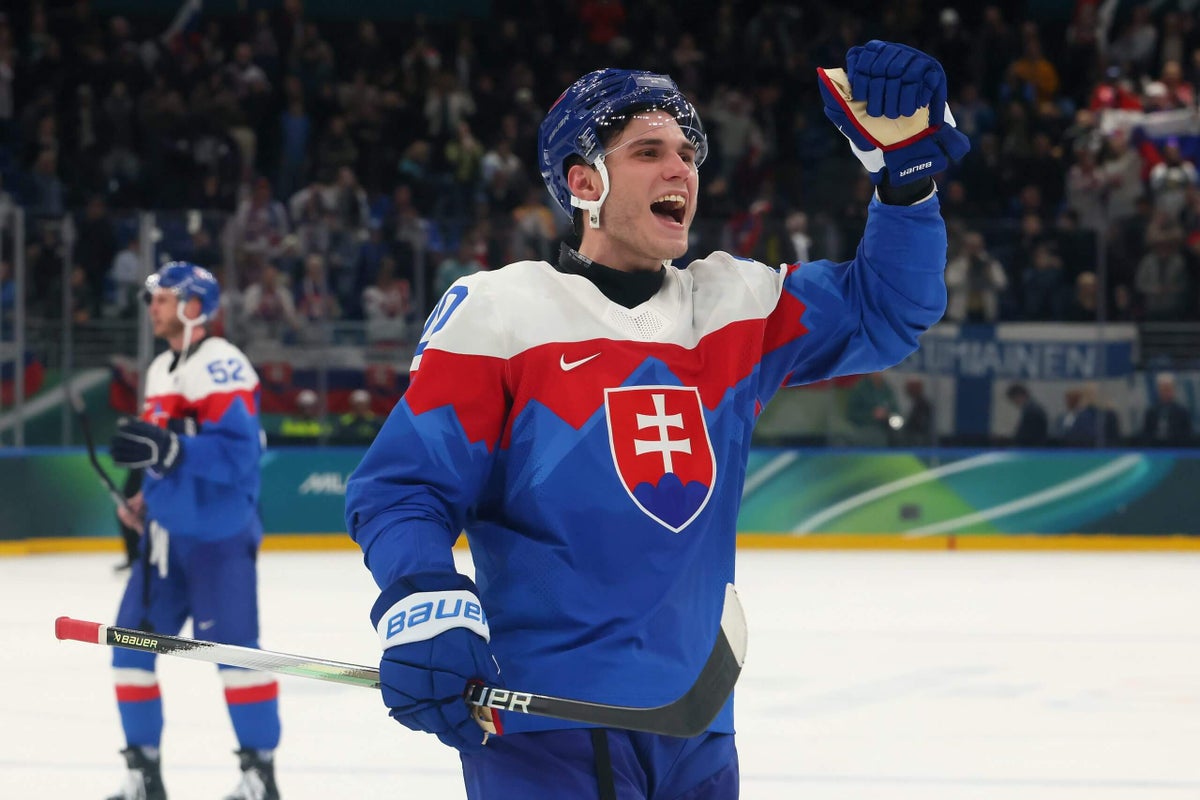
Juraj Slafkovský thrives on the international stage.
Team Slovakia isn’t a front-runner in this year’s Olympic Games, with NHL players back in the fold. The team entered the tournament with less than a one percent chance of reaching the gold-medal game, and only a 27 percent chance of topping Finland in its opening game. While Slafkovský is only one of seven NHLers on Slovakia’s roster, this is the perfect setting for him to excel. And that’s exactly what he did with a dominant two-goal, three-point performance that helped power his underdog team to a 4-1 win against Finland on Wednesday.
Slafkovský’s game-changing play on Wednesday was a reminder of what rocketed his stock on the draft radar almost four years ago.
Go back to 2022, when the NHL Draft was held in Montreal, with the Canadiens holding the first pick. Through all the buzz and energy, one thing wasn’t completely clear: who would be drafted first. There wasn’t a generational talent at the top of the draft class like Connor McDavid or Nathan MacKinnon. Still, most rankings had Shane Wright No. 1 in July 2022. He was the projected first pick heading into the 2021-22 season, but others, including Slafkovský, started to gain more traction as the year rolled on.
Slafkovský’s scoring, competitiveness and frame commanded attention in his draft season. His standout play on the Olympic stage, where he scored seven goals in seven games (before adding another nine points in eight games for Slovakia at the World Championships), fueled his case and hinted at his readiness to make an early impact at the NHL level. All of that built toward the Canadiens selecting him first.
But it wasn’t just that Slafkovský jumped to the top of the class as the No. 1 pick; a gap formed between the Canadiens’ pick and Wright’s selection. The New Jersey Devils, who already had a high-end one-two punch down the middle, opted for defenseman Simon Nemec second. The Arizona Coyotes went for center Logan Cooley at No. 3. Wright ultimately slid to the Seattle Kraken with the fourth pick.
And when Wright was drafted, he appeared to stare down Montreal’s draft table, adding even more drama to the situation. Even though that was later dispelled, and the two forwards ultimately landed on teams that only play each other twice a year, there was enough spice to make for a pretty formidable rivalry between Wright and Slafkovský (and the Canadiens overall) — if both of these players developed into difference-makers.
Instead, the Canadiens’ decision to select Slafkovský first looks more right by the day, as these players have taken totally different paths over the last couple of seasons. While there is still time for Wright to define himself at the NHL level, their future outlooks have diverged in opposite directions since the 2022 draft.
Juraj Slafkovský
There is a burden that comes with being the No. 1 pick. In the grand scheme of things, it doesn’t matter that there wasn’t as strong a consensus for that pick, or if the draft class was weaker at the top. The No. 1 tag is what gets remembered and what becomes the measuring stick. Slafkovský’s perceived readiness, fueled by his play at the Olympic and international level, only inflated his value and expectations, adding more pressure to the situation.
So a 10-point, 39-game rookie season was always going to underwhelm for a player drafted there.
Slafkovský didn’t generate enough puck touches as a rookie to really make an impact. The context of his situation didn’t help, with deployment in mind and how many different line combinations he played with. But there was, at least, a path forward to becoming more of an impact player; Arpon Basu’s deep dive showed how more neutral-zone puck touches would be key to taking the next step.
That’s become a key part of his development over the last few seasons, as he has put the pieces together between using his physical stature and raw talent. Having more skill (and consistency) around him seemed to help, with the Canadiens maximizing his usage alongside Nick Suzuki and Cole Caufield over the last two seasons. In that role, he isn’t the driver, and instead has been able to focus on finding his strengths and improve his decision-making on the fly with two-way support around him.

But even after all that growth and progress since Year 1, Slafkovský’s trajectory wasn’t the most inspiring last season.
As unique as every player’s set of traits is, there are still ways to spot similarities. Players, within the same age range, can be grouped by physical attributes, play-driving, overall style and production, among other factors. Dom Luszczyszyn’s model uses those factors to build a player’s similarity score; that can show close matches for a given season and give some insight into what the future could hold.
In Slafkovský’s case, there was still a path to becoming the next Jonathan Huberdeau after last season. But closer matches, like Milan Lucic, Marcus Johansson and Peter Mueller, raised some red flags.
This year, Slafkovský has raised the bar once again, which is helping lift that outlook. As similar as he is to Lucic in size at 21 years old, the production and finesse have added separation. Now the worst-case scenario has him becoming the next Boone Jenner, Jonathan Drouin or Wojtek Wolski. The best-case scenario still has him following in Huberdeau, Max Pacioretty or Jamie Benn’s footsteps.

Slafkovský has become less of a passenger to the Canadiens’ best this year and is doing more to actively contribute to their success, whether he’s alongside Suzuki and Caufield, or doing damage with rookies Ivan Demidov and Oliver Kapanen.
At five-on-five, there’s more balance to Slafkovský’s scoring chance generation. Last year, his playmaking took a major step forward; his high-danger passing was a standout league-wide. This year, that puck-moving play is still a part of his attack, especially in transition. Slafkovský is using his size to his advantage more to maintain possession when entering the zone. He’s combining his physical attributes, his frame and long reach, to shield the puck while carrying it further from his body.
His slick passing is helping set up his teammates to give his line more dimension and options, in whichever top-six combination he is a part of.
And Slafkovský is still finding ways to drive right to the scoring areas himself as well, whether he is creating space for himself in transition or getting set up by one of his linemates. An inflated shooting percentage has something to do with his goal-scoring boost, but there are two other contributors as well — primarily playing with a dynamic passer in Demidov and an uptick in speed.
In seasons past, Slafkovský’s ability to maneuver in tight was a strength, but his overall straight-line speed wasn’t as remarkable. He only generated 23 speed bursts of 20-plus miles per hour in all situations last year, across 79 games. This year, in 57 games, he is already up to 101.
Add in his power-play contributions and it makes for a career-high scoring pace of 2.62 points per 60, a plus-0.39 improvement from last year. All of that progress makes that high-end road path look more likely.
Slafkovský may never be The Guy in Montreal, or even match the elite impact of some of the best No. 1 overall picks. But his growth has made him an important part of the Canadiens’ top six, and his bright future should help this team take the next steps toward contention.
Shane Wright
Sometimes, it’s just hard to recalibrate expectations for a player — especially for someone who 1) had exceptional status in the OHL and 2) was projected by many to be drafted first.
Even when Wright was projected to go first in the 2022 draft, it was with the disclaimer that he was never expected to become the next McDavid or Auston Matthews. The 2022 draft class wasn’t booming with generational players. Having players who had to suffer through the COVID era during an important time in the developmental process added another challenge to the situation.
Back in 2022, Wright was projected to become a top-six center at the NHL level (versus a true No. 1, like most players drafted that highly). His shot, maturity and all-three-zones play were considered strengths that would transfer to the NHL early.
But 151 games later, Wright has yet to become an impact player at the NHL level, and the vibes couldn’t be more different compared to Slafkovský in Montreal. One of these 2022 top-five picks is locked in as a franchise winger, with an eight-year, $60.8 million contract, while the other’s name is surfacing on trade boards before his entry-level contract even expires.

Last year, after Wright’s first full season in the NHL, his comps showed a few different ways his future could play out. On the bright side, Martin Necas, Brayden Schenn and Mika Zibanejad were all decent matches. Chris Tierney and Tomas Jurco represented the worst-case scenario. But Wright’s closest matches fell somewhere in between: Marcus Johansson and Anthony Beauvillier, two top-nine utility players.
The problem is, Wright isn’t building on his rookie season well enough this year to push higher than that.
Sure, there are some positive signs of progress. He can generate some pressure on the forecheck, is doing a better job of getting his shots on goal and is sprinkling in some chances off the rush. His release, which was a standout leading up to the 2022 draft, can still be dangerous.
But some of the flaws are even more glaring — like the fact that his all-situations scoring pace has slowed (from 2.38 points per 60 to 1.70) after his shooting percentage dipped below 20 percent this season. Wright doesn’t consistently drive play into the offensive zone, either; AllThreeZones’ tracking has him below average in controlled entries among forwards this year.
As much as the Kraken have invested in Wright’s development, the team hasn’t surrounded him with dynamic skill to help solidify and elevate his game. Berkly Catton, Kaapo Kakko, Ryan Winterton and Jani Nyman aren’t the most inspiring list of linemates (and it’s a downgrade from primarily playing with Jared McCann last year).
But Seattle has tried to support his game in different ways, with extreme sheltering in terms of quality of competition and deployment. Wright has started in the offensive zone 77.5 percent of the time at five-on-five this year. Despite that usage, he still isn’t driving play or breaking even in xG.
Now, Wright’s profile has 288 above-average comps, 30 of which qualify as strong matches. Within that group of 30 players, his current season stacks up well to Pavel Buchnevich, Rickard Rakell and Oliver Bjorkstrand at that age — and they represent the best-case scenario at this point. While these are all very capable forwards, it’s a far cry from the shades of the John Tavares comparison from 2021. On the other end of the spectrum, there is still a much lower range of outcomes possible, since Wright hasn’t taken enough of a step forward this season: Mason Raymond, Blake Comeau, Richard Panik and Riley Sheahan, among others.

That outlook explains why the Kraken may want to move on from Wright.
Could a change of scenery change his trajectory?
It’s possible Wright just needs to be exposed more to NHL competition, and that his minimal, carefully selected usage is doing more damage. Without the reps or chance to problem-solve on the fly, he hasn’t had enough of a chance to get comfortable at this level or adapt to NHL action. Sometimes, when players don’t get the chance to sink or swim, it can force them to solely focus on minimizing risk, instead of playing to their strengths. So a clean slate with a new team and more playing time could alleviate some of that pressure.
But sometimes, there is a reason coaches don’t trust a player to take on more responsibility or minutes. And that could be the case in Seattle, since Wright hasn’t been able to put together all the tools that made him so effective pre-draft, let alone build on those skills. While his hockey IQ has been a strength of his game, his awareness and timing could use work at the NHL level. His playmaking hasn’t progressed enough, either. Without the most dynamic skill set, those other qualities have to add up more.
Wright is only 22 and hasn’t hit his prime yet, so nothing is set in stone. Considering his limited NHL experience in his first two post-draft seasons, it wouldn’t be entirely surprising to see him become a late bloomer or an outlier to aging curves, either. But until something improves, the arrow is pointed much further down on his future than originally expected.
Data via Evolving-Hockey, HockeyViz, HockeyStatCards, All Three Zones, Dom Luszczyszyn and Natural Stat Trick. This story relies on shot-based metrics; here is a primer on these numbers.