
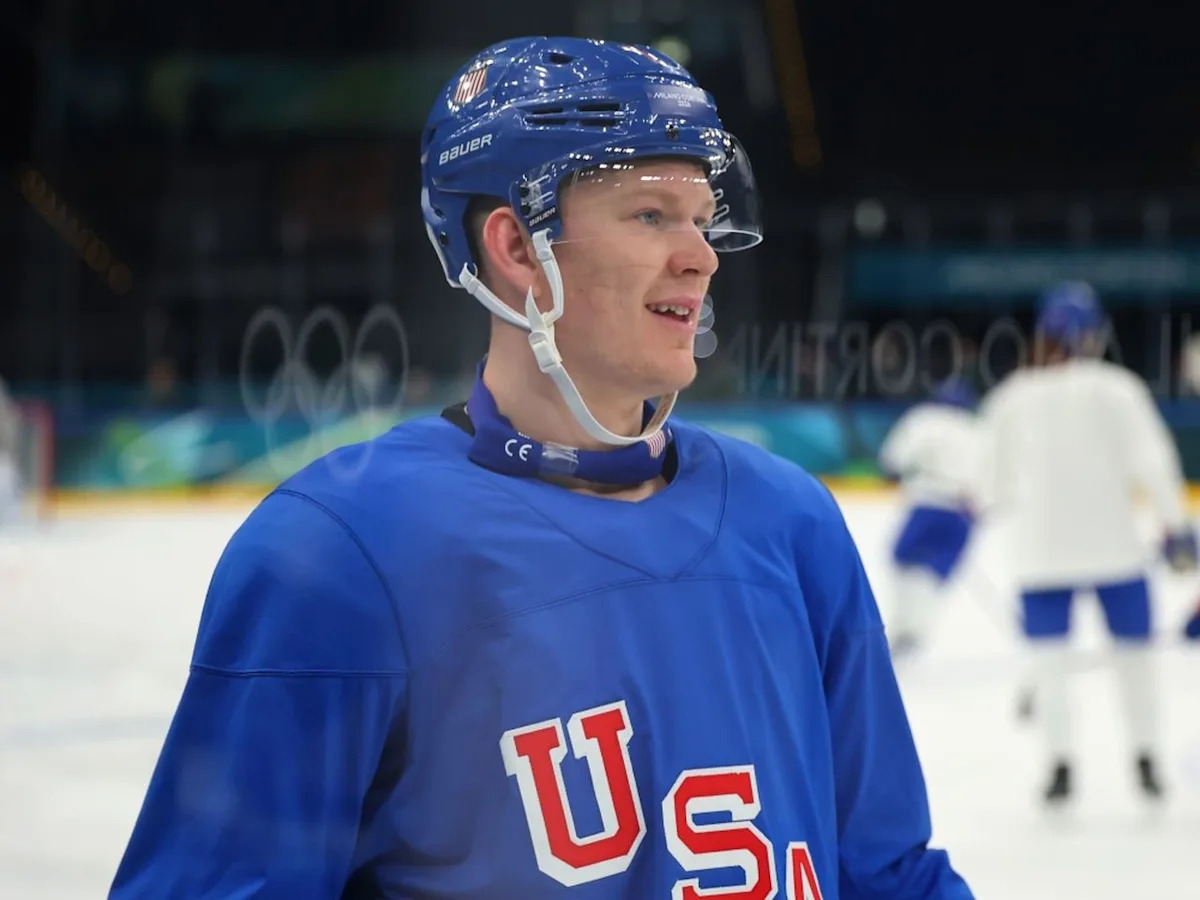
It has been 12 years since the best players in the National Hockey League suited up at the Winter Olympics.
Fans of the Ottawa Senators will be holding their breath during the 2026 Winter Olympic Games in Milano-Cortina, Italy, hoping that all of the club’s six participants will return home safely and healthy with the tournament officially having started on Wednesday.
Sitting six points out of the final wild-card spot in the East with the National Hockey League schedule on hold until Feb. 26, the Senators will need all hands on deck in the final 25 games of the regular season to make the playoffs for a second straight spring.
The task isn’t impossible, but you’ll have to excuse some of the faithful if they’re concerned that the club’s participants — Brady Tkachuk, Jake Sanderson, Tim Stutzle, Lars Eller, Mads Sogaard and Nikolas Matinpalo — may get injured during the Games.
The NHL Players’ Association pushed for participation in the Olympics in the most recent negotiation of the Collective Bargaining Agreement. Senators owner Michael Andlauer supports player participation and the fans want to see best-on-best.
The last time NHL players suited up at the Olympics was in 2014 in Sochi, Russia. We got a glimpse at the 4 Nations Face-Off in Montreal and Boston at how good the hockey can be, but it also ended with Tkachuk missing some games with the Senators.
The previous time the Games were in Italy was in 2006 — and that left fans of the Senators with a sour taste in their mouths.
It has been two decades
Twenty years ago, I was sitting in the media room in the bowels of the Palasport Olimpico in Turin, Italy, furiously typing up a game-over column from Team Canada’s 7-2 victory over the host Team Italy when something caught our attention on the television nearby.
While most people were working in the press tribune in the stands to get a first-hand look at Germany facing the Czech Republic, retired Ottawa Citizen columnist Wayne Scanlan and I opted for the quiet of the media room in the rink to do our work.
We both looked up at the monitor as Dominik Hasek left the net. Signed to a one-year, $2-million US deal by the Senators before the start of the 2005-06 campaign, the 39-year-old Hasek went down to make a save early in the first period and headed for the exit on Feb. 15, 2006.
Back then, we were competitors, but we were always — and remain — friends. In those days, there was no social media to send out the information immediately.
Our first instinct was to head to the Mixed Zone. That’s an area where the participants meet with the crowds of media during the Games and, in those days, the players couldn’t get to the dressing rooms without walking through that area.
By the time we got out there, one of the broadcasters for the CBC indicated to us that Hasek had already passed through the area. Our cellphones were starting to ring off the hook as we both tried to gather more information about exactly what happened.
Naturally, I ignored the calls from my bosses — also known as the Senators’ fans back home — but immediately took the one from late Ottawa general manager John Muckler, who was trying desperately to get more information on Hasek’s status.
He had already reached out to the club’s longtime athletic therapist, Gerry Townend, who was there with the Canadian team, and Dr. Mark Aubry, who was with the International Ice Hockey Federation, and Muckler was waiting on a response from both.
You could tell from listening to Muckler’s voice that his dreams of winning a Stanley Cup with The Dominator were flashing before his eyes, but by all accounts, this wasn’t anything serious.
The next day
Though we were both there for our respective “chains” of newspapers and our priority was to cover Team Canada, Scanlan and I both knew where our bread was buttered in Ottawa, so we ventured over to where Team Czech was holding its practice.
Since nothing in Turin was organized, we had learned to use the streetcar and public transit system pretty well. We figured out a way to get to where the Czechs were scheduled to skate early that day and landed there with time to spare.
There was no sign of Hasek on the ice and, as I can recall, there wasn’t a whole lot of an update given by Czech officials. He was listed as day-to-day; he just wouldn’t be on the ice today. Well, by the end of the day, Muckler and the Senators had him on a flight back to Ottawa.
Since there was no such thing as text messaging in those days, I’d already exchanged emails with the late Senators owner, Eugene Melnyk, and spoken with former club president Roy Mlakar, by phone, because they were both keenly interested.
By that point, Ottawa’s medical staff had played a role because even if the injury wasn’t serious, they didn’t want to take any chances with Hasek risking any further injury by playing for his country. He had led the Czechs to a gold medal in 1998 in Nagano.
It seems to me that Scanlan and I, who liked having a beer and dinner at a pasta place across the street from the rink, were relieved that Hasek had gone home because then it became somebody else’s headache to deal with and we could go back to covering the Games.
The aftermath
The Senators were confident when they returned to work in late February that Hasek would be back sooner rather than later from what was being called “an adductor” muscle ailment.
The days turned into weeks and the weeks turned into months. Hasek was often asked when he might play again and his stock response was the now-famous “Maybe Friday.”
Every Friday came and went.
At one point, the Ottawa Sun reported that Hasek was in fact “done for the season,” which caused Muckler to call a snap press conference on a Saturday morning at the rink with Hasek sitting beside him to support the fact he’d play again.
Everybody left the room with the feeling that someone had forgotten to give Hasek “the memo he was supposed to play again” because that possibility seemed even bleaker at that point.
The late Ray Emery carried the ball down the stretch for the Senators with a lineup that featured Daniel Alfredsson, Jason Spezza, Dany Heatley, Martin Havlat, Wade Redden, Zdeno Chara, Mike Fisher, Chris Phillips and Chris Neil.
Though the Senators went to the Stanley Cup final in 2007, many would argue the best team ever assembled was the 2005-06 team that still had Chara on the roster.
The Senators were confident they’d have Hasek back at some point in the playoffs that spring. With Emery in the net, they easily got by the Tampa Bay Lightning in Round 1 with a five-game series win.
Preparing to face the Buffalo Sabres in Round 2, there was still some sense that Hasek might return.
Though Hasek took part in practice regularly, he claimed he was never strong enough to return and it was the morning of Game 4 against the Buffalo Sabres in Round 2 that sealed his fate with the Senators.
After taking part in the morning skate in Buffalo with Ottawa trailing 3-0, the Senators were hopeful Hasek would go back in the net in place of a struggling Ray Emery.
Alfredsson, along with Havlat and Redden, tried to convince Hasek before Game 4 at lunch at a Buffalo hotel to give it a try.
Hasek told TSN’s Off the Record that spring he told his teammates he wouldn’t “cheat them.”
“I could stand in the net, but we’ll lose 6-2,” Hasek told Michael Lansdberg. “I walked away from the table.”
The Senators lost in Game 5.
In 43 games with the Senators that season, Hasek had a 28-10-4 record with a 2.09 GAA and .925 save percentage. In his last game on Feb. 11, 2006, he made 29 saves in a win over Philadelphia.
Though Hasek wanted to return to Ottawa for the 2006-07 season, then-coach Bryan Murray told Muckler the Senators couldn’t bring him back. That closed the door on Hasek’s stay in Ottawa. He went on to win a Cup with the Detroit Red Wings in 2008.
The bottom line
NHL owners have never loved the idea of players going to the Olympics because they don’t see much benefit to the league.
Is the risk worth the reward? In Ottawa, fans of the Senators who remember the Hasek soap opera will tell you they don’t think so. The same concerns were raised about Linus Ullmark before he suited up for Sweden at the 4 Nations Face-Off.
Related
Ullmark had been out for six weeks with a back ailment before the tourney, but he came back healthy and played a key role in helping to lead the Senators to the playoffs for the first time in eight years.
If all goes well in Italy and everybody comes home ready to help the Senators try to close the gap in the final 25 games of the season to make the playoffs, then all will be fine.
But if Tkachuk, Stutzle or Sanderson aren’t healthy, the NHL resumes on Feb. 26, then that will leave some wondering if it was worth it.