
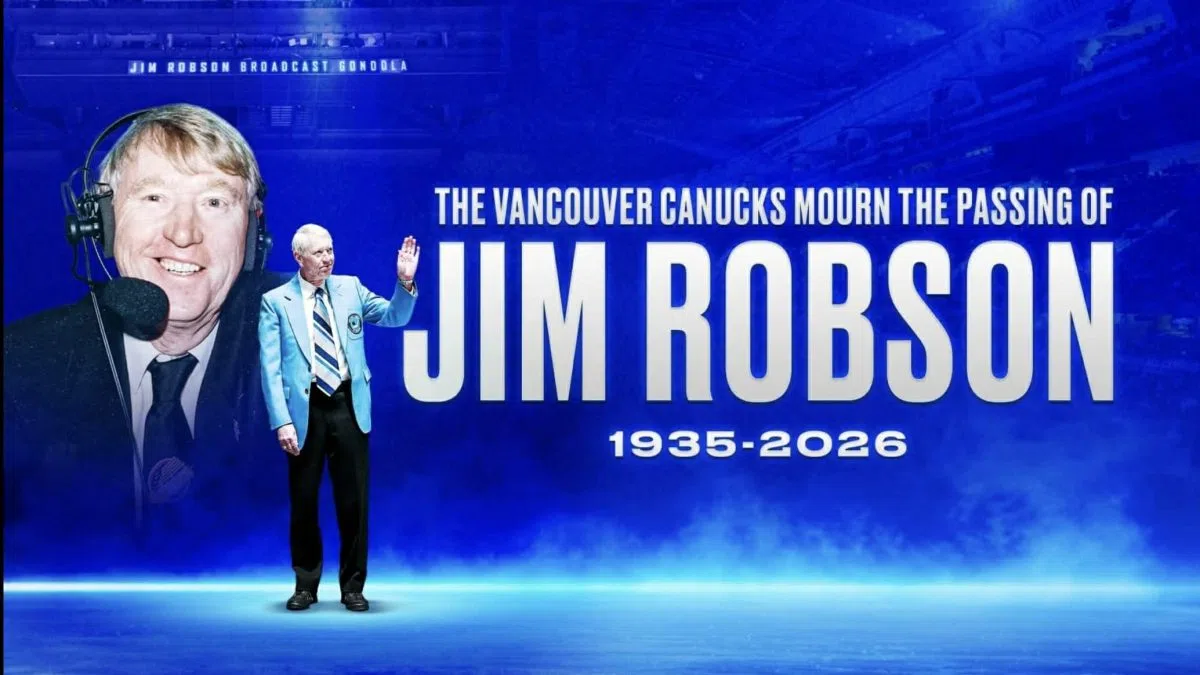
From there, Robson moved to Port Alberni, B.C. where he got his start calling senior men’s basketball at the age of 17. His early career saw him cover hockey, lacrosse, football, and baseball. Then came the year 1970, and the Vancouver Canucks entered the NHL.

That was where Robson went from a regional broadcaster to the voice of an entire province.
From 1970-1999, Robson was the voice of the Canucks on either radio, television, and simulcast on both for a portion of his career.
“He just wasn’t big for the city of Vancouver, he was big for the entire province of British Columbia,” said Rick Dhaliwal, who has been covering sports in B.C. since the mid 90s, and currently co-hosts The Donnie and Dhali show on CHEK radio in Victoria, and has been a lifelong fan of Robson’s.
“I got to take you back to the 1980s and the 70s, and the Canucks only had one game of the week on television, it was on Wednesdays. The rest of the Canucks schedule was on radio. It was Jim, my radio, my transistor radio, and my Walkman, and he was just like he was Vancouver’s Vin Scully. Not every city, but there are cities that have a Vin Scully type guy, and Jim was our Vin Scully.”
With a radio network that spanned over an entire province from Northern B.C. all the way down to Vancouver Island and everywhere else in between, the beginning of the Canucks history from 1970-99 was told by Jim Robson on the radio.
When it comes to what made Robson so great as a broadcaster, Dhaliwal credited it to a combination of excitement, genuine humility, and the ability to describe the play in perfect detail. Dhaliwal said that often as a kid, he would tape the games on the radio, and when the highlights came out the next day, he’d sync things up with Robson’s radio call to see just how vividly the picture Robson painted was.
“When Canucks got more and more TV games, what people in Vancouver would do is they would turn the TV down and just turn Jim’s play-by-play on the radio up. Nothing against the TV broadcasters who were doing Canucks games, but we just wanted to hear Jim. So we turned the TV down and we turned Jim up on the radio, and that’s how we watched the Canucks on TV.”
Robson never got to call that Stanley Cup win for the Canucks during his career, but he did get to follow his team to the finals in 1982 and1994 against the Islanders and Rangers respectively. During that 94 run, Robson called the game winner in double overtime that sent the Canucks to the cup finals, but it was game six of the 1994 Cup Finals where Robson had the call that defined his career.
In the final minutes of the game, Trevor Linden was highsticked and bloodied up, and then on his way back to the bench was hit to the ice by Mark Messier. As the seconds ticked down towards a 4-1 win for the Canucks to force game seven, and as Linden limped his way to the bench, Robson’s words echoed across Canada.
He’ll play, you know he’ll play. He’ll play on crutches. He will play, and he’ll play on Tuesday night at Madison Square Garden; the game is over!
Ironically, Robson’s most famous moment from his career was not on a Canucks broadcast. Back in the day, CBC would take the top three broadcasters who didn’t have a playoff run to attend to, and that would be their crew for the Stanley Cup Finals, and Robson got to call cup finals in 1975, 1980, 1982, and 1983. During game six of 1980 Cup Finals between the New York Islanders and the Philadelphia Flyers, it was Robson’s words that marked the start of the Islanders dynasty.
“The pass, right on the stick of Tonelli. Coming in with Nystrom, Tonelli to Nystrom, HE SCORES! Bob Nystrom scores the goal! The Islanders win the Stanley Cup!”
Away from the mic, Robson was as humble as they come. His signature way of welcoming people into the broadcast was always the same, ‘a special hello to all the hospital patients and shut-ins, those of you who can’t make it out to the game’.
In Dhaliwal’s case, Robson was his broadcasting hero growing up, so he was starstruck when his hero reached out to him after Dhaliwal’s first Vancouver Giants broadcast with advise.
“After I did the first for Giants game, he reached out. He was just the nicest, humblest guy you will ever meet. There’s a lot of ego in our business, but he had no ego. He was humble. He didn’t want to be recognized. He didn’t want people to say, ‘you’re the best of all time’, and people would call him a Hall of Famer and he’d say, ‘don’t call me a Hall of Famer’. He was just a humble, humble, nice human being.”
Dhaliwal added, “The greatest Canucks of all time are Pavel Bure, Trevor Linden, the Sedin twins, guys like that, but he’s right up there with those guys in terms of important people in the Vancouver Canucks organization as well.”
—
nick.nielsen@pattisonmedia.com