
Once the Olympic break ends and the Islanders begin their final 24-game push for a playoff spot, the data strongly suggests they must improve their ability to play in the offensive zone.
The Islanders, who will resume practice next week ahead of their first game back on Feb. 26 in Montreal, are not blind to the numbers. They just believe there’s a deeper analysis that accounts for why they are in a playoff position.
“As a team, I think we have a good system,” Jean-Gabriel Pageau told Newsday. “We find ways. We’re finding ways to score, right now, most of the nights, more goals than the other team. It’s good, obviously, to have the puck. But you can also play on the outside and not create anything. So I don’t see really anything in our system that we could change. I think we trust and we’re comfortable with what we are doing.”
The Islanders often create scoring chances off the rush rather than establishing a forecheck and a cycle, which would increase the time spent in the offensive zone.
The NHL average percentage for playing in the offensive zone is 41.1% and the Metropolitan Division-leading Hurricanes lead the league at 45.2%, according to NHL Edge. The Islanders rank 29th at 39.9.%
Yet the Islanders (32-21-5) went into the Olympic break having won five of seven and sit in third place in the Metropolitan Division. They are one point behind the second-place Penguins, who have played two fewer games, and four points ahead of the Blue Jackets, who also have played two fewer games, and the Capitals, who have played one more.
Their 169 goals scored ranks 21st in the NHL, but their goal differential of plus-seven is 13th.
Mathew Barzal leads the Islanders with an offensive zone faceoff percentage of 56.96% — indicating the percentage of faceoffs in the offensive zone for which he was on the ice. That ranks 78th in the NHL, according to NaturalStatTrick.com. Capitals linemates Alex Ovechkin (86.63%) and Dylan Strome (70.00%) are 1-2 in the league.
It’s another metric of offensive-zone possession in which the Islanders again pale analytically.
“There’s certain things you can take from advanced metrics,” Casey Cizikas said. “I think there’s an advantage where you can look at it from the defensive standpoint and be like, ‘All right, this is where we’re giving our chances up. This is where teams are getting the majority of chances against us. If we take care of this, it’s only going to lead to more offense and more offensive-zone time.’
“But at the end of the day, you have a feel for the game. Advanced metrics don’t come out until after the game. You can feel when momentum is on your side, when your guys are playing well, even if you’re not creating. You can feel the push. You can feel the energy on the bench. Sometimes [those statistics] don’t necessarily grab a hold of that.”
Percentage of shift starts in the offensive zone is another metric in which the Islanders lag. Again, Ovechkin (28.8%) and Strome (26.8%) lead the NHL, according to MoneyPuck.com.
Kyle Palmieri, who suffered a torn ACL in his left knee on Nov. 28 and was lost for the rest of the season, is the highest-ranked Islander in that category at No. 56 at 20.7%. He’s the only Islander above 20.0%. Jonathan Drouin is the next highest-ranked Islander; his 18.8% is 107th in the NHL.
“You can look at the analytics and stuff like that all you want,” Cal Ritchie said. “But when you actually watch the game and go through the shifts, you see the structure and how we are able to keep stuff to the outside in the defensive zone. And Barzy’s line is always in the offensive zone wheeling around and always has possession there.”
That’s the perception on the bench, even if the numbers don’t support the statement.
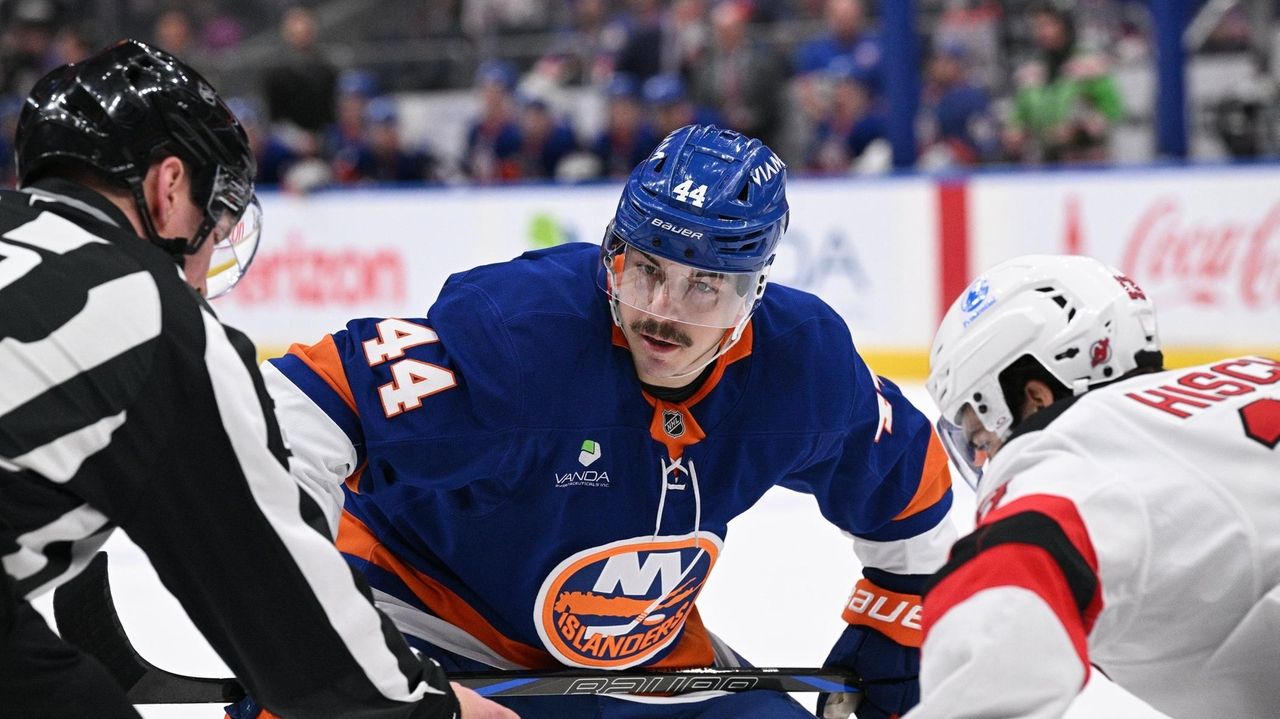
MoneyPuck.com ranks the Islanders 14th in the NHL in winning 50.6% of their faceoffs across the three zones, with the Maple Leafs first at 55.85%. But in Pageau, fifth overall at 60.4% (443-for-733), and Bo Horvat, 15th at 56.4% (444-for-788), the Islanders do have two of the league’s elite faceoff-takers.
That theoretically can help the Islanders improve their substandard offensive-zone time.
Pageau said taking draws in the offensive zone is “totally different” because the visiting player must place his stick down first.
“You can go down second,” Pageau said. “It’s different with different linesmen every night. Some make you stop a little longer than others. Some you can cheat a little more. Before every draw, I have one strategy, that I won’t say, but it doesn’t change from defensive zone, offensive zone, neutral zone.
“The offensive zone, you have a little bit of an advantage because you don’t have to stop as much. The other guy is mostly standing still waiting for you, so you have more momentum coming in.”

Andrew Gross joined Newsday in 2018 to cover the Islanders. He began reporting on the NHL in 2003 and has previously covered the Rangers and Devils. Other assignments have included the Jets, St. John’s and MLB.