
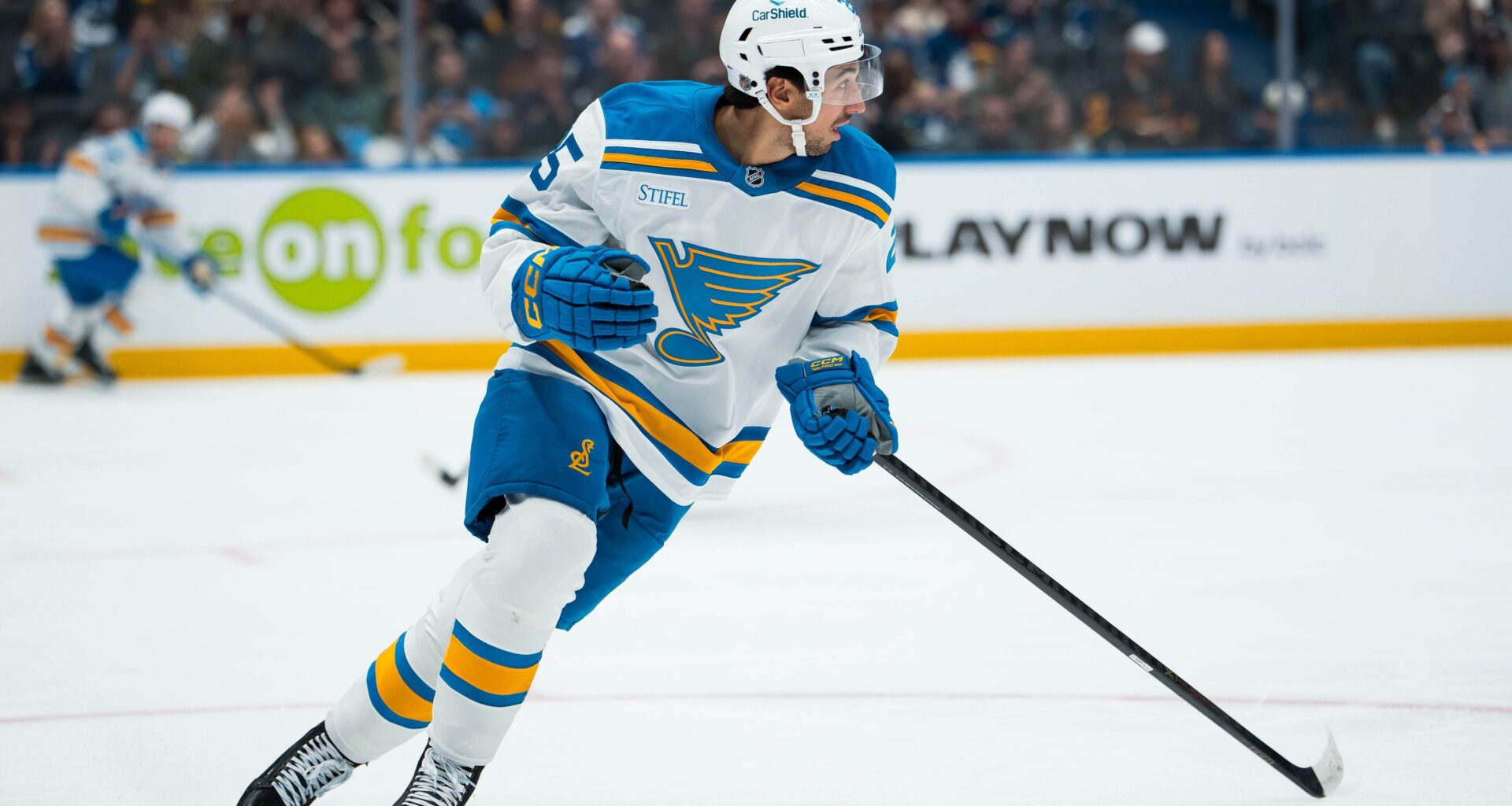
If the Minnesota Wild miss out on a true first-line center again, they cannot afford to simply “run it back” with the same forward group. In that scenario, aggressively pursuing a prime-age, top-six winger like Jordan Kyrou should move from a luxury option to an immediate priority.
Minnesota’s organizational problem is less about having no center depth and more about lacking a game-breaking forward who consistently tilts the ice. If they strike out on acquiring a legitimate No.1 center, the next-best way to inject high-end offense is to stack the wings on the top two lines and let a “good, not elite” center ride shotgun.
In practice, that means accepting that a true first-line pivot might not be available via trade or free agency at a reasonable cost, then reallocating assets toward an impact winger who can still drive a line. A player like Kyrou fits that philosophy because he brings elite speed, transition ability, and consistent goal-scoring that raises the ceiling for whichever center he plays with.
Jordan Kyrou is 27 years old, right in the heart of his statistical prime. The St. Louis Blues have signed him to an eight-year contract with an $8.125 million cap hit that runs through 2030-31. For a winger who has averaged a roughly 30-goal pace over the last four seasons, that price point is exactly the kind of committed AAV you accept if you believe your window is opening.
Minnesota’s core players, Boldy, Kaprizov, Faber, and Hughes – if he stays – are all in their late 20s, so adding another prime-age top-six forward would align their competitive arc rather than bringing in an aging stopgap. Instead of chasing older, short-term scorers, targeting Kyrou gives the Wild term, prime years, and cost certainty while the cap continues to rise.
Kyrou entered the league with a reputation as a speedy, playmaking forward who could play center or on the wing. However, he has settled primarily on the wing at the NHL level. His profile is exactly what Minnesota’s top six needs: an explosive skater, great in transition, with the hands to create off the rush and the touch to finish chances at a 30-goal pace. Because he can play on either of the top two lines, he gives the Wild badly needed lineup flexibility.
Adding Kyrou would allow the Wild to load up a first line with Kaprizov-Hartman-Kyrou to create a matchup nightmare, or it can balance the attack with Kyrou riding shotgun with Boldy on the second line to ensure teams can’t just focus their best checkers on a single unit. That kind of versatility matters even more when your center group is imperfect. The more your wingers can drive play, the less pressure there is on having a “true” No. 1 center.
Any Kyrou deal will be expensive, likely involving a first-round pick plus a premium young asset. He’s a proven scorer on a long-term deal, in his prime, and widely viewed as a top trade chip on a retooling Blues team. That price might feel uncomfortable. Still, it’s exactly the type of move teams make when they believe they are one high-end forward away from becoming a real threat, not just a fringe playoff team.
Suppose Minnesota fails to land a first-line center. Then, standing pat risks wasting more prime years of Kaprizov and Boldy with a forward group that can’t consistently trade punches with elite offenses.
Paying up for Kyrou pivots the plan. Instead of trying to fix everything in the middle, the Wild lean into overwhelming top-six talent, accept a committee approach at center, and trust that adding another dynamic, prime-age, top-line-caliber winger is the more realistic, attainable upgrade.
In that context, “plan B” stops looking like a consolation prize and becomes the smartest available path to unlocking the team’s ceiling.
Think you could write a story like this? Hockey Wilderness wants you to develop your voice, find an audience, and we’ll pay you to do it. Just fill out this form.