
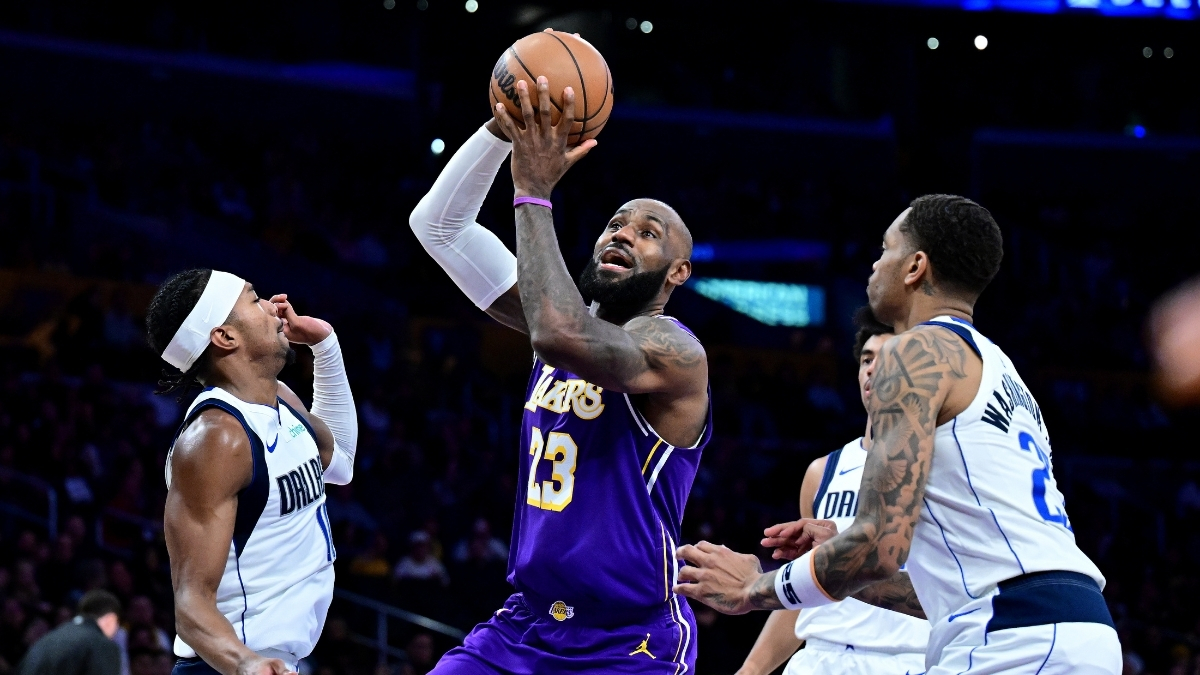
The Dallas Mavericks entered Thursday night short-handed, stretched thin by injuries and searching for something that has eluded them for weeks: traction. They left Crypto.com Arena with another loss and a steeper climb ahead in the Western Conference standings.
The Los Angeles Lakers defeated Dallas 124-104 in the final game before the All-Star break. The Mavericks fell to 19-35 overall and 5-19 on the road, extending their losing streak to nine games — their longest skid since a 15-game stretch from Dec. 6, 1997, through Jan. 6, 1998.
Los Angeles improved to 33-21 overall and 15-10 at home, strengthening its hold in the upper half of the conference.
Even without Cooper Flagg and Luka Dončić on the floor, the game remained competitive for a half before the Lakers seized control in the third quarter and widened the possession margin beyond Dallas’ reach.
The Mavericks were already operating without Kyrie Irving (knee), Dereck Lively II (right foot surgery), and Caleb Martin (ankle), further thinning a rotation that has struggled to stabilize. The injury list grew during the game when Naji Marshall exited with a left foot strain and Daniel Gafford left with right ankle soreness, leaving Dallas without two of its most physical contributors as the Lakers began to separate after halftime.
By the fourth quarter, the Mavericks were piecing together lineups that lacked their primary shot creator, starting center depth and multiple rotation wings — a combination that forced Dallas into smaller, offense-heavy units that struggled to secure defensive rebounds against a Lakers team that controlled the glass and capitalized on second-half execution.
Competitive First Half Fueled by Naji Marshall’s Aggression
Dallas opened with pace and purpose despite missing Flagg (left midfoot sprain), while Dončić missed his fourth straight game for the Lakers with a mild hamstring strain.
LeBron James immediately dictated tempo. He scored 14 points in the first quarter, repeatedly pushing in transition and attacking before the Mavericks’ defense could get organized. Los Angeles shot 56% in the opening period and built a 36-31 lead, briefly stretching its advantage into double figures behind early fast-break points and physical finishes inside.
But the Mavericks did not allow the game to fracture.
Naji Marshall sparked a stabilizing response with direct downhill pressure. He attacked closeouts, forced switches and collapsed the defense repeatedly. His rim attacks created either finishes or kick-out opportunities that helped Dallas reset its offensive rhythm.
Marshall scored 15 of his 19 points in the first half, converting through contact and anchoring a rally that erased most of the early deficit. Max Christie complemented him with perimeter shot-making, and P.J. Washington added efficiency at the free-throw line.
Dallas outscored Los Angeles 32-28 in the second quarter, holding the Lakers to fewer transition chances and forcing more half-court possessions. The Mavericks trailed just 64-63 at halftime — a one-possession game that reflected their ability to absorb the Lakers’ early push and respond with composure.
James acknowledged afterward that Dallas remained competitive despite missing its leading scorer.
“I think that was my only mindset was how can we go into the break on a high note,” James said. “Obviously, that team is, you don’t know what, no matter who’s out on the floor for them. They [are] well coached and they [are] gonna play hard. They did that for the majority of the game tonight, but [I] just tried to set the tone and end the first half of the season on a high note.”
At halftime, the margins were thin — but still manageable.
Game Gets Out of Hand for the Dallas Mavericks After Halftime
The balance shifted significantly after halftime. Los Angeles opened the third quarter with sharper defensive discipline and tighter shell rotations. The Lakers closed driving lanes more effectively and limited second-chance opportunities that Dallas had converted earlier.
The result was a 32-19 third-quarter advantage that turned a one-point halftime game into a 96-82 deficit entering the fourth.
Lakers coach JJ Redick said the halftime message centered on restoring defensive fundamentals that slipped during the competitive first half.
“Just challenge the guys to be better defensively,” Redick said. “The stuff we talked about before the game, partially just the individual pride on the ball, our low-man, our shell principles, they weren’t sharp in the first half. We went away from it, the zone, when [Klay] Thompson was on the floor. For the most part in the first half, did a nice job to start the third. 41 points in the second half, I thought we definitely picked it up defensively.”
The Mavericks’ margin for error narrowed further as the quarter progressed.
Marshall exited with a left foot strain, and Daniel Gafford left with right ankle soreness. Neither returned. Their absence removed Dallas’ most physical wing presence and its primary interior defender at the exact moment the Lakers were increasing pressure.
Mavericks coach Jason Kidd said the injuries compounded a third-quarter stretch where missed opportunities quickly turned into momentum swings.
“We had some good looks that just didn’t go down and they capitalized on that and had a big quarter in the third,” Kidd said. “Naji was playing at a high level and Gaff — he was helping us on both ends. For those two to go out, next man up. Unfortunately, those two couldn’t come back.”
From there, the possession battle widened significantly. Los Angeles won the rebounding margin 44-28. The Lakers generated 10 offensive rebounds and finished with 35 assists. Dallas committed 15 turnovers, which the Lakers converted into 20 points. Over the final 24 minutes, Los Angeles outscored Dallas 60-41.
The Mavericks shot 49% overall (39-79), but went just 7-of-26 from three-point range (27%). The Lakers shot 56% (48-86) and consistently created clean paint touches that collapsed Dallas’ defensive shape.
LeBron James Makes History While Controlling Tempo
James finished with 28 points, 10 rebounds, and 12 assists, recording his first triple-double of the season. At 41 years and 44 days old, he became the oldest player in NBA history to post a triple-double, surpassing Karl Malone’s previous mark.
He entered the fourth quarter with 22 points and 12 assists already logged. When he secured his 10th rebound with just over two minutes remaining, the game was firmly decided. Kidd, reflecting on the performance, emphasized both its statistical significance and the sustained excellence behind it.
“It’s pretty impressive,” Kidd said. “I think the stat that might be wrong, but he is leading the league in fast break points.
“He’s playing the game at a high level. At the age of 41 to put up a triple-double is really amazing. It just shows for someone that’s taking care of his body and mind up to this point he’s playing the game the right way at a high level.”
James framed the milestone in team terms, redirecting attention from the historical significance of the triple-double to the timing of the win. While becoming the oldest player in NBA history to record a triple-double adds another chapter to his résumé, he emphasized that the result — securing a victory heading into the All-Star break — carried greater importance.
“The win, that’s the most important,” James said. “And to be able to do it and get the win, that means more to me than anything. But [I’ve] been very blessed to play this game, play at a high level and was able to do it again tonight.”
Later, he acknowledged the perspective that comes with the later stage of his career — a vantage point shaped by longevity, durability and the awareness that milestones now carry different weight than they once did.
“I don’t know, I’m definitely, I guess, more appreciative of moments like this in my career,” James said. “Understanding where I’m at, at the later stage of my journey. So, [I’m] definitely taking it in a little bit more.”
Austin Reaves said the second-half separation flowed directly from James’ control of pace and rhythm — not just through scoring, but through possession management and decision-making.
“I think LeBron [James] just was being himself, controlling the game, doing what he does, and everybody kind of followed suit after that,” Reaves said. “Like you said, that’s a good win and now we get a week off, or some of us do, LeBron has to go play and Luka [Dončić] has to go play so good luck to them.”
The Lakers’ lead expanded to 22 points when Jaxson Hayes dunked to make it 122-100 with 1:49 remaining.
Rui Hachimura scored 21 points. Reaves added 18 points and six assists. Hayes contributed 16 points, seven rebounds and three steals.
Brandon Williams: “We Just Didn’t Match It”
Dallas received 19 points from Marshall before his exit, 19 from Christie and 18 from Washington. Brandon Williams added 17 points, five rebounds and seven assists, continuing to navigate expanded playmaking duties.
Williams said the defining stretch came down to competitive intensity — not necessarily scheme, but the urgency and physical edge that often determine games coming out of halftime.
“Ultimately they just picked up their intensity on both sides of the floor,” Williams said. “They were a little more aggressive on both sides of the floor and we just didn’t match it.”
That disparity showed up in multiple areas at once — contested rebounds, loose balls, early-clock drives and defensive rotations that were a half-step late. As Los Angeles increased its pressure, Dallas struggled to generate the same physical resistance or sustained defensive possessions. What had been a one-possession game at halftime quickly expanded into a double-digit deficit, and the Lakers never relinquished control.
For Williams, the third-quarter surge was less about adjustments on the whiteboard and more about competitive response — an area Dallas will need to sharpen when play resumes after the break.
He also acknowledged the ongoing challenge of cohesion amid injuries and rotation changes, noting that the Mavericks are still navigating shifting responsibilities and new combinations on the floor.
“Yeah, it’s good,” Williams said. “I mean, they fit into our system well. We’re still trying to figure it out while guys are gelling, and a lot of it’s on me and Tyus [Jones] as point guards just getting everybody on the same page. Both on and off the floor. I think that is something that people don’t really understand which is that off the court, we need to get to know each other and just hang out with each other.”
All-Star Break Comes at the Right Time for the Dallas Mavericks
The Mavericks now enter the All-Star break at 19-35 and 5-19 on the road, still searching for answers during a nine-game skid. They resume play Feb. 20 in Minnesota to begin a three-game road trip.
Kidd said the priority remains straightforward, even if the path toward it has not been. For a team that has spent much of the season adjusting lineups and redistributing responsibilities due to injuries, he emphasized that recovery — not schematic tweaks or rotation experiments — must come first.
“I think one, is we just have to get healthy,” Kidd said. “That’s just something that has been part of our DNA here for the last two years. It’s just a lot of injuries and hopefully we can come out of this break healthy and ready to go.”
Williams described the break as both physical restoration and mental reset, particularly for a team that has operated without consistency in its rotation for much of the season. With multiple starters sidelined and younger players absorbing expanded roles, he acknowledged that the schedule has required both physical endurance and emotional steadiness.
“I think first and foremost we need to just get healthy and just get away from basketball and do whatever a guy need to do,” Williams said. “Some of us need to actually get in the gym and work on our game. Ultimately, just a nice little mental re-charge and then come back ready to work.”
Christie echoed that view, framing the All-Star break as more than just a pause in the schedule. For a Mavericks team that has navigated injuries, lineup changes and an extended losing streak, he described the week as a necessary reset both physically and mentally.
“Obviously, we want to be as healthy as we possibly can,” Christie said. “We’re already more than halfway through the season here and going into the break. The goal for us is, obviously, to use this time to rest, relax, and take advantage of it. Obviously, it’s been quite the season with a little bit of injuries to start and a little bit of a rollercoaster to start. It’s good for us to, obviously, to get a physical break, but mentally as wel. Just to be able to kind of shut down and relax for a little bit. I’m looking to come back stronger, obviously, after the break.”
For Dallas, the break arrives not as celebration, but necessity — a pause to restore health, recalibrate rotations, and attempt to halt a skid that has now reached nine straight losses.
Latest Dallas Mavericks News & Trade Rumors