
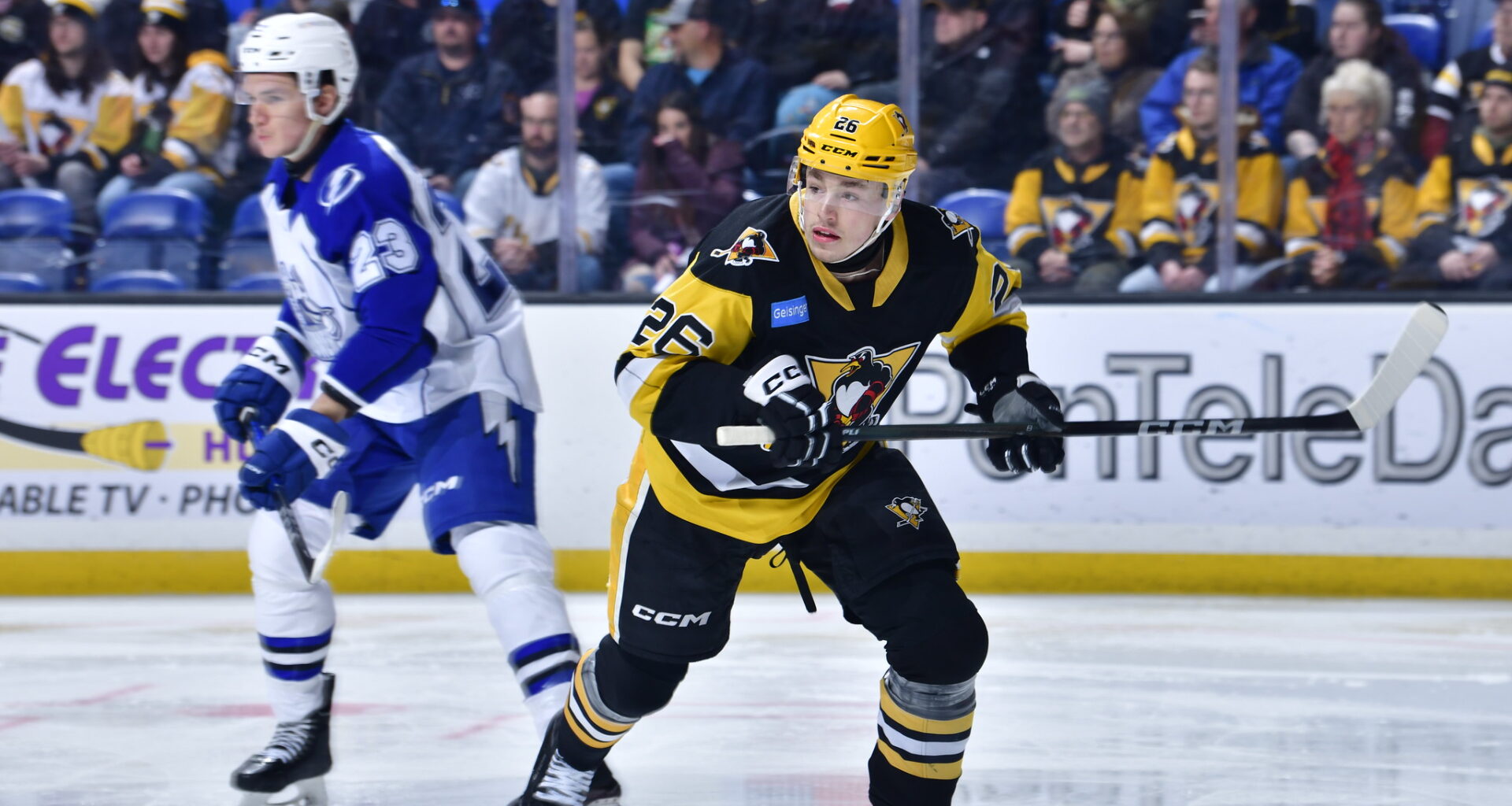
WILKES-BARRE, Pa. — The score of the Wilkes-Barre/Scranton Penguins’ 5-0 loss to the Syracuse Crunch was pretty well indicative of the game. The bad landed harder than the gastronomic delight of a double Chickie & Pete’s cheesesteak and extra-large fries from the corner concession stand at Mohegan Sun Arena.
“We don’t lose often, but when we do, whew, we make it an art form,” Wilkes-Barre/Scranton Penguins coach Kirk MacDonald said.
Pittsburgh Hockey Now did not make the trip to cover the game score, nor evaluate the team as a whole. No, the morning drive from Pittsburgh to Wilkes-Barre, which was accomplished, including a pit stop for gas, in merely three hours and 45 minutes, was about much more than the scoreboard.
This trip is about talking to a few of the Pittsburgh Penguins prospects currently stationed, or perhaps marooned in Wilkes-Barre, as well as getting a good look at the status of their games and the progress they’ve made since Penguins training camp began filling the AHL camp with cuts and assignments.
Or in the case of defenseman Matt Dumba, players who arrived here via begrudging waivers.
The WBS Penguins are in second place in the Atlantic Division, racing to 32-13-2-2 record and the fifth-best winning percentage in the AHL.
Yet as the WBS Penguins suffered through an absolutely muddy loss, which ended their five-game winning streak (sorry, the Kingerski-WBS curse is seemingly gaining strength like a spring storm in the Atlantic), a few thoughts about the overall team were unmistakable.
Even as the typically emotive MacDonald essentially dismissed the embarrassment with an incredulous laugh, the Penguins’ situation, as both the WBS Penguins and also the army of players fighting to be the next wave of Pittsburgh Penguins, showed several telling truths.
First, the Penguins organization has built a farm system with an organizational identity and an emotional buy-in to the team.
“Especially with the group we have in this locker room–obviously, we’re not going to win every game, but just losing one, it’s very salty for this group,” Imama said. “That’s just the standards that we have. And of course, I think tomorrow you guys will see a way better game.”
Interestingly, the WBS Penguins are a blue-collar team. They do not have sniping wingers, slick centers, or offensive defensemen. They have to fight for their space and their chances, and then they need a few more chances to light the lamp.
“We’re moving as one big pack, and this group of players is very tight. Guys love each other. We love working, coming to work, working hard, and having fun together,” said Boko Imama. “And I think it’s a talented group as well. If you go from our goalies, our defense, our forwards, even our coaches are pretty hungry. So I think we just have a mix of everything. So just better use that to an advantage and keep pushing.”
That’s the positive spin.
But the Penguins traded away or quick-strike wingers Philip Tomasino and Valtteri Puustinen. They also traded away center Sam Poulin.
There is an obvious lack of next-level offensive talent. And that opens up the discussion.
In the disjointed game that was just Wilkes-Barre’s 13th loss this season, a pair of fundamental roster construction issues that are also inexorably linked were readily apparent.
For context, Penguins president of hockey operations/GM Kyle Dubas has discussed in each of his last couple of season-ending press conferences the need for WBS to go on a playoff run, both for development and evaluation of players performing under pressure against higher quality opposition.
But the roster issues might again prove to be an impediment.
The Penguins organization has a dearth of centers at the professional level. The WBS top-line center is fittingly prospect Tristan Broz, who was in line to be the AHL All-Star MVP with five points until the league mistakenly denied the Atlantic Division team a spot in the ASG Final (not a joke). Yet there is a significant drop off to second-line center, the undrafted Gabe Klaussen.
With full respect to Klaussen, 22, who spent his first professional season almost exclusively with the Wheeling Nailers of the ECHL before earning a promotion this season, he’s not yet an NHL prospect.
Saturday, the Penguins badly needed more offensive push. They needed someone, anyone, to create a few offensive chances.
Klaussen has a respectable 22 points (12-10-22) in 39 games between NHL-quality wingers, including Rutger McGroarty and Avery Hayes. But for development purposes of the wingers, WBS general manager Jason Spezza needs a Help Wanted sign for his crop of pivots.
In fairness, 2025 first-round pick Bill Zonnon is currently performing well for his QMJHL junior team, the first-place Blainville-Boisbriand Armada. He could be the center the Penguins’ farm team needs next season, but that’s unlikely little help to this season.
In addition to a lack of centers for the depth of quality wingers, the Penguins also lack high-end skill. Maybe Zonnon or the University of Michigan’s Will Horcoff becomes that net-filling offensive weapon next season.
The issue is the here and now.
It was one loss in an otherwise great season, and there can be no aspersions on the quality and chemistry of the team, but the shortcomings strike at the larger picture of the status and progress of the Pittsburgh Penguins’ rebuild.
Sunday, Pittsburgh Hockey Now will have more from our conversations with prospects Owen Pickering and Tanner Howe, and hopefully a lot more to analyze from the game, too.
“We’ll win tomorrow, and the boys will feel better,” said Imama.
Tags: Pittsburgh Penguins Tristan broz wbs penguins
Categorized:Penguins Prospects