
The Athletic has live coverage of Canada vs. Switzerland in the 2026 Olympic women’s hockey semifinals.
Few saw Slovakia as the breakout team of the 2026 Olympic men’s hockey tournament. Most of us pegged the Czech Republic, also known as Czechia, as the surprise. But after being upset by Switzerland on Sunday morning, the Czechs’ road to the podium is extremely difficult, with Canada waiting in the quarterfinal if they can get past Denmark on Tuesday.
Instead, it’s Slovakia playing disruptor at the Games. It started with an electric 4-1 win over Finland and continued with a pesky late goal against Sweden to clinch a spot in the quarterfinal. Now this team’s chances of reaching the semis have spiked from eight percent at the start of the tournament to 47 percent.
There was a strong relationship between Dom Luszczyszyn’s pre-game expected goals and Dimitri Filipovic’s scoring chance tracking in the preliminary round. Based on that, Luszczyszyn figured out what the ‘expected scoring chances’ were for each game, to help spot which teams played better than expected. Slovakia is one of the few teams that have exceeded expectations on both ends. Having Italy as a Game 2 opponent plays into that, since Slovakia generated 24 slot shots and only gave up eight. Still, that was far from their only impressive showing so far.
A few players are driving Slovakia’s success. Along with his clutch goal against Sweden, Dalibor Dvorský has been a spark and created some quality looks in transition. Simon Nemec’s 14 scoring chance contributions (through two tracked games) are a standout not just among defensemen, but all skaters in the tournament. Five of those 14 came against a tougher defensive opponent in Sweden. While Nemec is still pretty raw and has his lapses (like getting walked by Lucas Raymond for the 5-2 goal), he has shown a lot of promise in a meaningful role.
But the story for Slovakia is Juraj Slafkovský, who continues to dominate on the international stage. His seven goals in seven games back in 2022 raised his draft stock up to the No. 1 pick. Four years later, after leveling up to true difference-maker status in the NHL, he is the backbone of this team with 11 slot shots (second only to Leon Draisaitl’s 12) and six points in three games.
Switzerland exceeding expectations
One other team pushing the boundaries above expectations? Switzerland.
On the men’s side, Switzerland has led the way with 11.7 scoring chances above expected. Losing a needle-mover like Kevin Fiala was a major blow, but this team has taken a by-committee approach to this point. Roman Josi is the driver from the back end, while players like Timo Meier and Nico Hischier are doing damage from the slot. Supporting players like Pius Suter and Sven Andrighetto have stepped up, too. And then there’s Leonardo Genoni’s .949 save percentage through two games; granted, his one night off was when Switzerland had to take on Canada.

Chart by Dom Luszczyszyn
While the men’s 3-2 overtime win against Czechia was an upset, the women had an even slimmer chance (30 percent) against Finland in the quarterfinal. Andrea Brändli was the difference for Switzerland, with an impressive 40-save shutout that included eight key saves from between the dots and clutch stops against rising Finnish star Nelli Laitinen. Alina Müller’s game-winning goal was her 27th Olympic point (eighth all-time) and her 15th goal, which is only three back from Marie-Philip Poulin’s record.
Sweden’s goalie woes
Goaltending can make or break a team’s chances, especially in a fast-paced tournament setting.
That made it a major discussion point for some favorites heading into the men’s tournament. Jordan Binnington’s status as Canada’s presumed starter despite ranking dead last in goals saved above expected for this NHL season drove the conversation. Connor Hellebuyck’s recent trends and play in high-pressure situations, and the USA’s deep crease, also took up a lot of air space.
Meanwhile, Sweden’s goalie situation went pretty under the radar, because the focus wasn’t on how their trio could crater its chances of medaling — it was how key injuries to Leo Carlsson and Jonas Brodin would strain this group.
But now their goalies are front and center heading into the elimination rounds.
After a shaky start against Italy and seriously struggling against Finland, Filip Gustavsson has a .889 save percentage and minus-0.76 goals saved above average (GSAA) through two games. As strong as he was for the Minnesota Wild in the first half of the season, his play in the month leading into the Games dipped. Gustavsson only earned two quality starts in his last nine appearances, and that level put Sweden in a tight spot heading into Saturday’s matchup against Slovakia.
Jacob Markström took over the net for that crucial game, and it proved costly. He lucked out in the first period when Adam Ruzicka’s shot trickled past him but ultimately didn’t cross the line. But the real dagger was Slovakia’s third goal in the final minute of regulation — that mistake erased the goal difference that was the standing tiebreaker, earning Slovakia a bye in the playoff round and putting Sweden into the qualifiers and on a collision course for a matchup against Team USA in the quarterfinal. Sweden’s odds of reaching the semifinals have subsequently dropped by a dramatic 40 percent since the start of the tournament.
Forsberg’s usage
Since the goaltending has been less than stellar for Sweden, the team needs to outscore its problems. The ice time distribution just doesn’t quite reflect that logic, considering how little Filip Forsberg has played.
Forsberg only saw 1:07 minutes of action as the 13th forward against Italy in Game 1. He played more in Game 2, but was still limited to less than 10 minutes. Those deployment decisions were glaring as Sweden struggled to convert on its chances through the two games, considering Forsberg is on track for 35 goals through 57 games with the Nashville Predators this year and his scoring pace is second only to William Nylander on Team Sweden.
While Forsberg still didn’t play much on Saturday (11:45, to be exact), moving him into a top-nine role at least gave him actual reps and a chance to make an impact. He led the way with 10 scoring chance contributions, according to Filipovic’s tracking. In theory, that should lead to a more meaningful role as the stakes rise.
Poulin’s importance
It’s never easy losing a player in an Olympic tournament without a pool of replacements at the ready. It’s even worse when a team loses one of the greatest players of all time.
With her elite offensive skill, defense, all-situations deployment, leadership and clutch play, Marie-Philip Poulin is her team’s backbone. And Canada looked absolutely lost without her against Team USA in a 5-0 rout.
That game was the second half of a back-to-back, so Canada really didn’t have a chance to practice and restructure the lines without Poulin before matching up against their toughest opponent yet. Still, some questionable decisions — like over-deploying Blayre Turnbull instead of leaning on Sarah Fillier and an up-and-coming fourth line, proved costly.
Two things have changed since then: Canada rebalanced its lines more successfully, and Poulin returned (in a limited role). That puts this team in a better position if another meeting with the USA is on the horizon in the gold medal game. But is it enough?
Canada can never be fully counted out, especially with Poulin in the lineup. Still, this team has been outscored by Team USA 29-7 between that preliminary game and the Rivalry Series. Players like Jocelyne Larocque have been exposed in the process, as has Canada’s unwillingness to lean on its fourth line. So this aging core has to prove they have the juice to take out USA’s up-and-comers.
Team USA’s young guns leading the way
Speaking of those up-and-comers…
As much as Hilary Knight making history is a story for Team USA, the young guns are stealing the spotlight. Hannah Bilka and Abbey Murphy are a dangerous combination on Team USA’s second line. Laila Edwards’ versatility and bomb of a shot have been a threat from the blue line. Caroline Harvey, after playing a very limited role back in 2022 (with less than 9 minutes per game in the prelims and only 1:02 minutes in the gold medal game), is showing that she is one of the most dynamic defenders in the world. Joy Dunne, Tessa Janecke and Kirsten Simms, among others, have added a much-needed spark, too.
Team USA’s skill, speed, and energy have been noticeably different from the silver-medal-winning squad in 2022. And that was clear, even against an opponent as deep as Canada in that 5-0 win. Team USA was stingy at the blue line, disruptive in the neutral zone and played with a lot of pace to generate rush chances and win puck battles.
Before getting to the gold medal game, the USA still has Sweden in its path (a team that deserves a lot of credit for upsetting Czechia to get to this point). But the game plan is there to advance and take home gold this time around.
USA’s 4 Nations glow-ups
Jack Hughes wilted at the 4 Nations Face-Off last February. He was a mismatch on the wing, where he generally hasn’t been his most effective, and that, paired with some health concerns, raised questions about his potential impact level. Through three games at the Olympics, his creativity and puck-moving have been a difference-maker from the wing. While the USA has over-relied on playing a chip-and-chase game, Hughes has been one of the more effective puck carriers.
Hughes’ game has paired well with Brock Nelson already; in Game 1 against Latvia, he set up two inner-slot goals with his primary passing. Nelson’s 4 Nations performance was forgettable at best, and that raised similar questions as Hughes on whether he should have been named to Team USA this time around. His goal scoring and shutdown play in Colorado earned him a utility role, and he is proving management right so far.
But maybe the player with the most to prove was Auston Matthews. Team USA’s captain only earned two points on his team’s 11 combined goals against Latvia and Denmark. But his efforts stemmed deeper than the scoresheet — through two games, he had eight scoring chance contributions, which trailed only Jack Eichel. On Sunday, it all came together in a two-goal, three-point performance where he generated four scoring chances and set up another three.
Canada’s MVP line
No one can hold a candle to Canada’s star power on the men’s side, especially when Macklin Celebrini, Connor McDavid and Nathan MacKinnon are on the ice together. It’s a combination of three offensive forces, who are all front-runners in this year’s Hart Trophy conversation.
When Jon Cooper puts this combination together, magic happens — whether it’s Celebrini’s one-timer set up by MacKinnon against Switzerland, or a drawn penalty shot that gave Canada a 5-1 lead over France.
The risk of keeping these three together is that Canada’s lineup gets a little too top-heavy. The reward is that it brings out the best version of each of these players in their minutes together. The MacKinnon-Nick Suzuki combination hasn’t been as effective as hoped, and Tom Wilson isn’t standing out enough with Celebrini and McDavid, either.
The coaches could make other tweaks, whether it’s moving someone like Seth Jarvis or Sam Reinhart up, or working Brad Marchand into one of those combinations to limit any potential weak links. But with Mitch Marner, Sidney Crosby and Mark Stone absolutely thriving on the ‘third’ line (with a 15-5 shot advantage and 88 percent xG through two games), Canada may have enough top-six balance to load up those three as they advance.
Quick odds and ends
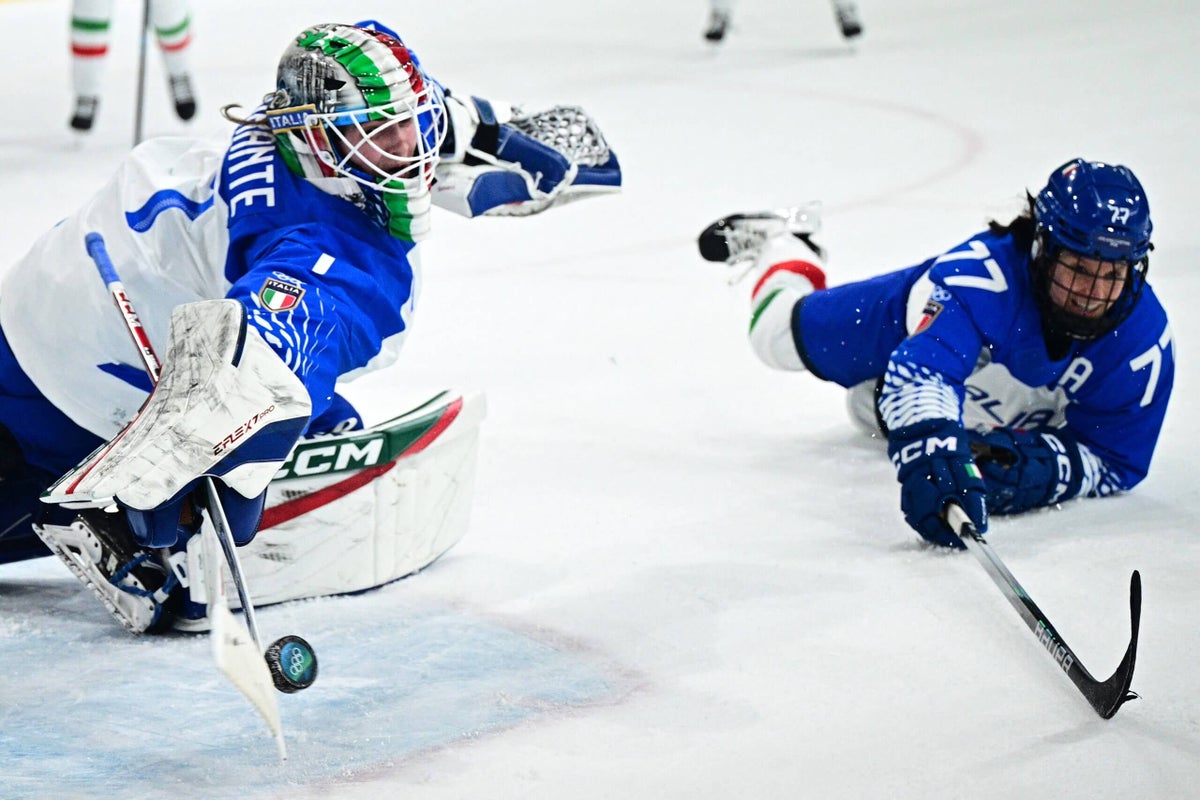
• Italian goalie Gabriella Durante was phenomenal in an impossible situation in Italy’s quarterfinal loss to Team USA. She made 19 saves in the first period alone, including a ridiculous stick save against Murphy. She ended the night with 45 saves against an absolutely stacked Team USA in a 6-0 loss. Damian Clara deserves a lot of hype for his play between the pipes for Italy, as well; the home team was much more exciting than expected. He is tied for a tournament-high 85 saves with Samuel Hlavaj of Slovakia.
• Monday’s women’s quarterfinal between USA and Sweden will feature the two best goalies in terms of save percentage in the tournament: Aerin Frankel, who is rocking a .978 save percentage (and has only given up one goal against), and Ebba Svensson Traff, who has turned aside 82 of 84 shots for a .976 save percentage.
• Juuse Saros leads the men’s tournament with 2.91 GSAA. Finland hasn’t rotated its goalies like most other teams, so two days off gives him a chance to rest ahead of Wednesday’s quarterfinal.
• Per Filipovic’s tracking, Leon Draisaitl generated 17 scoring chances and set up another 13 in three games for Team Germany in the preliminary round.
• David Pastrnak and Marty Necas have been so dynamic together for Czechia, combining for 18 slot shots in three games.
• Only two men’s players have crossed the 10-minute threshold in penalty minutes in the prelims: Pierre Crinon (33) and Tom Wilson (27), who fought each other in Canada’s 10-2 rout of France on Sunday.
Data via Dom Luszczyszyn, Dimitri Filipovic and HockeyStats.com