
The Athletic has live coverage of the 2026 Winter Olympics.
As a teenager, Mats Zuccarello travelled from his native Norway to Sweden for a hockey tournament. He stopped in a video store, where he found a VHS tape with highlights from the Colorado Avalanche’s 2001 Stanley Cup run.
“I watched it probably 400 times,” said the 38-year-old Minnesota Wild forward, who has played 942 NHL games — more than 700 more than his next-closest countryman.
It’s fitting that Norway’s greatest hockey player found one of his biggest sources of inspiration while away from home.
Norway and Sweden border each other for more than 1,000 miles, together forming the Scandinavian peninsula. The northeastern part of Norway curls around Sweden and borders Finland, too. All three are Nordic countries with populations above 5 million and strong winter sport pedigrees — Norway most of all. Though its population is only 5.6 million people, it is a Winter Olympic behemoth, sitting atop the medal table as of Monday:
(Note: This chart updates in real time, so rankings may change.)
Norway also finished first in 2022, 10 medals ahead of Germany, a country with nearly 15 times as many people.
Yet in ice hockey, a quintessential winter sport and one at which Finland and Sweden excel, the Norwegians lag. Only three Norwegian players — Zuccarello, the Tampa Bay Lightning’s Emil Lilleberg and Detroit Red Wings prospect Michael Brandsegg-Nygård — have appeared in NHL games this season, compared to 95 Swedes and 46 Finns. Norway failed to qualify for both the men’s and women’s Winter Olympics hockey tournaments, which Petter Salsten, the general secretary of the Norwegian Ice Hockey Association, called “a sad thing.” The hockey association could have used a big international appearance to promote the sport to younger players.
According to the IIHF, the Finnish and Swedish hockey federations both have at least 65,000 registered players. Norway, meanwhile, has 14,742 licensed players, per its ice hockey association’s most recent numbers. Soccer, handball and skiing are all more popular.
“It’s a small sport back home,” Zuccarello said.
From an outside lens, Norway’s lack of hockey success doesn’t make much sense, especially considering its status in other winter sports. It’s in a region with excellent hockey nearby. Sweden has a larger population, but Finland doesn’t. What’s stopping Norway from having a larger hockey presence?
Explanations go back decades. The reasons usually are cultural — success in other sports has led to their popularity rising in Norway — and economic. Geography is another factor: Norway is more mountainous than Sweden and Finland, which is conducive to skiing, a sport it dominates.
“In Norway, we have a lot of role models, but (they are in) a lot of other sports: cross-country skiing and stuff like that,” said the 60-year-old Salsten, who represented Norway three times in Olympic hockey. “We have maybe a tougher competition in recruiting the athletes.”
Perhaps the easiest way to see it all manifest is the country’s lack of rinks. Norway has 54 indoor rinks, per its hockey association. There are more rinks within 100 kilometers (about 62 miles) of Stockholm than in the entirety of Norway. Sweden and Finland both have at least 300 indoor rinks, per the IIHF.
By the numbers
CountryPop.Registered playersRinksNHLers
Norway
5.652 million
14,742
54
3
Sweden
10.688 million
76,841
366
95
Finland
5.627 million
66,078
300
46
(Sources: IIHF and country federations)
Zuccarello blamed the Norwegian government for the lack of rinks, calling it “poor management” in an April interview with The Athletic. Most of Norway’s rinks are in the southern part of the country, many centered around Oslo, the capital. Elsewhere, rinks are far more sparse — especially in the north — which Zuccarello believes leads to the country losing out on players.
Rinks are costly not only to build but also to maintain. Norway has added only seven new rinks in the past 10 years, per its ice hockey association.
The rink disparity’s roots go back to well before the countries’ current allocation of resources. The Swedish hockey federation was founded in 1912, more than two decades before Norway founded its own in 1934. Sports pedagogy professor Josef Fahlén, who works at Umeå University in Sweden, said that Sweden’s milling and mining companies supported hockey’s growth dating back to at least the 1930s. The country’s government also invested in the construction of sports facilities to create jobs before World War II, according to Fahlén.
Germany occupied Norway during World War II, which affected the country’s economy and likely influenced some of the decisions it made in the war’s aftermath.
“They had to focus on rebuilding their country while we in Sweden could focus on less-pressing issues and could perhaps thereby afford to invest in something as mundane as sports facilities,” Fahlén said.
In Norway, hockey also had to contend with other popular winter sports, including skiing, for people’s interests. In a 2025 article published in the journal “Sport in Society,” Christian Tolstrup Jensen wrote that in the pre-war period, hockey was limited to only the areas around Oslo and Trondheim. Meanwhile, Sweden and Finland had clubs in cities across their countries.
Both nations got a head start on Norway in terms of infrastructure and cultural relevance. That growth continued in the decades after World War II. Norway, meanwhile, invested more in other sports facilities.
“Of course it is a choice, but it also is a reflection of what’s already there,” said Ørnulf Seippel, a sociology of sport professor at the Norwegian School of Sport Sciences.
Norwegian hockey participation grew in the 1970s when “shorter work hours and an increase in welfare made the number of members and facilities boom,” according to Jensen’s research. It was too little too late for Norway to compete with its neighbors: Swedish and Finnish hockey was already more established at that point.
Now, Norwegian hockey is much more comparable to that of Denmark, its southern neighbor across the North Sea. The Danes, though, have more recent momentum, at least on the men’s side. Denmark beat Norway in 2024 to qualify for the 2026 Olympics. The game still rankles Brandsegg-Nygård, who said he remembers the 4-1 loss “as if it was yesterday.” The next summer, Denmark upset Sidney Crosby and the Canadians at the 2025 World Championships. At this year’s Olympics, the Danes went 1-2 in group play, beating Latvia 4-2. If they beat the Czech Republic on Tuesday, they’ll advance to the quarterfinals, where No. 1 Canada awaits.
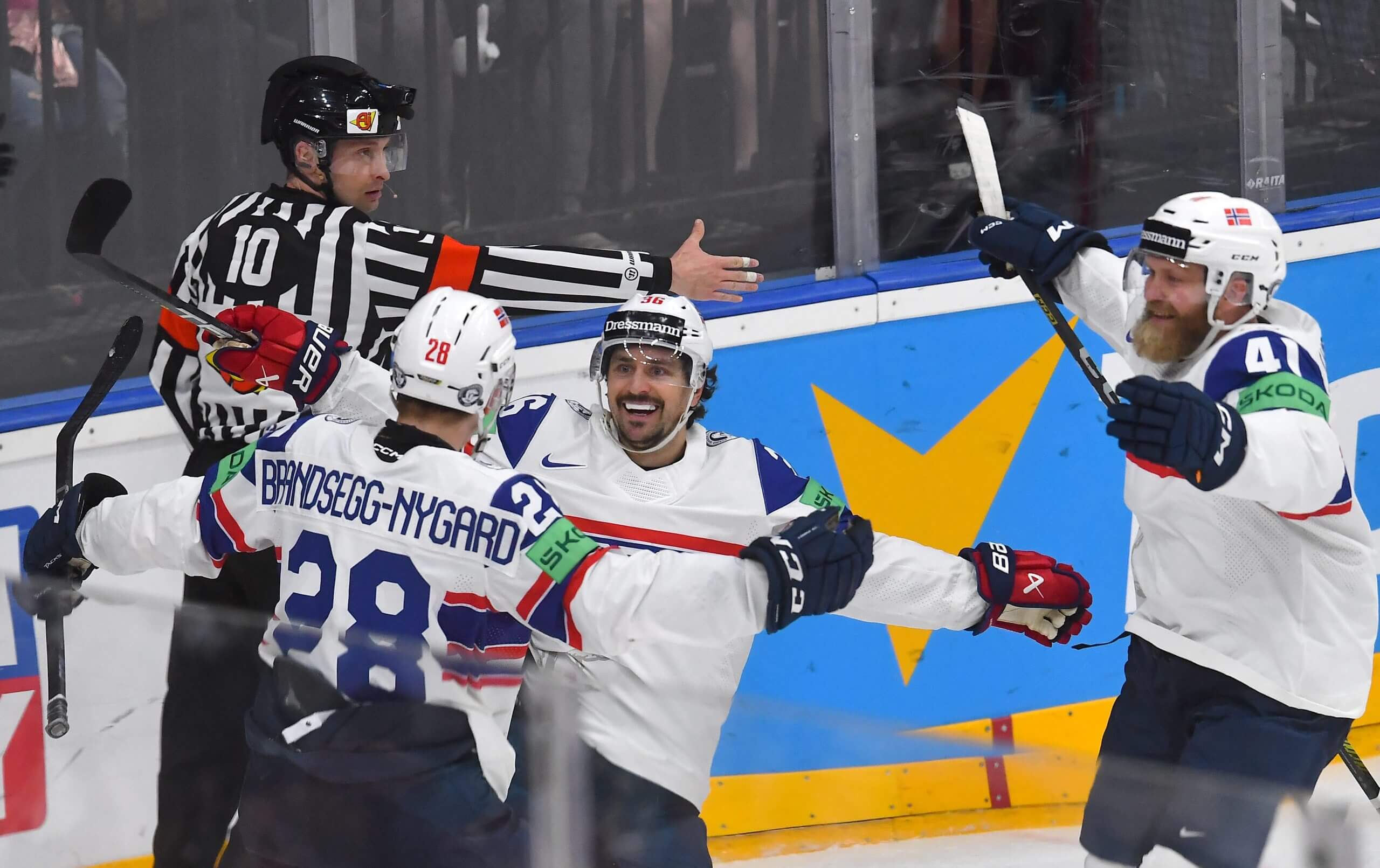
Norway’s Michael Brandsegg-Nygard, left, and Mats Zuccarello, center, celebrate after scoring in the 2024 World Championships against Denmark in Prague. (Michal Cizek / AFP via Getty Images)
The Norwegians still have reasons for optimism. Salsten said Norway’s number of total hockey participants is higher than ever, and he views being a team that can compete for quarterfinal berths at international tournaments, much like Denmark, as a realistic goal. He’s also encouraged by the country’s growth in women’s hockey. The women qualified for the top division of the World Championships in 2025 for the first time since 1997. (Norway was relegated back to the Division I World Championships for 2026.) Salsten views the women’s hockey ladder as potentially easier to climb than the men’s.
“Aside from Hockey Canada and USA Hockey, I think it’s reachable in the next five, six, seven years to do something there,” he said.
On the men’s side, Zuccarello takes pride in his country’s 19-year streak of appearing at the World Championships, and two Norwegians — Brandsegg-Nygård (Detroit) and Stian Solberg (Anaheim) — were drafted in the first round of the 2024 NHL Draft. Toronto drafted another Norwegian, Tinus Luc Koblar, in the second round in 2025.
“Hopefully, younger kids back home can look at that and see they can be good even though you’re from Norway,” Brandsegg-Nygård said.
Brandsegg-Nygård said the average Norwegian person knows only about one hockey player: Zuccarello. With some of the young players emerging, perhaps that can change in the coming years, even if Norway never has as many stars as other hockey hotbeds.
“We’re not in a position to challenge the big neighbors here in Nordic countries like Sweden and Finland, but we know our spot in the hierarchy in a way,” Salsten said. “We’re moving forward all the time.”