
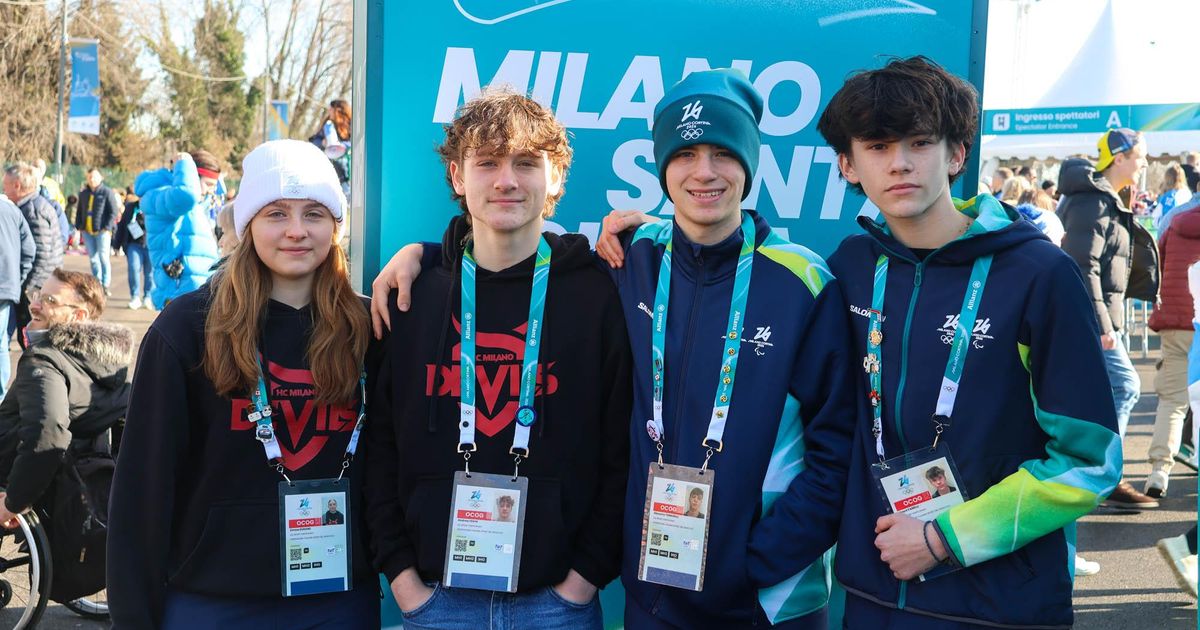
Watching Olympic hockey games on TV at home entails three commercial breaks every period. In Milan, during these commercial breaks, 12 skaters clad in the blue and green uniforms of Olympic volunteers take to the ice with plows reaching out in front of them. They skate laps around the rink, scraping the ice to push away excess snow, loose shaved ice and clean the surface before play resumes.
These young skaters are members of the Milano Devils, the only hockey club recognized by the Federation Internationale Cinema Television Sportifs in Milan, Italy. Of the 120 players in the Milano Devils, 47 were selected to be ice boys and girls for the Milano Cortina 2026 Winter Olympics, after the federation reached out to the club for volunteers.
For these 47 hockey players, getting to skate on Olympic ice and watch their favorite players compete at the highest level is a once-in-a-lifetime opportunity.
“You’re seeing the best players in the entire world, so close. And for days on end, it’s fantastic,” Giacomo Tomaselli, a 15-year-old player and volunteer, said.
A mom of a player on the team, Elissa Fesyk, has been going to the Olympics since she was 18 years old, and her husband works on the organizing committee for the Olympics. The Fesyks are an Olympic family through and through.
“What the Olympics does is it brings the world together to celebrate sport, and that’s something that’s a really important value for my family,” Fesyk said.
Naturally, Fesyk was thrilled when she learned that her 15-year-old son, Andrew Fesyk, would get to volunteer as an ice boy at the Olympics.
Andrew Fesyk started truly caring about hockey after he watched Connor McDavid get drafted in 2015. He’s grown up watching the legend score goals on a TV screen. Now, he’s skating on the same ice as him.
For him, it’s a life-changing moment. For his mom, it’s an emotional experience.
“For him to have this experience at such a young age and get to have this role on such a grand scale and make a difference for the players on the ice and everything else,” Fesyk said, through tears. “It’s emotional. Yeah, it’s really amazing.”
Susan Fanelli, another mother of a player and volunteer, also thought that this experience was great for her son. She hoped that he would take it all in, despite how chaotic the volunteering sessions can be. Specifically, she was hopeful that her son would gain some professionalism and techniques that he could apply to his own hockey game.
The educational aspect of the opportunity seems to be rubbing off on Grant Fanelli, her son.
“Seeing those players up so close, so aggressive and so fast has definitely inspired me to skate a little harder on the ice every time I go out,” Grant Fanelli said.
While being Olympic volunteers is an incredible opportunity for these young hockey players, it isn’t easy work.
Depending on the schedule, the skaters work up to 3 games a day, with the first game starting at 12:10 p.m. and the last starting at 9:10 p.m. They arrive at the stadium an hour before the first game.
Volunteer responsibilities include collecting pucks after warmups and clearing snow off the rink during the game. Skating 6 laps every time they are on the ice and cleaning the snow three times each period amounts to 54 laps of hard skating per game.
“We are asking them a very big effort, but they are giving us something, and they are having a lot of fun,” Gabriele Fumagalli, the general manager of the Milano Devils and a sport function manager for the Olympics, said.
While skating with their heroes is exciting enough, the young players have found fun in other places during their volunteering experience as well. In brief moments of free time between games, they enjoy trading pins with spectators and other volunteers, or simply taking a moment to relax and reset their minds before they are back on the ice.
More than being fun and meaningful for current players in the club, Fumagalli is hopeful that the Olympics will highlight winter sports and result in the growth of hockey, specifically in Milan. For him, the goal of this experience is to motivate his players and excite the surrounding community about hockey.
Currently, in Milan, there are almost no options to watch live hockey, and very few opportunities to play it. Grant Fanelli said he hadn’t watched a professional hockey game in person since he moved to Milan.
With the Olympics in town, not only do the Milano Devils get to watch hockey and see some of their idols in action, but it also draws the larger crowd of Italian fans, and places hockey on their radar. Fumagalli enjoys seeing Italians gather to watch hockey and appreciate the sport. He is optimistic that the Olympic buzz around hockey will carry forward after the closing ceremony.
“I think that a lot of families, a lot of kids, they can be interested after these Olympic games,” Fumagalli said.