
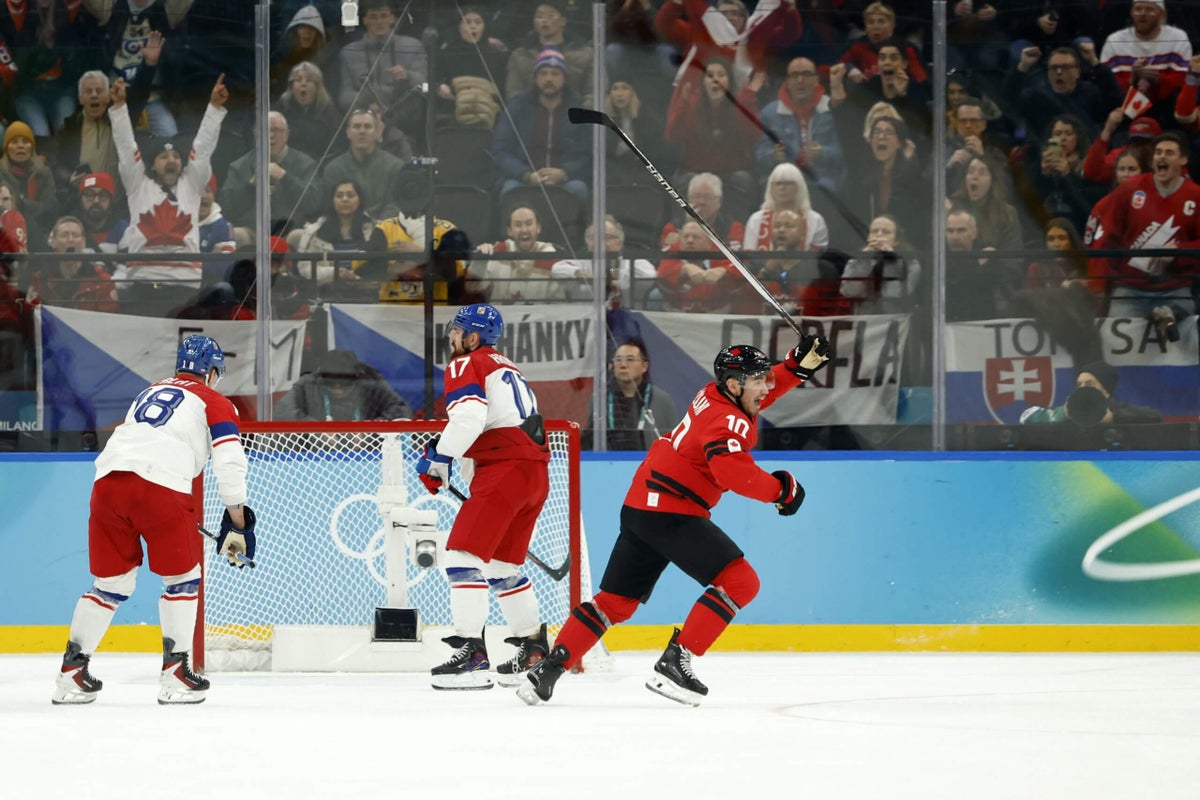
MILAN — When Nick Suzuki jumped over the boards with 4:34 to play in regulation with Team Canada down 3-2 to the Czech Republic, he did so with a heavy mind, a sense of responsibility for the predicament Canada found itself in: a potentially imminent elimination from the Olympics.
Suzuki missed an open net in the second period with the game tied 2-2. He was also on the ice and in pursuit of Martin Nečas when Ondrej Palat took a drop pass and gave the Czechs a 3-2 lead with a little less than eight minutes left in the third period.
Of the two, Suzuki was more upset with himself on the goal against — one where the Czechs had six skaters on the ice for a long time, and where Palat was the sixth player to enter the defensive zone — than he was for missing the open net, saying he would have liked to better anticipate the drop pass to Palat as opposed to having his stick in the lane to prevent a pass to David Pastrňák on the weak side.
All of this was on his mind when he jumped on the ice, playing between Mark Stone and Mitch Marner as a replacement for captain Sidney Crosby, with less than five minutes left in regulation.
“After that,” Suzuki said, “I knew I had to step up and do something.”
The shift was not amounting to much when, with 3:39 left — or 55 seconds into his shift — Suzuki hit the red line with the puck as Stone and Marner headed to the bench.
When Suzuki was younger, when he first started working with Montreal Canadiens coach Martin St. Louis, he would regularly extend shifts to try for one more offensive opportunity. It took some time and persistence from St. Louis to get Suzuki and his regular linemate Cole Caufield to stop doing that and instead just put the puck deep and get off the ice when it was time for a change.
But when Suzuki hit that red line, he knew Stone and Marner were already close enough to the Canada bench to get the change in safely, and so he remembered something else St. Louis has been preaching to him in Montreal.
He extended his shift, yes. But he did it in a smart, calculated way, in a way that St. Louis always preaches to his players: when you have multiple options available to you, don’t simply choose a good option, choose the best option.
“It’s kind of something that Marty (St. Louis) always talks about. If you’re by yourself, linemates are changing, maybe just try to get it in, go forecheck by yourself and buy yourself some time for fresh guys to get out there,” Suzuki said, “and I was able to do that.”
Suzuki held onto the puck, absorbed a light cross-check from Lukas Sedlak, chipped it softly into the Czech zone and prepared himself to battle defenseman Filip Hronek for that puck. The goal was simply to get a stick on the puck, to keep it alive, to give Canada’s next line a chance to spend its shift in the offensive zone.
Despite everything that was on Suzuki’s mind, how badly he wanted to make up for a perceived mistake on what was still the potential winning goal at the time, he made a second calculated evaluation on the play.
“They played yesterday and we knew we’ve just got to keep wearing them down and getting in hard on the forecheck,” Suzuki said. “(Hronek) plays a lot of minutes. I just tried to do my best to go win that battle.”
And because of the first calculated evaluation Suzuki made — to keep the puck to begin with — Seth Jarvis was able to enter the offensive zone with fresh legs and a fresh mind, and recovered the puck in the spot Suzuki placed it for him to collect. As that happened, Devon Toews was also coming off the bench fresh, and Suzuki curled toward the front of the net as Jarvis sent Toews the puck at the blue line.
And as Suzuki made that curl, he did a subtle little thing to make the play work. He showed Toews the blade of his stick, on his forehand side, wide of the net.
Essentially, he gave Toews a target, and Toews hit it perfectly.
Suzuki tipped the puck between Lukáš Dostál’s legs, the game was tied, a nervous Canadian-heavy crowd exploded, and Suzuki’s goal celebration nearly saw him fall through the open gate where the skating camera operator had just gotten on the ice surface.
But it all began with Suzuki — with tired legs and a tired, burdened mind — making a decision.
“That was an elite play,” Canada forward Brad Marchand said. “I don’t know where he was at in his shift but the fact he got that in by himself, created the forecheck and won a battle, allowing those guys to get in — it’s not just the tip, it’s the entire play. That’s what sometimes guys don’t get credit for. He’s done that 1,000 times throughout the tournament, but some people are just counting points.
“That’s why we’re not too concerned about it; we know the effort he puts in every day and that’s why we appreciate it.”
Marchand’s answer was tainted by him being told Suzuki had been getting some criticism for how his tournament had been going. His line with Nathan MacKinnon and Brandon Hagel was somewhat inconsistent, and Suzuki himself had admitted he was having some trouble adjusting to plays along the walls in the defensive zone, something he doesn’t do as a natural center but must as a winger.
That criticism was loud online, but it did not reach Canada’s dressing room.
“Yeah, no one’s really worried about outside noise, no one pays attention to that in our room,” Marchand said. “Every guy is valued and has a role to do. He’s been having a great tournament through our eyes, regardless of what the outside says. We’re in this position because of the whole team. It was great to see him get that. He’s a big-time player, he’s showed that his whole career, and he showed that again tonight.”
Best-on-best hockey is about details, and that emphasis on details is only heightened at the Olympics. Suzuki felt he had not paid enough attention to the details on the Czech go-ahead goal, and that he needed to do something about it.
More than the goal, more than the tip, what Suzuki did about it was make a decision.
The right decision.
The best decision.
“Like I told you, he’s a Swiss army knife, he can play with anybody, and I thought he elevated his game,” Canada coach Jon Cooper said. “And when our country needed a goal, Nick Suzuki answered, and good for him.”