
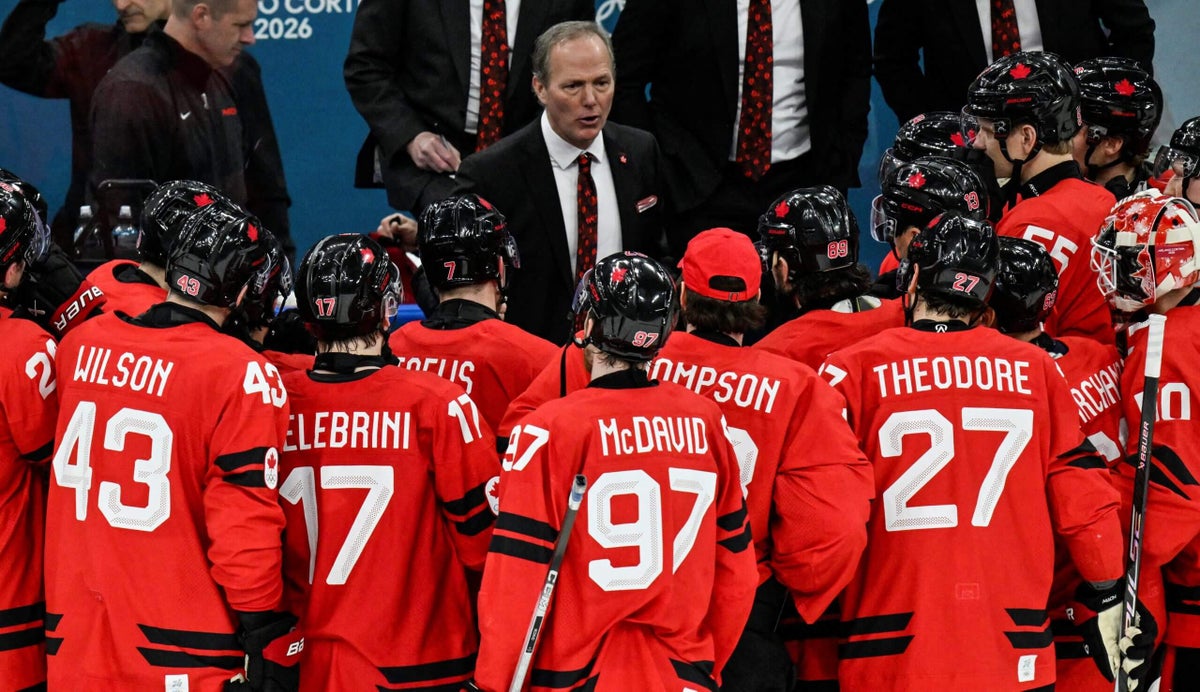
Chris Pronger is a guest columnist for The Athletic during the 2026 Milan Cortina Olympics.
That was great hockey. I honestly think the real winner of Wednesday’s Olympic quarterfinals was the hockey world.
Three of the four games go to overtime, and that speaks volumes. It tells you the round robin was just another day at the office.
These elimination games are different. These are the games where blood, sweat and tears make the difference. Where the tension mounts and everyone is leaving it all on the line, doing everything to try to advance.
In the quarterfinals, we saw two comeback wins. And Sweden came awfully close against the United States. Now the games we’re about to see between Canada and Finland and the U.S. and Slovakia should be even tighter and even better. Especially because of the adversity that Canada, Finland and the USA overcame to get here.
Let’s take Canada as an example, because you look at the first three games, and they just weren’t tested. They didn’t look like a team that had been forced to deal with anything hard.
In the round robin, they didn’t have to battle much, and they didn’t have to overcome any adversity whatsoever. They really didn’t have to fight through anything. It just kind of came easy to them early in these Olympics, and when things come easy, you forget what difficult looks like.
That’s human nature. When you’re rolling like that, you can’t help but think, “Hey, this is great, everything’s gonna come easy.” Then, when it doesn’t, that’s when you figure out what you’re made of. That’s when you figure out the types of characters you have on your team and in your locker room.
Just look at the guys who stepped up for Canada on Wednesday. Everyone kept saying, “Where’s the depth?” Well, when the chips were down, Nick Suzuki scored a huge goal. Then Mitch Marner scores a massive goal to send them to the semis.
Don’t get me wrong, either; Canada’s depth wasn’t great in that game. All tournament, they’ve relied completely on the Connor McDavid line to do the heavy lifting.
The elimination round games are different, though, and when that moment came, it demonstrated the ability of other players to step up. Now they’ll have to do it again, and they may have to do it without Sidney Crosby, who’s the heart and soul of this Canadian team.
Before we move on, can we take a minute to appreciate Jordan Binnington? We’ve been questioning this guy the whole time. Can he get it done? He hasn’t played well this year! His analytics are down! Blah blah blah, whatever. This f—— guy was huge again. He made three incredible stops to preserve the win for them.
Anyway, these moments force a team to take a good, long, hard look in the mirror. They force you to ask yourself what you’ve got. What sort of characters do we have? Do we have the grit that we need to pull ourselves into the fight, or pull ourselves out of the fire when things don’t go our way? You look at this game against Czechia, and it was an incredibly tight checking game. Canada had just been pounding everybody all tournament, then they’re challenged, and they found a way to respond.
As for USA, there were moments when they looked like a machine and moments when they didn’t have a ton of punch offensively. For me, it’s all about their defense right now.
I think it’s safe to say that Quinn Hughes is clearly their best player, but with him and Zach Werenski, every time they’re on the ice, that team is in control and is usually generating high-quality scoring chances. Especially when they’re using them together.
With those guys on the ice, Team USA just looks like they’re under control, like they’ve got their legs beneath them and the whole team looks like they understand what they’re doing and where they’re going with the puck. In the other minutes, I still think they look a bit lost offensively.
In those Hughes minutes, though, he’s got the puck on his stick, looking and surveying, and if he doesn’t have it on his stick, he’s moving to where he can be an option to get it back. His spatial awareness is incredible; it’s on another level compared to everybody else.
The only guy like him is Cale Makar. As good a skater as Hughes is, watching Makar in this thing right now, it blows me away. His speed and edge work are at another level, even among the other elite Canadian skaters. When you watch him, and he really wants to go, he’s just gone.
They’re such different skaters, but they’re both great. They both have that 10-and-2 ability, but they utilize it differently. It’s a showcase for the two best defensemen on the planet. It’s so much fun to be able to watch and enjoy their magic.
We shouldn’t forget Slovakia, who have been strong all tournament and blew out Germany in their quarterfinal. Who’d have expected Slovakia to have the most dominant showing in the quarters?
When you look at this Slovakian team, they’re definitely going to be in tough against the depth and pace that the U.S. can play with, but they shouldn’t be overlooked. They’re so young that they’re dangerous; they won’t be scared of the moment. They don’t know any better.
My first Olympics was 28 years ago in Nagano, and I just remember the pressure on our team. It was the first time that NHL players were at the Olympics, and that Team Canada had Wayne Gretzky, and we were massive odds-on-favorites. I felt that pressure, but being a young guy, you’re not really worried. On some level, you’re thinking, “Oh, I’m going to have another opportunity, another shot at it.”
That’s Juraj Slafkovský, that’s Simon Nemec, that’s Dalibor Dvorský against the U.S. Where the Canadians and Americans are all in, gold or bust, Slovakia has the advantage of feeling like they’re building toward something. That they’ve got time.
They’re going to be underdogs, but as the quarterfinals reminded us, weird things happen in single-game elimination. If they can play fearlessly, Slovakia might be able to make things more interesting than you’d expect.
Anyway, I want to come back to Canada, and how they’re going to fare if they have to move forward at this tournament without Crosby. It would obviously be a huge loss. You’re losing your captain, you’re losing a guy who does a lot of the grunt work that you don’t really think about or see, or pay too much attention to. The handy faceoff work, and how smart he is on the ice calming things down when needed. You can lose sight of how he impacts the game with how intelligent he is.
This could be a big deal for Canada because even if they had some big moments from their depth guys, right now they’re relying on McDavid’s line to create energy and offense. If you’re Canada’s coaching staff, how do you get away from that?
As incredible as McDavid has played, there shouldn’t be this much pressure on this guy to score every time he touches the puck with this lineup! It seems ridiculous to be in this tournament with a roster this good, and they’re that reliant on this one line to generate all the looks and score all of the goals.
Canada cannot go into the semifinal without having a line built around Nathan MacKinnon. Loading up one line is great, but then you don’t have the depth needed on the other lines. Right now, I wonder if McDavid feels like he’s playing in Edmonton, and I don’t think Canada can win that way.
Everybody says that MacKinnon is the MVP, and he’s great, but how can he be the MVP when Canada can’t find anyone to play with him? Aren’t MVP’s supposed to make the players around them better?
Who can they play him with? I like the idea of building a line around MacKinnon with Bo Horvat, but then you’re left asking yourself who can play on the right side that can play with pace the way MacKinnon wants to? Is it Seth Jarvis? Because I think he played pretty damn well on Wednesday, he created a lot of opportunities, held onto the puck, battled hard and skated. Maybe that’s the fit they are looking for.
Whatever they decide to do, it all comes back to how you have to play to win. As fun as the games were on Wednesday, I thought a lot of these teams just got too cute.
It drives me nuts when I see Filip Forsberg passing when he’s got a grade-A scoring chance coming right down the slot multiple times. This happened to the U.S. on Wednesday, too, and some of the top Canadian players were guilty of it. Canada for sure got a bit too loosey goosey in the quarterfinal, with the three-on-twos and the two-on-ones, and the risks they were taking to try to make something happen.
You can’t play like that and win at this stage of the tournament. You worked to break them down, you had the opportunity, and you didn’t take advantage of your efforts, and now they’re going the other way. Again and again, we saw plays like that, and hopefully, some of these top players got that out of their system with the close calls they experienced in the quarterfinal.
At this stage of the Olympics, when the pressure mounts, you can’t afford to think there’s a better opportunity, and you can’t defer. In this environment, you have to take your chances, and everybody else on your team has to know that you’re going to take your chances. Then they can go to the net with a purpose to get a loose rebound, or to get a tip on it.
That’s where the goals are scored when this much is on the line. Teams are too dialed in defensively for you to be trying to make the pretty play every shift.
The quarterfinals showed that. It was a reminder that it might take a 1-0 final to win, it might take 2-1. You cannot be frustrated if you’re not scoring, because there’s a good chance you’re not going to score.
You just have to work, take what you can get and stick to your grind game. Funnel pucks to the front of the net, get traffic to the net and simplify. You’ve got guys that can score, you just have to do the simple things to get them the puck in the dangerous areas.
This is the secret at this stage of the Olympic tournament. It’s the same thing in the playoffs, and in overtime, and in a win-or-go-home Game 7.
When you’re out there, you start to notice how often fatigue and confusion shape results. Players get tired and tight. They start making reads and making mistakes and doing stuff that’s out of character.
The only way to deal with that when it starts to happen to your team is to simplify.
When the fatigue and the pressure mount, that’s when you have to keep it simple. It’s not until you start to calm down and until your team settles down that things start to open up again. Whoever does that best when the inevitable chaos of a single-game elimination tournament — the noise, the pressure, the fatigue, the missed calls — sets in, they usually win.
That was a valuable lesson for the teams advancing; Canada, the U.S. and Finland are all hardened and tested now. They better be. On Friday in the semifinals, we’ll find out what they learned from the thrillers we witnessed in the quarterfinal round.