
The Conn Smythe Trophy is awarded to the most valuable player of the National Hockey League (NHL) Stanley Cup playoffs, and it usually goes to forwards who light the lamp at key moments. However, the award has gone to a defenseman 12 times in the history of the playoffs.
When defenders elevate their game, it’s usually due to a mix of more offense in their style of play, mastery on defense, and overall solid leadership that helped the team raise the Stanley Cup. Let’s take a look at five legendary defensive Stanley Cup performances.
Bobby Orr, Boston Bruins, 1970
Bobby Orr set the standard with his 1970 playoff run. It was a performance of pure dominance, and it also gave the NHL one of its most iconic goals. Orr didn’t just win the award, but he skated to a new style of play for the defenseman position. He completed a proverbial “Grand Slam” of NHL awards that season: he won the Hart Memorial Trophy as league MVP, the Art Ross Trophy as the league scoring leader, the James Norris Memorial Trophy as the league’s best defenseman, and of course, the Conn Smythe Trophy as playoff MVP.
Over the Bruins’ 1970 championship run, Orr made things look easy. He finished the postseason with nine goals and 11 assists, for 20 points in only 14 games, continuing his unheard-of production for the defenseman position. Even though he was a blue liner, Orr led all skaters in scoring in the playoffs. He dominated the game with uncommon speed and skill for the era at both ends of the ice, dictating the play on offense while still being able to get back and play responsible defense.
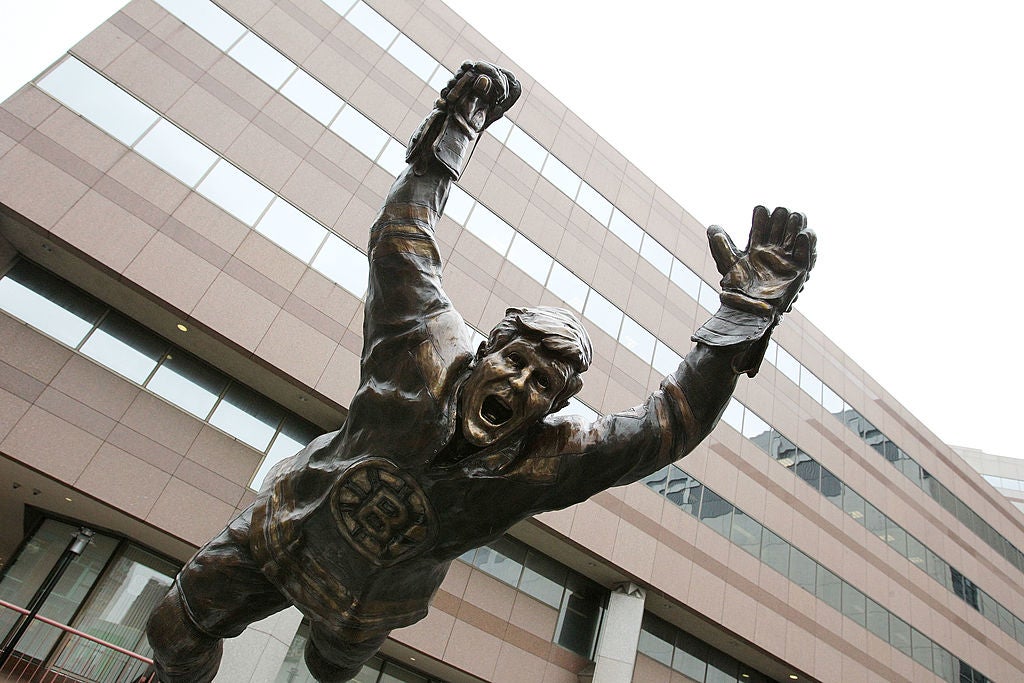
In the Stanley Cup Final against the St. Louis Blues, Orr famously scored the overtime winner in Game 4 to complete a sweep and give the Bruins their first Stanley Cup title in 29 years at the time. The famous goal shows Orr completely airborne after he lit the lamp, resulting in one of the most iconic photos in sports history.
Brian Leetch, New York Rangers, 1994
Brian Leetch’s effort in the New York Rangers’ 1994 playoff run was the main reason why the Rangers won the Stanley Cup, ending a 54-year drought. The 1993-94 season marked the end of the road for a high-scoring era of NHL hockey, as the league moved toward the infamous “Dead Puck” era in the mid-to-late-’90s. But for the Rangers, Leetch developed an excellent two-way game, scoring 79 points while patrolling his own end effectively. He ultimately made history in the playoffs, becoming the first American-born player to take home the Conn Smythe Trophy.
Leetch continued to play exceptionally well at both ends of the rink, a critical component to the Rangers’ playoff success. During this run, he scored 11 goals and 23 assists for an eye-popping 34 points in 23 games. Leetch led all skaters in playoff scoring, a remarkable feat for a defenseman in an era that featured some of the most prolific scorers in league history. It was a well-earned Conn Smythe Trophy for Leetch, who is widely considered the greatest defenseman to ever suit up for the Rangers.
Scott Stevens, New Jersey Devils, 2000
Scott Stevens’ Conn Smythe win for the 2000 Devils was all about the art of being a shutdown defender. The NHL at the time was known for the neutral zone “trap” defensive system, which New Jersey executed at a high level. Stevens was also known for his explosive hits and intimidating presence on the ice, making opposing forwards think twice before rushing in his direction. Stevens ran the defense the way he wanted to, controlling games throughout the playoffs for the Devils.
Stevens finished his 2000 playoff run with only three goals and eight assists in 23 games. But his value wasn’t on the scoresheet, but instead in his dominant defensive play and leadership for New Jersey. He and goaltender Martin Brodeur locked things down, taking pressure off the Devils’ forward group to provide just enough scoring to ultimately hoist the Cup.
Nicklas Lidstrom, Detroit Red Wings, 2002
Lidstrom, a native of Krylbo, Sweden, became the first European player in history to win the Conn Smythe Trophy for the 2002 Red Wings. A unique player, Lidstrom produced well offensively, but his biggest strength was in the defensive end with his impeccable hockey IQ and flawless positioning.
During the Red Wings’ 2002 Stanley Cup championship run, their third in six seasons, Lidstrom scored five goals and 11 assists for 16 points in 23 games. Despite chipping in on offense, ultimate value came on defense and a superior all-around game, and stacking up playing minutes when called upon. Lidstrom was surrounded by a handful of Red Wings Hall of Famers, and he mixed in with them perfectly.
Victor Hedman, Tampa Bay Lightning, 2020
Hedman’s 2020 Cup run for Tampa Bay showed what an elite two-way defenseman is supposed to look like. The Lightning blue liner was the total package: he could skate, he could shoot, he could score, and he had the smarts to play sound defense on top of it.
His numbers for that 2020 playoff run were pretty eye-opening, given the amount of offense he brought to the table. Hedman scored 10 goals and 12 assists for 22 points in 25 games. Those 10 goals were the third-most by a defenseman in a single postseason. He also showed a knack for coming through in the clutch, scoring three game-winning goals over the course of the playoffs. And Hedman still controlled the full sheet of ice whenever he was on it, marking one of the more dominant playoff runs ever seen by a defenseman.
To deliver a legendary performance on defense in the Stanley Cup playoffs, the defender needs to be exceptional, dominant in all four rounds, and be one of the key players that makes everything click for the team. It’s all about the player taking on massive minutes, playing a two-way style, scoring a high number of points, and delivering a huge impact, especially in critical moments. These defensemen are among the best examples of blue liners that dominated throughout the playoffs en route to getting their names on the Stanley Cup.