
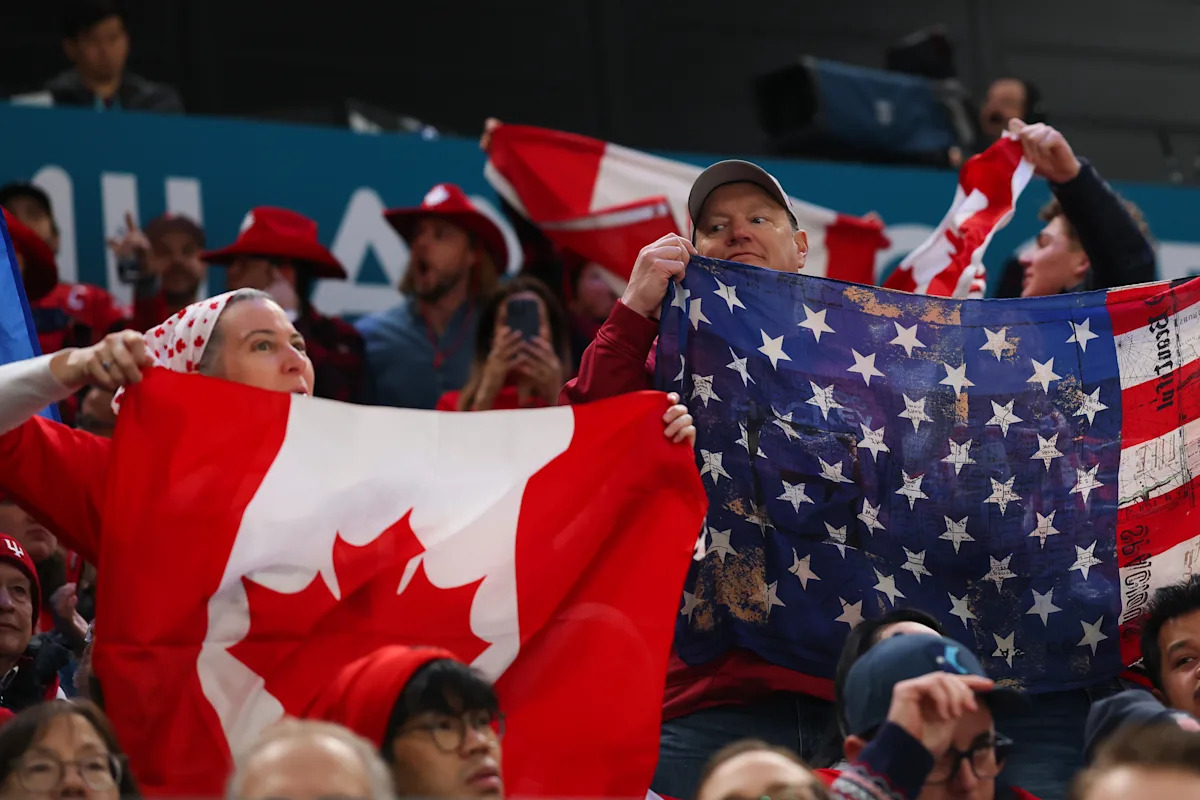
MILAN — The showdown that the hockey world has waited a dozen years to see again on an Olympic stage is finally here.
It’s the U.S. vs. Canada in Sunday’s gold-medal match. The stakes could not possibly be any higher.
Advertisement
“This is the pinnacle of the sport, this is as good as it gets,” American forward Matthew Tkachuk said.
Then, perhaps forgetting that the puck will drop at 8:10 a.m. ET, Tkachuk added optimistically, “There will not be one TV without this game on in the United States and Canada. That should get you pretty fired up.”
The Americans have not won Olympic gold in men’s hockey since the iconic “Miracle on Ice” 46 years ago. They last reached the gold-medal match in Vancouver in 2010 when Sidney Crosby’s overtime goal lifted host Canada to victory in what remains the most-watched TV broadcast in that hockey-obsessed country’s history.
While nine-time champion Canada won the last two times the Olympics featured NHL players in 2010 and 2014, a best-on-best U.S. victory on Sunday would not be a miracle. The Americans came to Milan with a roster overflowing with NHL talent and the unwavering belief that it is at last their time again.
Advertisement
Many of Sunday’s key players were also on the ice last February when the U.S. and Canada split a pair of tense, hard-fought games at the 4 Nations Face-Off. The Americans won the round-robin matchup in a game that began with three fights in the opening nine seconds. Connor McDavid’s overtime goal secured revenge for the Canadians in the final just a few days later.
Will Canada celebrate Olympic gold for the 10th time? Or will the U.S. end its decades-long drought? Let’s address five key questions about Sunday’s blockbuster gold-medal match.
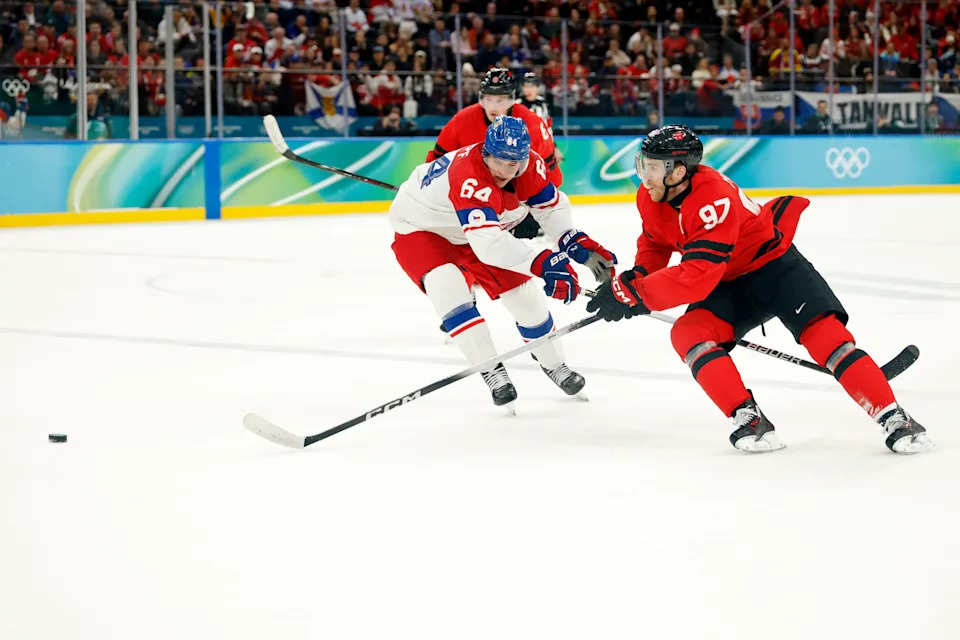
Connor McDavid is the best player whenever he steps on to the ice. (Geoff Burke-Imagn Images)
(IMAGN IMAGES via Reuters Connect / REUTERS)1. Where does Canada have the biggest advantage?
Canada’s forward group boasts high-end attacking talent that no opponent can match, not even the U.S. The Canadians feature a trio superstars who are three of the NHL’s leading points scorers this season in former league MVPs Connor McDavid and Nathan MacKinnon and teenage phenom Macklin Celebrini.
Advertisement
McDavid has been the most unstoppable player at these Olympics, leading the tournament with 13 points in five games thanks to his lethal combination of speed and skill. MacKinnon put his stamp on these Olympics with his late goal to complete Canada’s semifinal rally to beat Finland, while Celebrini has 10 points and a tournament-best five goals — not bad considering he won’t turn 20 until mid-June.
While the U.S. can’t counter Canada’s top-tier playmakers, the Americans do have plenty of attacking depth. Auston Matthews, Jack Hughes, Brady Tkachuk and Jack Eichel each have scored two or more goals at these Olympics.
The U.S. so far has also gotten more attacking contributions from its blue line than Canada has. Quinn Hughes, in particular, leads the U.S. in points at the Olympics with seven. He produced the Americans’ biggest goal of the tournament so far, an overtime game-winner to beat Sweden in the quarterfinals.
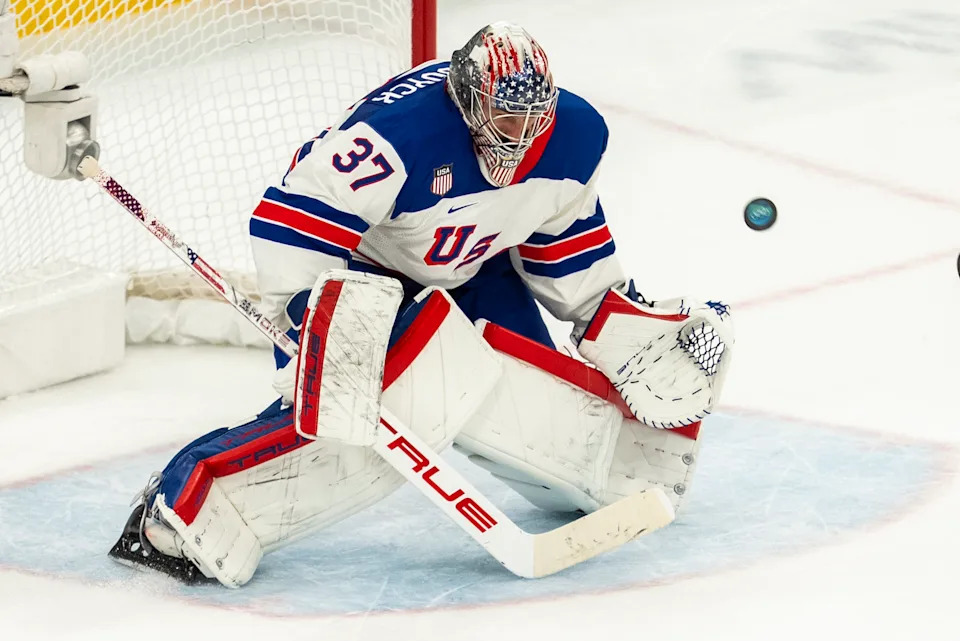
Connor Hellebuyck is the best goalie whenever he steps onto the ice. (Andrzej Iwanczuk/NurPhoto via Getty Images)
(NurPhoto via Getty Images)2. Where does the U.S. have the biggest advantage?
The presence of Connor Hellebuyck gives the U.S. a clear edge at goaltender. The ferociously competitive three-time Vezina Trophy winner is always calm, never flustered. He often makes the difficult look routine with his long 6-foot-4 frame, savvy anticipation and knack for positioning himself perfectly.
Advertisement
This has been a rough, injury-plagued season for Hellebuyck at the NHL level, but the Winnipeg Jets netminder has performed up to his reputation in Milan. His goals against average and save percentage both lead the Olympics — and they would be even higher if he didn’t, in his words, get “a little bored” during the third period against Slovakia on Friday and surrender a goal that he doesn’t believe he should have.
Asked where his confidence level is after Friday’s game, Hellebuyck said that it’s at an “all-time high.”
“I’m really enjoying this,” the typically stoic, serious Hellebuyck continued. “This is fun.”
Goaltending was Canada’s primary question mark entering these Olympics, but so far Jordan Binnington has proven up to the challenge. He has raised his level of play while playing for his country, just as he did last year at the 4 Nations Face-Off.
Advertisement
While Binnington has shown a knack for big saves in big moments, he can be susceptible to giving up rebound goals. Canada’s array of formidable defenders will have to be cleaning up those big rebounds. Otherwise that could be a weakness to exploit for a U.S. team with plenty of physical forwards who excel at crashing the net.
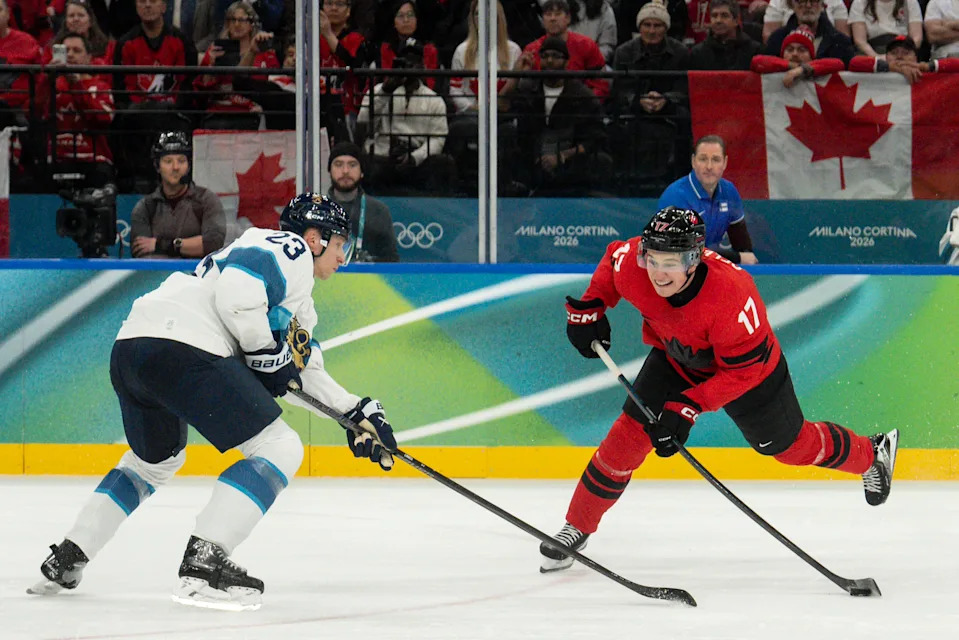
Just 19, Macklin Celebrini has already established himself as a premier goal scorer. (Foto Olimpik/NurPhoto via Getty Images)
(NurPhoto via Getty Images)3. How often will Canada play the ‘Three Macs’ together?
That’s one of Jon Cooper’s key decisions prior to Sunday’s gold-medal match. Does he put McDavid, McKinnon and Celebrini on the same line from the get-go? Or does he save that superline as a break-glass-in-case-of-emergency option should the Canadians fall behind like they did against Czechia and Finland?
Advertisement
Cooper’s most likely choice would be to start enforcer Tom Wilson alongside McDavid and Celebrini so that Canada has someone on its top line capable of matching the physicality of the Tkachuk brothers. MacKinnon’s presence on Canada’s second line also makes that unit more threatening.
Of course, it doesn’t take a hockey mastermind to understand the appeal of the “Three Macs” line, especially when Canada has an extra man on the power play. There’s a certain intimidation factor in sending three of the sport’s most skilled players onto the ice at the same time.
When asked if he’s ever seen a line quite like McDavid-MacKinnon-Celebrini, Canada’s Sam Bennett said, “No, I never have and I don’t know if there ever will be.”
“Those are three generational players, and they’re doing ridiculous things out there,” Bennett added.
Sidney Crosby left Canada’s quarterfinal game with an injury, and did not play in the semifinal win over Finland. His status for the gold-medal game remains up in the air. (EyesWideOpen/Getty Images)
(EyesWideOpen via Getty Images)4. Will Sidney Crosby play?
Believe it or not, the U.S. could have to deal with another Canadian attacking superstar. When speaking with reporters after Canada’s semifinal victory over Finland, Cooper did not rule out the possibility that Crosby could return to the ice for Sunday’s gold-medal match.
Advertisement
“We have 48 hours to decide that,” Cooper said, “but I will tell you he’s got a better chance of playing in the gold-medal game than he had playing in tonight’s game.”
Crosby suffered an unspecified injury in the quarterfinals against Czechia when he took a hit from defenseman Radko Gudas and his leg bent in an unnatural direction. He sat out the rest of that game and did not dress for Friday’s semifinal.
If Crosby were to play through the injury, his return would provide Canada an emotional lift as well as a boost on the ice. Crosby had two goals and six points during the Olympics prior to his injury. Even at 38 and having long since outgrown his “Sid the Kid” nickname, Crosby remains a force.
5. Who is helped more by the 3-versus-3 overtime rules?
If the U.S. is going to win, it may have to be in regulation.
The American roster is built for the tight spaces and physical battles of 5-on-5 hockey. The faster, more skilled Canadians would have a clear advantage in a wide-open 3-versus-3 overtime.