
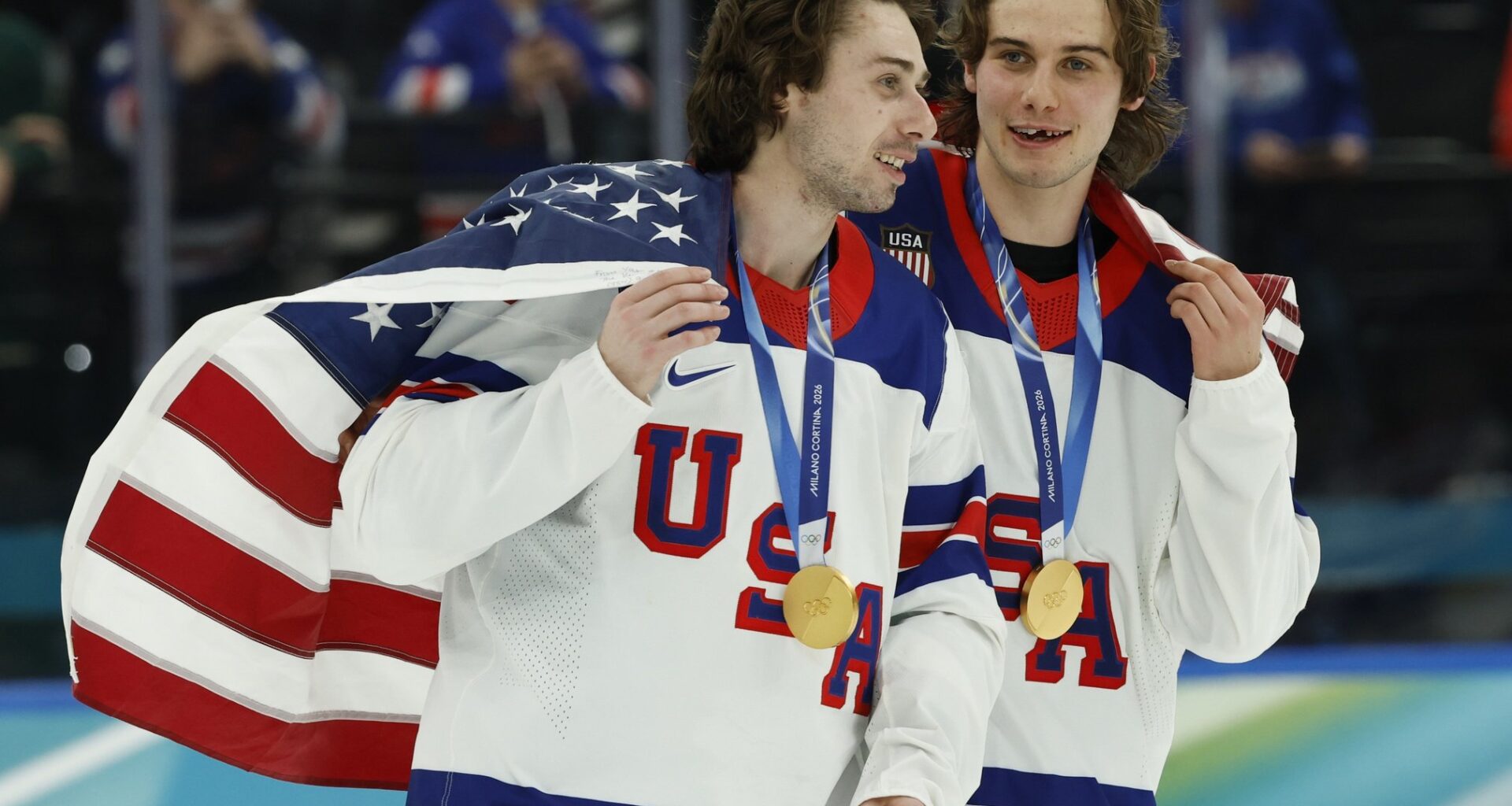
40-plus years from now, when the one broadcasting company that remains shows highlights of Team USA’s Gold Medal 2026 Winter Olympics squad, we’re going to re-live a lot of moments. Jack Hughes‘ overtime-winner is a given. Connor Hellebuyck stonewalling Connor McDavid and Macklin Celebrini on breakaways will be there. Matt Boldy‘s opening goal should be in the rotation, as well.
What we’re not going to see is how easily that instant classic game might never have happened at all.
Heading into overtime in the semi-finals, the US was dangerously close to being bounced by a seventh-seed. And the reasons were entirely predictable. The criticisms for Bill Guerin‘s roster-building — that a team that fell one goal short in the 4 Nations Face-Off more or less ran it back for the Olympics, leaving goals on the table by bringing penalty-killers over superstars in Cole Caufield and Jason Robertson — were threatening to manifest themselves in the worst way.
The 6-on-5 goal by Mika Zibanejad tied that quarter-final with 90 seconds remaining came with J.T. Miller, Vincent Trocheck, and Brock Nelson on the ice. One bad break in overtime, and Guerin’s hand-picked squad would have mustered just one goal and finished a goal short.
But then the biggest difference between last year’s 4 Nations team and this year’s Olympic squad showed up.
Hughes, who was off the 4 Nations squad only due to injury, made up for lost time during the Olympics. It wasn’t just that he led Team USA in scoring with eight points — tied for fourth in the tournament — but he registered a point or more in every single game. It wasn’t just excellence; it was clockwork. The Americans needed Hughes to set the tempo and push the pace while defending the world’s best players, and he was always up for the task.
There are stars, and there are superstars. Then there are players like Hughes. Guerin doubled down on his vision for Team USA, and Hughes proved to be the rare player who could transcend the line between a humiliating defeat and a golden moment.
The script is flipped. Guerin isn’t the GM who embarrassed his country by stepping on a rake that he carefully placed in his way. Agree or don’t, but he’ll now be venerated as the genius who delivered the US its first Gold since 1980. History is written by the winners, and Hughes (along with Jack) authored Guerin’s page.
Fortunately for Guerin, Quinn might not be done editing his GM’s Wikipedia entry.
Putting Hughes on Team USA took zero brains and zero guts. Hughes was one of the first six players named to the squad, and with a Norris Trophy under his belt, his inclusion would have been assured no matter who was heading the team. However, Hughes on the Minnesota Wild? That did take a lot of guts.
On the night of the trade, few Wild fans would have given up the package required to land Hughes. Zeev Buium was considered a top-five prospect worldwide, and losing Marco Rossi meant taking a huge chunk out of an already-thin center group, on top of Liam Öhgren and a first-round pick. All this for a defenseman? On a team that has, for whatever its flaws were, pretty much always had good defensemen?
Especially one that wouldn’t commit to signing with his new team when he was being shopped?
Just two months later, it’s unfathomable that anyone could have argued against the move. Forget the overtime goal vs. Sweden, forget frustrating the likes of Connor McDavid in the Gold Medal Game, forget winning the whole damn thing at the Olympics. Look at that track record in Minnesota! Hughes has 34 points in 26 games with the Wild, who have a 16-6-4 record with him in the lineup. The impact has been nothing short of transformational.
Transformational, mind you, on a team Guerin built that looked like it didn’t have enough offensive punch. Sure, Kirill Kaprizov and Matt Boldy are fantastic players. Stars at least, arguably superstars. But the GM has also invested heavily in mid-tier players whose contributions aren’t driven by their points. Players like Marcus Foligno, Ryan Hartman, Jake Middleton, and Yakov Trenin stand out. Partially out of cap-related constraints, of course, but also partly out of genuine admiration for that side of the game.
It made for a team that had a philosophy not at all unlike Team USA’s 4 Nations group. In fact, last year’s Wild fell short by one goal in Games 4, 5, and 6 during their first-round series against the Vegas Golden Knights. Barring a huge, near-instant impact from Buium, Guerin’s Wild seemed destined for the same fate.
Another first-round exit probably wouldn’t have ended Guerin’s tenure in Minnesota. Ownership has a fondness for stability at GM, so it’s difficult to see a scenario where Guerin got fired one year into their post-Parise/Suter buyout era. But it would have cemented a feeling that his reign in Minnesota would be similar to Chuck Fletcher’s tenure — big on hype and hope, but never delivering on it come playoff time.
Hughes already rewrote Guerin’s legacy as a GM once in 2026. He did so on the biggest of stages, against the best players six different countries could throw at him. It doesn’t feel far-fetched at all to think Hughes could do it again.
Think you could write a story like this? Hockey Wilderness wants you to develop your voice, find an audience, and we’ll pay you to do it. Just fill out this form.