
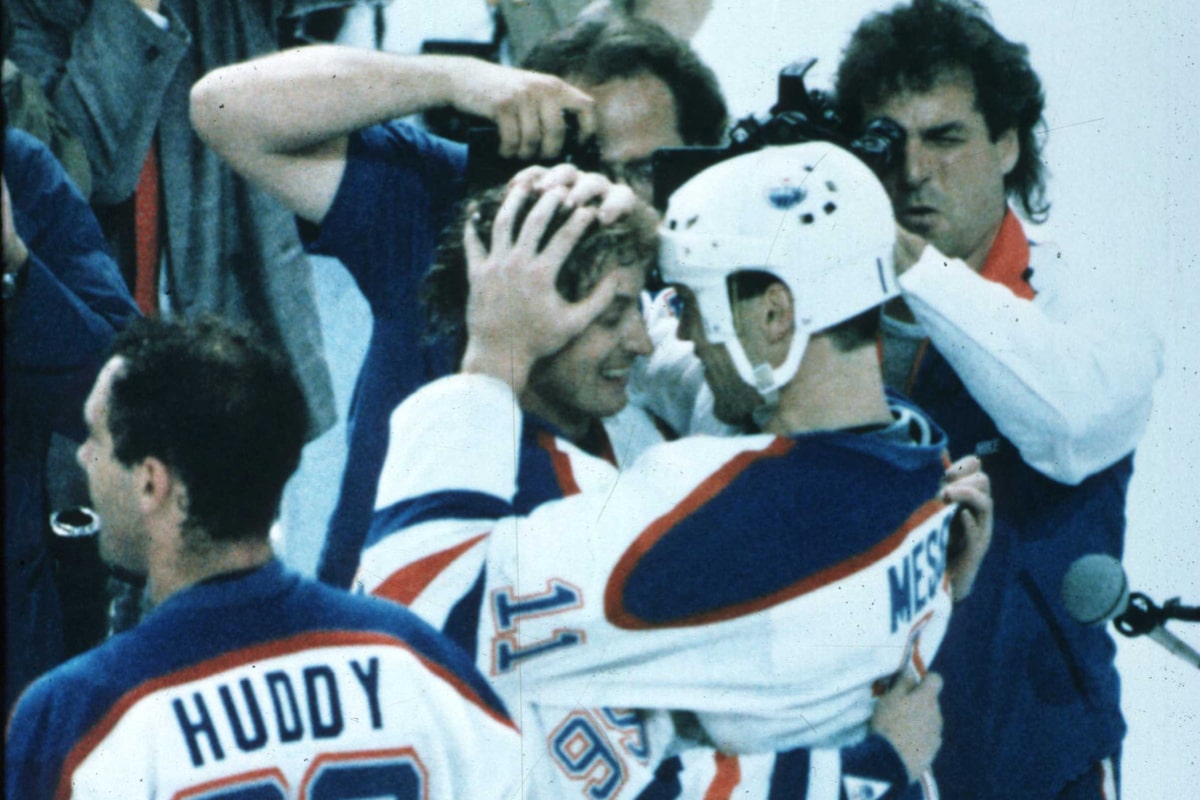
The Boys on the Bus cinematographer Michael Boland films Wayne Gretzky #99 and Mark Messier #11 embracing each other after the Edmonton Oilers defeated the Philadelphia Flyers in Game 7 of the 1987 Stanley Cup Finals in Edmonton.B Bennett/Supplied
A couple of years ago, Mark Messier invited Daniel Amigone, a producer of sports-reality documentaries, to his home to talk about an idea he had for a new TV series. Game Seven, as Messier envisioned it, would revisit some of the most famous win-or-go-home playoff matchups across the NHL, Major League Baseball and the NBA.
One game especially was a no-brainer to include: the May 31, 1987, final between Messier‘s Oilers and the Philadelphia Flyers, when Edmonton secured its status as a dynasty by winning a third Stanley Cup in four years. As the two men chatted about what sort of footage Amigone might use to bring the series to life, Messier mentioned a groundbreaking documentary he’d been a part of which followed the Oilers during that championship season. It was called The Boys on the Bus.
To make that doc, a small production crew had embedded with the team: in the dressing room, on road trips and personal outings, even popping up in some players’ homes. They caught an alcohol-soaked dinner at Messier‘s condo with Wayne Gretzky, Glenn Anderson and Kevin Lowe. Their camera swooped around the ice during practice, letting viewers feel for the first time what it was like to bob and weave among the pros. They were there when Gretzky and Messier tried on a Pope’s mitre during a goofy team photo shoot, when Marty McSorley regaled Lowe about the brutish ways of life on his family farm, when the general manager and head coach Glen Sather tried awkwardly to deflect a reporter’s questions during a cocaine scandal, when the enforcer Dave Semenko choked up as he talked about being traded midseason to the Hartford Whalers.
For fans back then, it was all revelatory stuff. “That was at a time and place where there was a real barrier between the television that we produced and what occurred behind the scenes,” noted John Shannon, the veteran live sports producer who oversaw hockey coverage at the time for CBC-TV and, later, Global Television. “It was one of the very few glances behind the curtain where you got to feel and understand what really went on.”
The film became such a touchstone of hockey lore that Edmonton Oilers beat writers forever after referred to the team from that era as “the boys on the bus.”
A 1987 video with footage from The Boys on the Bus documentary combined with the film’s theme song, The Moment in Time written by Terence McKeown.
Amigone, 42, had never heard of Boys, which was produced and directed by the CBC investigative reporter Bob McKeown with field production by his brother, Terence McKeown, and cinematography by Michael Boland, a pro hockey player-turned-cameraman. But when he watched it later and then searched out Boland’s raw footage in the Hockey Hall of Fame archives, Amigone began to realize its significance.
“I’m not sitting here with a career without those guys,” he said during an interview. “I really do think of them as the godfathers of this kind of sports follow-doc access-style show.”
That genre is now a pillar of sports cable channels and streaming services, including such hits as Netflix’s Drive to Survive, which brought millions of fans across the globe to Formula One. When Michael Jordan’s The Last Dance premiered in the spring of 2020, producer Andy Thompson pointed directly to Boys as the inspiration for the NBA to embed a camera crew with the 1997-98 Chicago Bulls.
Late last year, the first five-episode season of Game Seven premiered on Amazon’s Prime TV service along with Face-Off, a six-part embedded-camera NHL series that Amigone also produced. Both were hits with fans and critics. With the Stanley Cup playoffs in full swing, Amigone is in production on a second season of Face-Off that‘s due to premiere this fall.
The Globe and Mail spoke with the men who made Boys, as well as key Oilers personnel, to go behind the scenes of the first sports doc to really go behind the scenes.
Here, in their words, is an oral history of the film that started it all.
Before The Boys, Les CanadiensOpen this photo in gallery:
Bob McKeown, Paul Coffey and Terence McKeown.Courtesy of Terence McKeown
In the early 1980s, Bob McKeown was hosting Daybreak, the morning radio show for CBC in Montreal, where he lived next door to the esteemed National Film Board of Canada director Donald Brittain.
Bob McKeown, producer and director, The Boys on the Bus: He knew my love of sport, and hockey in particular, and he knew I was looking for a project to do, and he said, What about the Canadiens? The 75th anniversary of the Club de Hockey Canadien was coming up in 1984. I went: ‘Oh my God! It‘s the greatest untold story of all!’ I went and introduced myself to Frank Selke and the other people at the Forum.
It took two years to negotiate access.
Bob McKeown: They gave us permission that no one had ever gotten, to go into the Habs’ dressing room and go out on the ice with them. By that point I was working for The Fifth Estate and one of our cameramen was a guy named Mike Boland, a former NHLer who had played a number of years in Europe. Mike was playing in our beer league, and I convinced him to make Les Canadiens.
The 50-minute documentary featured slick on-ice camerawork as well as interviews with the legends Maurice Richard, Aurèle Joliat, Jean Béliveau and, in his final season with the Habs, Guy Lafleur. It aired on CBC-TV on March 19, 1986.
Bob McKeown: Glen Sather had seen Les Canadiens. He called me and said, ‘Do you want to do a film about a really good hockey team?’ And I said, ‘Sure!’ The Oilers were playing the Capitals in Landover a few days later, and he said, Come on down, we’ll have dinner.
The team had won two consecutive Stanley Cups and were looking like a good bet to earn a third that year.
Bob McKeown: We didn’t even sign a contract. Given the personalities involved, I was a little concerned about that. I asked Glen, ‘Is there any protection in this agreement’ – it was just verbal at this point – that would guarantee us a certain amount of time with the players – on the ice, in the dressing room? And he pulled out the standard NHL player contract and he said: ‘You don’t need a contract. This says that the team owns the rights to the names, images and likenesses in perpetuity.’ And at that time of the evening, after a few scotches, that was good enough for me, I guess.
John Shannon, former executive producer, Hockey Night in Canada: This was not the first time the Oilers had allowed access. Peter Gzowski wrote a book about his year with the team. (The Game of Our Lives covered the 1980-81 team.) That was part and parcel of the great history of the Oilers that Glen Sather set the stage for, in so many ways. Glen is – I say this respectfully – the consummate schemer. He expected his guys to be on the stage for a long period of time. And if you look at the legacy of that organization, and you look at the legacy of Gretzky and the legacy of Messier, it has come to fruition.
Glen Sather, Edmonton Oilers general manager 1979-2000 and head coach 1980-1989: When this started, a lot of the guys, they were a little nervous about it. And I said, well, if you see something you don’t like when you preview the film, we’ll get it changed.
Kevin Lowe, Edmonton Oilers defenceman (1979-1992) and narrator of The Boys on the Bus: The leaders of the team were all onside with it. And you know, we can’t forget that we were travelling with soon to become the greatest player of all time, and that was worth documenting. Sure, it‘s about ‘the boys on the bus,’ but The Boys on the Bus doesn’t happen without Wayne Gretzky.
Terry McKeown, associate producer and original music composer, The Boys on the Bus: Bob brought me onto the film as an act of charity. I’d been in the music business. I had a management and production company and worked with other artists, and I produced an album for an independent band in Toronto called Klo, and the album was paid for by a friend of theirs named David Mackenzie.
Bob McKeown: David was an Arctic pilot and at some point, he discovered something in the Arctic of great value.
Mackenzie was chair of the diamond producer Dia Met Minerals.
Terry McKeown: CBC offered a licence fee that was maybe half of what Boys was going to cost, so we had to look for more money. And I called David and I said, ‘We need about $75,000, do you think you’d like to contribute a small part of the budget and become an equity owner of the film?’ And he said, ‘Well can I just pay for it all?’ He was fabulous to work with, because he was not hands-on at all. I think he was just really happy that he got to meet and occasionally hang out with the players.
The shoot began in Pittsburgh. The Oilers had six games left in the regular season.
A behind-the-scenes look at the mid-season tensions between Oilers all-star Paul Coffey and coach Glen Sather.
Michael Boland, cinematographer, The Boys on the Bus: Just before we go into the Oilers dressing room for the first time, Slats [Sather] says to Bob and Terry and me, ‘Listen, I can get you in the door. It‘s up to you to stay, because if you piss these guys off, there’s [nothing] I can do about it. If they kick you out, you’re out.’ So then we go in, and Slats gives us a little introduction and he goes, ‘These guys want to do a film.’
So he leaves with Bob, and Terry says, ‘What‘s the plan?’ I say, ‘We’re not filming. I just know the smell, and they don’t want us now. So put your stuff down and joke around.’
We went on our first road trip to Pittsburgh, and it was the big faceoff between Gretz and Mario Lemieux, and they won 8-3, so at the end of the game we’re in the dressing room and there’s a horde of cameras around Gretz. Messier comes up and sits down next to me and says, ‘Why aren’t you filming?’ And I said, ‘Why would I fight with the news cameras just to get, ‘Oh, we were really in tough tonight – cliché, cliché, cliché.’ And he said, ‘We’re going to this bar, the whole team‘s going, do you want to come?’ ‘Yeah, I’d love to.’ And he goes, ‘What are you going to do with that camera?’ And I said, ‘I thought I’d put it in your stall, if that‘s okay with you?’ And he looks at me and he goes, ‘Good answer.’ In other words, ‘Don’t bring that thing.’ I know what‘s going through those guys’ heads.
Bob McKeown: The guys knew that Mike understood what being a professional hockey player was. That gave us licence to be with them, and to get out on the ice in a way that they would never let a guy from CFTO do.
One of the earliest scenes in the film, shot in the back of the team bus as it drives in to New York, captures the easy fellowship of the players who had been together since the Oilers’ first NHL season in 1979-80, including Kevin Lowe, Dave Semenko, Dave Hunter, Messier, Gretzky and Dave Lumley. In an interview filmed later, Lowe explains to the camera: “Talent is one thing, but you need that tight-knit camaraderie, that tight-knit relationship to win.” He was tapped to be the film‘s narrator.
Lowe: The boys used to joke with me, they’d say that I never saw a microphone I didn’t fall in love with. I was very cautious and conscientious. I was apprehensive – only because I didn’t want to say or do anything that would offend any of my teammates.
Sather: I think the players kind of enjoyed it. The notoriety of cameras following them around and seeing how they lived and what they were doing. It was sort of fun for everybody, and I liked doing things that were different for the players to get involved in.
Lowe: There’s one scene where Jari Kurri gets off the bus in Manhattan. And you look at his face and he has this dumbfounded, never-been-here-before look, and he was putting it on for the camera. A lot of us chuckled when we saw that, because Jari was very reserved.
Though the Boys crew had unique access to the players off the ice, they quickly realized they couldn’t match the five-camera setup that was then the standard for live TV coverage.
Boland: We start to film a game, and I’ve only got one camera, and I don’t have a premier spot. And I’m panning all over the place and missing stuff. So I said to Bob, ‘If we think we’re going to capture goals or nice passes – forget it.’ So he says, ‘What do you suggest?’ And I said – ‘We film iso.’
Broadcasters had begun using iso – that is, cameras isolated on one player – a few years earlier.
Shannon: Gretzky’s play demanded you cover the game differently. The background was the famous Walter Gretzky saying of, ‘Skate to where the puck is going.’ You needed to show that with Wayne constantly – he was that far ahead of the play. So you needed to show, ‘Okay, here’s why they scored, and by the way here’s what Wayne saw what was happening.’ The fans became so sophisticated, they wanted to see what Wayne was doing all the time. That really was where it started. Then we started to do the same in Calgary, Winnipeg, Vancouver with all their stars – Lanny McDonald, Dale Hawerchuk.
Boland shot iso scenes of other players as well, giving viewers the rare chance to watch from a rinkside seat as Semenko cruised around the ice looking for someone to hit, or Messier cross-checking an opponent so harshly that he broke his stick and then argued with the ref who slapped him with a penalty. (Audio of the latter scene was picked up by a microphone hidden in Messier‘s jersey.)
An example of the camera isolating on one player in this video clip from the documentary film The Boys on the Bus, cinematographer Michael Boland captures Mark Messier swearing at referee Bill McCreary after getting a cross-checking penalty.
The Oilers crash out of the playoffs. Is Boys dead, too?Open this photo in gallery:
The Boys on the Bus crew with the Stanley Cup, from left, David Mackenzie, Bob McKeown, Kevin Lowe, Terence McKeown and Mike Boland.Courtesy of Terence McKeown
Edmonton placed at the top of the standings that year, winning the inaugural Presidents’ Trophy. And though it had a 6-1-1 record against Calgary in the regular season, it lost to the Flames in the second round in a gruelling seven-game series. The final loss came after an infamous own-goal by Steve Smith, whose attempt at a clearing shot early in the third period banked off the left leg of goalie Grant Fuhr and into the net.
Bob McKeown: After the game, we were following them around the ice, filming, and Steve looked at us – there were tears pouring down his face and he said, ‘I know it‘s your job, go ahead, but I just want you to know I’ll never be able to watch your film.’
The crew had their own reasons to be upset.
Terry McKeown: Our first thought was, ‘This is terrible for the team, this is terrible for the players,’ because we really got to like them and care about what happened to them. But the very immediate next thought was: What the heck’s going to happen with this film?
Bob McKeown: Not only do we not have the ending we need, we don’t have a film. The kids who are Oiler fans in Alberta – this was not going to be a Christmas gift for them!
Terry McKeown: We could have been just dead in the water. I went back to David and said, ‘Well, it‘s gonna cost us probably the same again to go back next season and take us through to the playoffs in ‘87. How do you feel about paying for it?’ And he said – ‘Yeah, okay.’ I don’t know what would have happened if anybody else had been the investor, or if we’d had to cobble together a consortium of sources of money. The film probably wouldn’t ever have been finished.
The crew rejoined the team when the Oilers convened for training camp in Edmonton that September.
Terry McKeown: When we went back, it was completely different. The players took it as a show of solidarity. They felt like we were part of them now, because we’d gone through the defeat with them – and they understood that it could be a big financial hit for us. And they were very kindly concerned about that.
The crew becomes like familyOpen this photo in gallery:
An Oilers 1987 team photo that includes Terence McKeown (third from right), Bob McKeown (fifth from right) and David Mackenzie (fourth from left).Courtesy of Terence McKeown
Terence McKeown: We were invited to Gretzky’s Grey Cup party that November at his apartment. Wayne had a lot of games. I think he had pinball machines and he had a pool table and shuffleboard. It was a very big man cave. But he also had this Wayne Gretzky table hockey game, the really cool one with the plexiglass dome and the actual clock. And I fancied myself to be a pretty decent table hockey player. I beat Jari Kurri and Esa Tikkanen. But Grant Fuhr just cleaned my clock. He just knew where that puck was going to be four bounces before it got there.
My dinner with Messier
One of the most famous scenes in Boys takes place during a small dinner party at Messier‘s apartment, in which the normally reserved Gretzky becomes animated after a few drinks.
Terence McKeown: Often, the night before a home game, the players wouldn’t go out, because you don’t want to be seen drinking out on the town and then losing the game and then someone says, ‘Yeah, I saw him in the pub at two o’clock.’ So, they would have little get-togethers in somebody’s apartment or home. And we were invited to a few of those. And one of them was at Mark’s apartment, a dinner party. Mark had a friend who was an Asian chef who did the food, and it was just great camaraderie. Afterwards, we said to Mark, ‘Look, we’d like to recreate what we just saw. Can you put something like that together for us?’
Bob McKeown: It was Mark, Gretz, Glenn Anderson, Kevin Lowe, Paul Coffey, Mark’s sister, Mary-Kay, and Mark’s brother, Paul, and Mary-Kay’s boyfriend, Daryl.
Terry McKeown: We hid microphones in the flowers in the middle of the table. When I watch it, I still cringe at how invasive those flowers are. But they did a good job of hiding the microphones. That gave us the ability to just kind of stand back and let them go.
Boland: Bob will always say that he came up with that idea. He didn’t. I came up with that idea, because at that time there was a film out called My Dinner with Andre. So, I said to Bob, we should do a My Dinner with Andre. He came up with the whole idea of expanding it.
My Dinner with Andre was a dry, experimental, philosophical art-house hit, directed by the French filmmaker Louis Malle, about two self-centred downtown New York theatre artists. When it premiered in 1981, a New York Times critic described it as, “nearly two hours of talk about theatre, art, life, electric blankets and Western civilization.”
Boland: Bob went out to the liquor store, got about 42 bottles of wine. Forty-one were drank by Gretz.
Lowe: That‘s Mike Boland folklore. We did not have 42 bottles of wine.
Clips from the dinner are sprinkled throughout the second half of the film. Gretzky teases Messier, Lowe and others about his dominant style of play – quipping, in a clip that‘s done the rounds on social media, that he’s so focused on the ice, he just thinks: “I want that puck, and you guys go get your own puck.” In another moment, the room erupts in laughter when Gretzky tells a goofy story about a duck hunting trip that he and Glenn Anderson had gone on which ended in failure because they didn’t realize they were using goose calls.
In one of the most famous scenes from the documentary The Boys on the Bus, Wayne Gretzky regales teammates with a story about a failed duck hunting trip with Edmonton Oilers right-winger Glenn Anderson
The 1987 Playoffs: Is the Boys crew cursing the team?
In the first three rounds of the 1987 playoffs, the Oilers made quick work of their opponents, beating Los Angeles in five games, sweeping Winnipeg and finishing Detroit in five. Then came the final. Edmonton went up 3-1 and seemed sure to take the Cup in five games. But Philadelphia fought back hard and won two squeakers. Game 7 was played in Edmonton.
Terence McKeown: I was in the lobby of the Westin Hotel in Edmonton, and two of the players came over to me and said, ‘We think your cameraman’s jinxing us.’ I told Mike and he was aghast. I mean, he felt like he was one of them.
Boland: It was Cruiser (Mike Krushelnyski) and Dave Hunter and Randy Gregg and a couple of others. I went to see Slats and told him I wasn’t going to come in the building for the first two periods and he said – ‘You’re being stupid, you believe in that hocus pocus [stuff]?’ And I said – ‘No, but your players do, and that‘s all that matters. I’ll check the score and in the third period, if you’re winning, I’m going to get on the bench.’ And he says, ‘Okay, go see Peter the trainer and get one of those trainer uniforms, the tracksuit with the blue and orange trim, so when you’re on the bench you look like you’re just another part of the training staff.’ So, they’re up 3-1, I decide I’m going to film at high speed [for slo-mo], because this is going to be a euphoric moment. I get ahold of MacTavish’s sweater and say to him, ‘I’m going to need a hand up, to get over the boards because I’ve got my camera.’ And he goes, ‘Just hang on, because I’m going to move.’ And 3-2-1 – over we go and I’m rolling as we go. And I was on skates. The camera crew all wear skates now. I was the only guy that ever wore skates up to that point.
Bob McKeown: When the film was done, the only people we had to show it to – not Slats, not Peter Pocklington – were Gretz and Mike Barnett, his agent. It was pretty clear what their test was going to be – and I think Kevin actually says this at some point in our film – that Gretz is the member of the team who is most concerned about his image. But he just looked at it and said, ‘Yeah, that‘s the way it was, don’t change anything.’
The Boys on the Bus had its world premiere at Edmonton’s Citadel Theatre that October in front of about 700 fans, with Messier, Gretzky, Lowe and the filmmakers in attendance. A VHS – and, later, a DVD – of the film was sold in the gift shop of the Northlands Coliseum. The documentary aired on CBC-TV on May 17, 1988 – the night before the Oilers faced off in the first game of the Stanley Cup final against the Boston Bruins. The Oilers won that series, 4-0.
That November, The Boys on the Bus won two Gemini Awards.
Postscript
Lowe: You know, some people might think – What about royalties? Who got paid? I don’t think there was any money for anyone. Well, there was no money for me, that‘s for sure. It was a different era. I mean, heck, even Wayne’s endorsements back then – well, by then, it was probably decent. But I remember he signed his first 7-Up deal and he got $5,000.
Terry McKeown: I can’t imagine that we’ve gotten close to paying David Mackenzie’s investment back. I don’t think it ever got distributed beyond the gift shop at the Coliseum in any official way. There were broadcast sales. But with all of the new programs that are coming out that include hockey history, I think there’s probably a streamer somewhere who would want to have The Boys on the Bus available.
Until that time, snippets can be seen in that episode of Game 7 featuring the Oilers-Flyers faceoff, which includes scenes that McKeown had left on the cutting room floor.
Daniel Amigone: This footage had been sitting in the Hockey Hall of Fame on [reel-to-reel film] since it was filmed – and no one’s ever seen it, because it‘s expensive to digitize that type of film. So, it was an epic journey to make the deal, to get the footage incorporated, to track down the crew members that were a part of it. It was important to me to make that an element of the show, to see their experience of having that front-row seat to history. They were the forefathers that allowed me to make shows like Game 7 and Faceoff.
Lowe: I get a lot of kids coming up to me, and NHL players – my son, who’s a pro hockey player now – saying, ‘Oh, man, we watched Boys on the Bus on the way from, you know, Brandon to Kelowna.’ That‘s really cool, thinking of hockey players watching The Boys on the Bus, on the bus.
The documentary The Boys on the Bus ends back at that dinner at Messier’s, as Gretzky, right-winger Glenn Anderson and the boys share a final laugh.