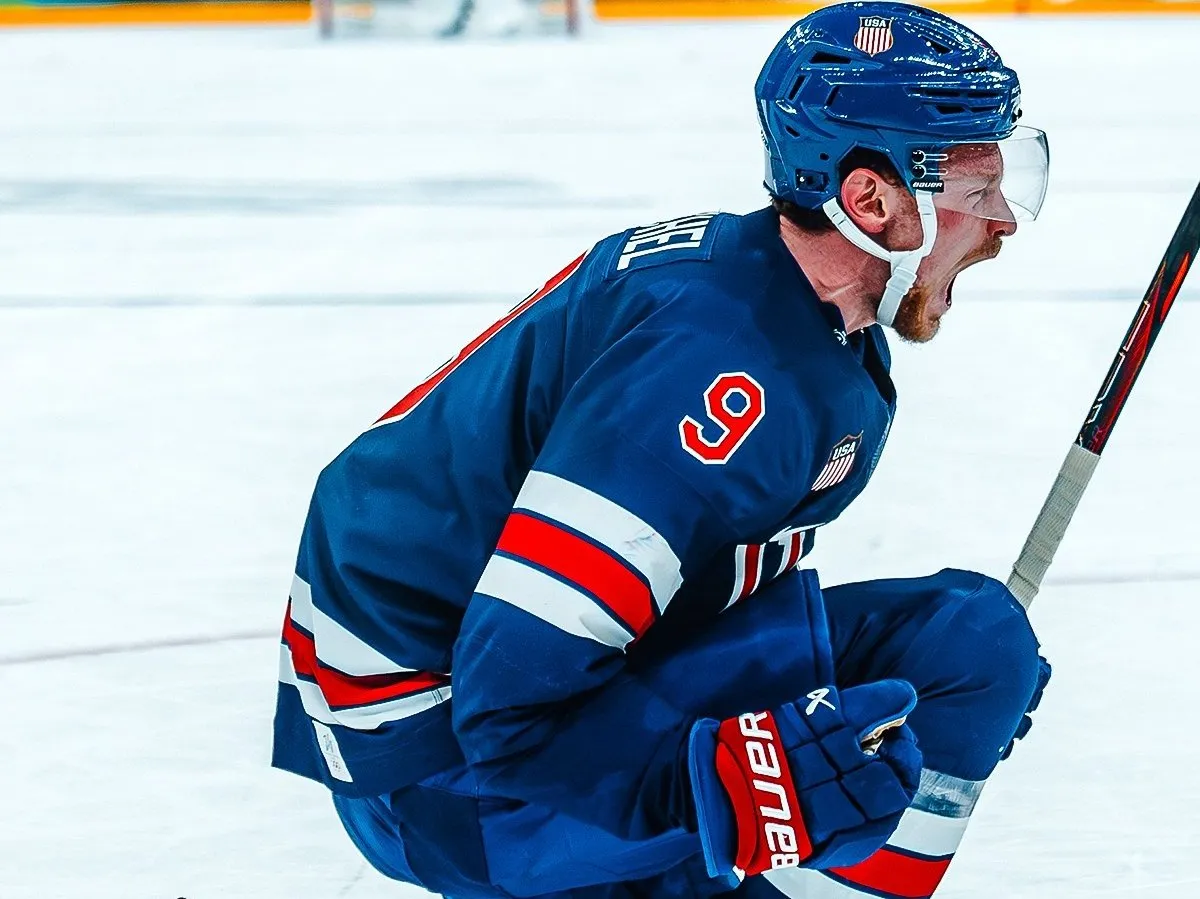

(Photo Credit: @GoldenKnights on X/Twitter)
Sadly, the Olympics are over. Now that the United States has proven its supremacy over the rest of the world in the sport of hockey, it’s time to return to the task at hand here in Las Vegas, winning another Stanley Cup.
The Olympics offered Golden Knights fans somewhat of a new look at many of the best players on the roster. With different teammates, different coaches, and different roster sizes, many VGK standouts were placed in unfamiliar roles. The condensed tournament causes all sorts of sample size issues, but there’s always something to glean from hockey games of that magnitude.
Eight Golden Knights players participated in the tournament for five different nations. Their usage varied drastically.
Jack Eichel
USA 🥇
As they do in Vegas, Team USA relied heavily on Eichel. He led all forwards in ice time by more than six minutes, and he finished with the 3rd most ice time on the entire team. For the whole tournament, Eichel centered a line between the Tkachuk brothers, and their impact was felt in all three zones. Early in the tournament, the line dominated on the forecheck and created havoc around the front of the goal. But as the Games progressed into the medal rounds, the Tkachuk/Eichel/Tkachuk line started to take on a bit more defensive responsibility. Eichel was also the fulcrum of the USA power play, in his usual spot on the half wall, and he was typically on USA’s second group of penalty killers after J.T. Miller and Vincent Trocheck.
Eichel finished the Olympics with two goals and six points while landing 25 shots. He was a +5 and played 109:39 over six games for an average of 18:16 per game. He led the team in slot shots, was second in inner slot shots, and was clearly one of, if not the most, impactful forwards on the roster.
Mark Stone
Canada 🥈
Vegas’ captain was placed on a line with Sidney Crosby and teammate Mitch Marner to open the Olympics. That line dominated pretty much every time over the boards, especially against the weaker competition in group play. Stone scored a tap-in goal on an unbelievable pass from Marner and ultimately scored two goals and four points in the tournament. He was used on the second power play unit in his usual spot near the goal line, and he was consistently used (often with Marner) as a penalty killer. Stone’s impact fell off a bit in the final two games after Crosby suffered an injury. In the gold medal match, Stone played just 14:53, landed just one shot on goal, and was the least noticeable of any of his games during the Olympics.
Mitch Marner
Canada 🥈
As mentioned above, Marner played with Crosby and Stone and had a strong tournament statistically. He tallied five points, including his game-winning overtime wondergoal, to help Canada beat Czechia and avoid disaster. Marner played the 4th most minutes by a Canadian forward behind only the mega line of Connor McDavid, Nathan MacKinnon, and Macklin Celebrini. Like Stone, he was a key cog in the 2nd power play unit and was called upon often as a penalty killer. Marner and Shea Theodore were both used on the same power play unit, with each often interchanging at the top near the blue line. It’s a look that VGK probably don’t need if fully healthy, but something Bruce Cassidy could lean on if needed. His gold medal match was one of missed opportunities. He created multiple chances for teammates, including the pass leading to the infamous Connor Hellebuyck paddle save. He walked away without a goal at 5-on-5 and silver medal around his neck, but questions about his “big game” ability were answered with the OT winner.
Tomas Hertl
Czechia
Hertl served as the #1 center for the Czechs in the Olympics and had a mixed tournament. He played big minutes for his country, averaging 18 per game, but his offensive impact didn’t come through as expected. He posted just one point in the five games Team Czechia played, and it came on a play in which he was illegally on the ice as the 6th skater (though the refs didn’t catch it). He landed 12 shots with most of them coming from dangerous areas, but none found the back of the net. As he does in Vegas, Hertl played the bumper spot on the power play, but the traffic in best-on-best hockey made it hard for him to get clean looks as he does with the Golden Knights. Team Czechia will view the Olympics as a success, nearly defeating Canada, but Hertl will likely look back at his individual performance, wishing he’d done more.
Shea Theodore
Canada 🥈
The most memorable moment of Shea Theodore’s Olympics, and maybe his life, will be the goal he scored in the semifinal to tie the game against Finland. Theodore was listed as the 7th defenseman for most of the games Canada played, but he was rarely the least-used defenseman on the team. Head coach Jon Cooper used Theodore almost exclusively in offensive situations, and he saw his minute share increase when Canada was chasing games. He wound up with the 5th most minutes among Canada’s seven defenseman, outpacing Drew Doughty by two seconds. He continued to prove to be an offensive dynamo, but his place as a true #1A defenseman was not backed up on the biggest stage.
Noah Hanifin
USA 🥇
Like Theodore, Hanifin was listed as the 7th defenseman for Team USA. Unlike Theodore though, he was actually used that way. Despite being active for all six games the Americans played, Hanifin registered just 56:08 and played only 5:46 (vs Sweden) and 6:03 (vs Canada) in the two most competitive games. He did, however, have a pretty strong impact on the games when he was in there. He scored a big goal in the game against Denmark, in which Team USA were struggling, and he finished with three points. He was also used sparingly on the American penalty kill, which finished the tournament a perfect 18-for-18.
Rasmus Andersson
Sweden
It’s hard to believe, but the Swedes opted to healthy scratch Andersson for three of the team’s five games, including both elimination games. In the two games he did play, he averaged 16 minutes per game and played with Victor Hedman. He did not record a point but was offensively active and looked fine in his own end. The most shocking moment of the entire tournament, and possibly the most telling, was when Hedman suffered an injury before the game against the US. Instead of swapping in Andersson, Swedish coach Sam Hallum said they preferred an injured and unable to play Hedman on the bench. The Golden Knights gave up a lot to get Andersson and still have to figure out what his next contract will look like. The Olympics could be just a blip on the radar, but what happened in Milan was ominous.
Akira Schmid
Switzerland
As expected, the Swiss leaned heavily on their legendary 38-year-old goaltender Leonardo Genoni. Schmid started just one game, the second of a back-to-back against Team Canada. He allowed five goals on 39 shots but looked pretty good in the net. He made a few incredible saves, the best of which was a scorpion save on Crosby, and kept Switzerland in the game a bit more than many expected. He served as the backup in all but one other game.
**Huge shoutout to HockeyStats.com for keeping updated in-depth stats during the 2026 Olympics.**