
tl;dr: It may actually be good to be a very young team in NHL in 2026, because the league may get younger over the next few years.
Let me explain why I think that way.
First, where this team is. Per Hockey Reference’s team age data (available since ’99 season), the Sabres have been the youngest team in the league for the past 3 seasons. That’s nothing new for this team, as it’s been the youngest 6 times during the Drought & one of the 7 youngest every year since ’14 season. If you use NHL experience instead of age, things might’ve even more extreme as this team had many “vets” who were/are just fringe NHLers. That’s what a rebuilding team looks like.
Currently, the Sabres are 26.5 year old on average. Still young, but not as young as last 3 seasons (26.1, 25.7 & 26.1).
There aren’t many very young (or very old) teams anymore.
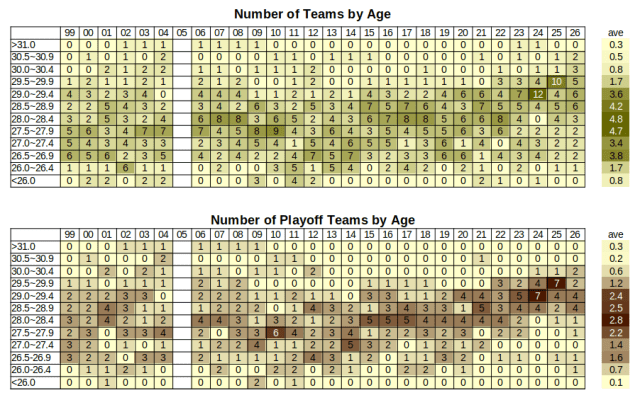
Here’s the table/heatmap of team age, both the league overall & for the playoff teams since ’99 season. You can see that the range has narrowed & there haven’t been that many very young or very old teams in the past decade. Not only that, lower % of teams <28.0 or >30.0 made the playoffs in the past decade, while % has gotten slightly higher for the teams between 28 & 30.
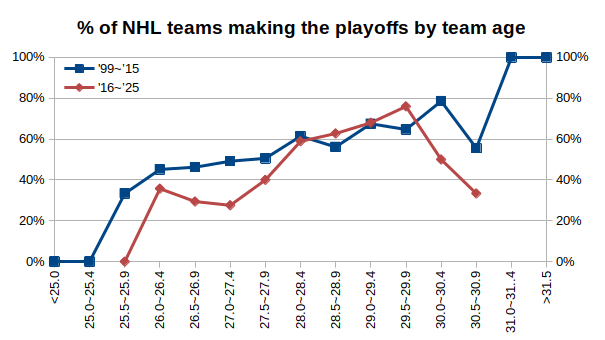
In short, as it became more difficult to make the playoffs with more teams added since ’99 (28->32), it was very young (& old) teams that took the hit.
A side note. Making the playoffs is harder than ever now with 32 teams (16/32). Back in 1980 when NHL went to 16 team playoffs, there were only 21 teams (16/21 or 76%). Before that, 12/17 (71%) in ’79. Making the playoffs now is considerably harder than any season other than ’73 & ’74 (8/16).
Average league age has fluctuated over time.
While long-term improvement in training, medical care, etc. probably means the league getting older over time, it hasn’t been steady in the last 3 decade & other factors (e.g. rule changes) also had mid/short-term influence. The change is probably easier to see in a chart like this:
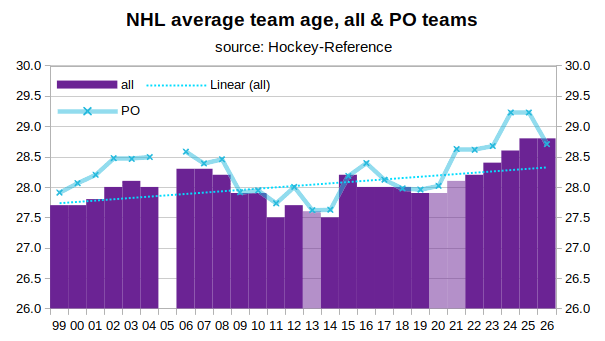
What else is noticeable in the data? It’s what a work stoppage has done to the average league age. Since ’99 season, there have been 4 shortened seasons coming in 3 separate occasions: ’05, ’13 (lockouts) & ’20/’21 (pandemic). What you see in the data is that a work stoppage in NHL tended to be followed by a brief increase in team age, both overall & for playoff teams. It’s not hard to guess why that may be. Less wear & tear for vets probably is a factor & prospects getting fewer chances probably is also a factor. Let’s look at each of the 3 occasions in more details.
’05 lockout.
2004-05 season was totally lost & it was followed by probably the most significant set of rule changes in the past 3 decades. Average team age was creeping up at the end of the Dead Puck era, but was stable for 3 years before the lockout (28.0, 28.1, 28.0). After the lockout, it went up a bit for a few years (28.3, 28.3, 28.2), but that was the start of the decade-long trend in teams getting younger. The rule changes favoring younger, faster teams meant a lot of young teams had success during that time. Sabres (’06 & ’07) were one on them, but also PIT, WSH, CHI, etc. as well. In this case, it’s probably reasonable to say the lockout pushed the league age up slightly, but the rule changes fairly quickly canceled that out & some.
’13 shortened season.
Probably the most insignificant of the 3 occasions, as it was just 48 games instead of 82. It also came as the league was trending younger after the ’05 lockout. We do see an increase in league age, but that was a bit delayed. The league was at its youngest in 26 seasons before the lockout (27.5 in ’11 & 27.7 in ’12) & it stayed there through the lockout (27.6 in ’13 & 27.5 in ’14). The league age jumped to 28.2 in ’15, but quickly came back down to 28.0 in ’16 & stayed stable until the pandemic (27.9~28.1 until ’21). Similar deal for the playoff teams. This lockout wasn’t that big of a deal, but may have stopped the decade-long trend in teams getting younger.
Pandemic-shortened seasons.
’20 season was a mess & ’21 wasn’t much better. Combined, it may have had more influence on NHL than ’05 lockout. What’s more, it was not just NHL this time. It affected everyone, especially prospects going through important development years. This topic has come up in the discussions on players like Quinn & Power on this site. So how did the the league age change after the pandemic? As already mentioned, it was very stable from ’16 to ’20 (28.0, 28.0, 28.0, 27.9, 27.9). But it started going up steadily from there. It went up a bit in ’21 (28.1) and kept on going up (28.2, 28.4, 28.6, 28.8) for the next 4 seasons until the last season. Average playoff team age saw a more drastic change. From being stable (28.1, 28.0, 28.0, 28.0 from ’17 to ’20) to 28.6 in ’21, the highest at least since ’99. It didn’t stop there. It went 28.6, 28.7, 29.2 & 29.2 from ’22 to last season (’25). Average playoff teams getting older by 1.2 yrs just in 5 seasons. Over the previous 21 seasons, the range was 27.6 (’13 & ’14) to 28.6 (’06). The increase since the pandemic was bigger than the drop in playoff team age after the ’05 lockout which took a decade.
What does it mean to the Sabres?
It sucks to be going younger when the league overall is getting older.
First, the misfortune for GMKA & HCDG was that they had to go younger after the Great Purge of 2021 just as the league was getting older. In that 91 point season (’23), the Sabres were not only the youngest, but also as “younger” as ever compare to the playoff team average (2.6 yrs younger). The Sabres haven’t been that much “younger” since ’02 (2.5) & ’03 (2.6). The biggest age difference during the Drought before that came in ’16 (2.1), but the difference has typically been ~1.5 for much of the Drought. Then came ’24 season when the difference jumped again to whopping 3.5 (Andy out, Benny in, etc.). It got a bit better last season (’25), but not by much (3.1). With that, HCLR did worse than HCDG & I can’t blame either of them. They were both swimming upstream if you will. In this context, I say this team has performed admirably over the last few seasons. Here I added the data for the Sabres to the chart I posted above. You can see how much “younger” this team has been in recent seasons.
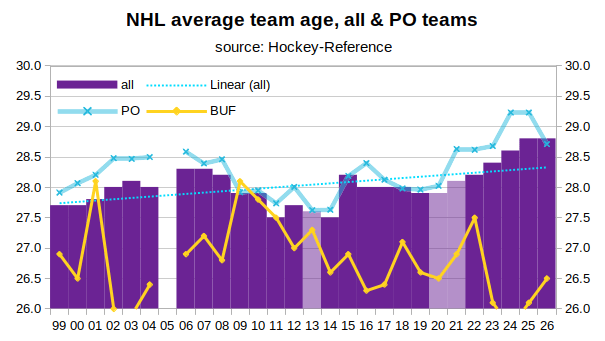
The league getting older may be temporary.
Nonetheless, the tide may have turned. At the end of last season, I noted that, while the league overall got even older (28.6 to 28.8), the playoff teams did not (29.2 to 29.2). I posted that maybe the pandemic-induced increase in league age was just about peaking & that was good news for the Sabres. Before the pandemic, majority of the 10 youngest teams making the playoffs wasn’t unusual (e.g. 6/10 in ’18 &’19). Then it became rarer (2/10 in ’22 & ’23, bottoming out with 0/10 in ’24). Last season, 2/10 youngest (MTL & OTT) made the playoffs.
How does it look for this season?
If things stay the same after the Olympic break, overall league age may still go up a bit (currently at 28.8, the same as last season), but playoff team age will go down (currently 28.7, compared to 29.2 last 2 seasons). Four of 10 youngest teams will make the playoffs. 5/10 if CBJ gets in (quite possible). Playoff teams will likely be significantly younger than the league overall this season, and that hasn’t happened at least since ’99.
So it does look like the league is about to get younger over the next few seasons. This Sabres team is 2.3 years younger than the league overall & 2.2 yr younger than the playoff team average as of now. Still a very young team in a league that is as old as ever. With that in mind, maybe GMJK should think twice before moving prospects/picks for immediate vet help, as tempting as that may be. With the Skinner tax next season, this team will get a bit younger next season anyway & most of HCLR’s best teams were young ones (’99, ’06, ’07, ’23, & ’26???).
p.s. Back in ’23, Lindy made a very young NJD (a year younger than any other playoff team) overachieve & got them to the 2nd round. The following season wasn’t so good as the league got even older & he was fired. Very similar to what happened to Donny Meatball. NJD kept on adding vets & barely squeaked into the playoffs the following year (’25). Now that team is among the oldest & floundering. Meanwhile, the Sabres didn’t add many vets & Lindy is leading a very young team into the playoffs just as the league may be getting younger. Ironic, isn’t it?