
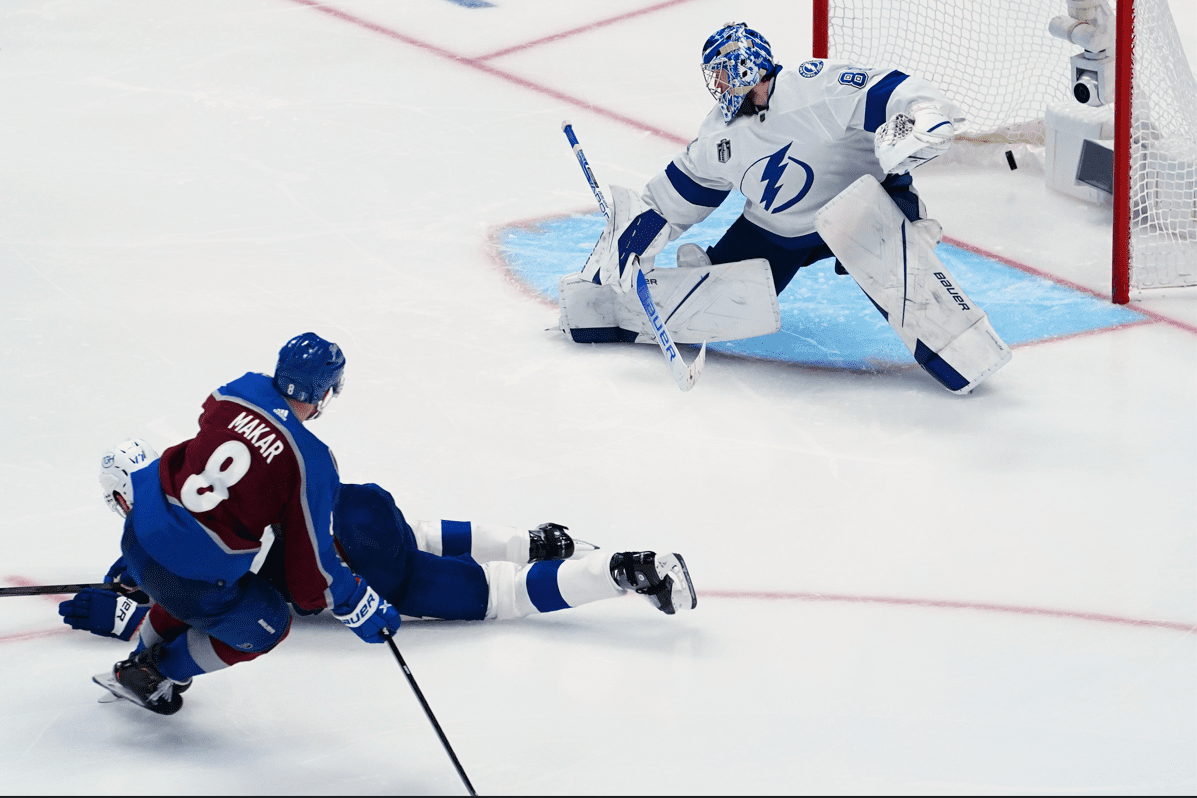
Amid the tumult that prevailed in Ball Arena Saturday night, Avalanche defenseman Josh Manson jumped up into the play and found himself speeding in on a 2-on-1 with veteran center Andrew Cogliano (whose broken finger, by the way, seemed fine).
Cogliano carried the puck on the left side, then fed Manson breaking down the right side, and Manson’s shot beat Lightning goalie Andrei Vasilevskiy clean to the stick side.
The goal gave the Avalanche a 2-0 lead at 7:55 of the first period in what turned out to be their 7-0 rout of the two-time defending champion Lightning in Game 2 of the Stanley Cup Final.
And to think that Josh Manson — the son of former NHL defenseman Dave Manson, now an assistant coach at Edmonton — in his mellow mid-teen years came close to quitting hockey to focus on snowboarding.
It was the 15th goal by a defenseman in the Avalanche’s 16 playoff games, and not for one second did anyone wonder out loud: What was an Avalanche defenseman doing that far up in the play?
That’s what they do.
And not just wunderkind Cale Makar, who had 28 goals in the regular season and in the third period got his sixth and seventh in the playoffs as the Saturday rout played out. One was on the power play, one was short-handed. (That pushed the total from the Avalanche D in the playoffs to 17.)
That’s the game, albeit with its offshoots, that has the Avalanche with a 2-0 lead in the series, with Game 3 coming up Monday night at Tampa. And it’s happening without Nathan MacKinnon ringing up the points, since he has two assists in the two games.
“The speed is what we like to stick to and we think that’s how we have to beat them,” Manson said. “They’re a patient team. They have good structure below the top of the circles, so we just have to keep playing like that.”
The Avalanche come at everyone — from everywhere, including from the D.
“I feel like we played to our identity to a ‘T’ tonight,” said Makar. “We had some good goals and stuff like that. … It was a little bit of a weird one tonight. Obviously, we’re getting opportunities but guys were able to able to capitalize, so that’s good part.”
Offensive aggressiveness doesn’t have to mean defensive irresponsibility.
Given this is a copycat league — as are all leagues — it might become a trend, at least for the teams with the requisite talent.
In fact, we probably haven’t given the Avalanche, plus Jared Bednar and Nolan Pratt, enough credit for boldness. Pratt, who has his name on the Stanley Cup as a player with the Avalanche (2001) and Lightning (2004), is in charge of the Colorado D.
It’s even a bit revolutionary.
When the Avalanche had been in Denver less than a year and were about to face the Florida Panthers in the 1996 Stanley Cup Final, I was enlisted to write a long narrative introducing the team to the many “new” hockey fans in the market climbing aboard the bandwagon.
I went over the handful of major trades GM Pierre Lacroix had made either as the season approached or during it, acquiring, among others, Claude Lemieux and disaffected Canadiens goalie Patrick Roy. But the deal I said was somewhat underplayed was Lacroix’s trade of standout power forward Owen Nolan to the Sharks for defenseman Sandis Ozolinsh.
In fact, when the trade was made, I was in Columbus, doing a story on Orlando Pace, Eddie George and the Ohio State Buckeyes as I finished up my commitment to The Sporting News. An Avalanche team official, knowing of my imminent return to the NHL beat in Denver a decade after covering the Colorado Rockies for five seasons, called me and briefed me on the deal. Before long, I realized that the Avalanche’s assessment of Ozolinsh as one of the final pieces was astute.
Soon, to me, he was The Wandering Latvian.
In that pre-Finals narrative, I described him as “one of the handful of defensemen in the NHL who is a major puck-rushing, free-skating, from-the-blue-line or break-to-the-net offensive threats.”
I also noted: “The period of adjustment was painful to watch at times, but Ozolinsh eventually figured out his role and settled in to provide the Avalanche with what they needed – an attacking defenseman, but in the right spots.”
The final words — “the right spots” — probably were charitable.
All spots were the right spots for “Ozo,” who held the franchise record for goals by a defenseman, at 23, until Makar passed it this season.
Ozolinsh’s defensive partner, most often the soft-spoken Jon Klemm, was charged with staying back, playing conservatively and compensating. (Those were Klemm’s instincts, anyway.)
The relevance here?
Among the ways the game has changed since the 1995-96 Avalanche delivered Colorado’s first major league championship is that Bednar — himself a rugged journeyman defenseman in pro minor leagues — and Pratt haven’t just given all their D-men carte blanche to jump into the play.
It’s their duty.
It’s a mandate.
The closest to a classic pairing of an offensive-minded D and a cover-for-him partner was when the undersized and mobile Samuel Girard was with Manson before Girard was sidelined for the rest of the playoffs after suffering a broken sternum in the second round against St. Louis. But even then, Manson jumped up when he had the opportunity. Now Manson is paired with Jack Johnson.
And they could be hoisting the Stanley Cup as soon as Wednesday.
Terry Frei ([email protected], @tfrei) is a Denver-based author and journalist. He has been named a state’s sportswriter of the year seven times in peer voting — four times in Colorado and three times in Oregon. His seven books include the novels “Olympic Affair” and “The Witch’s Season.” Among his five non-fiction works are “Horns, Hogs, and Nixon Coming,” “Third Down and a War to Go,” “March 1939: Before the Madness,” and “’77: Denver, the Broncos, and a Coming of Age.” He also collaborated with Adrian Dater on “Save By Roy,” was a long-time vice president of the Professional Hockey Writers Association and has covered the hockey Rockies, Avalanche and the NHL at-large. His website is www.terryfrei.com and his bio is available at www.terryfrei.com/bio.html
His Colorado Hockey Now column archive can be accessed here