
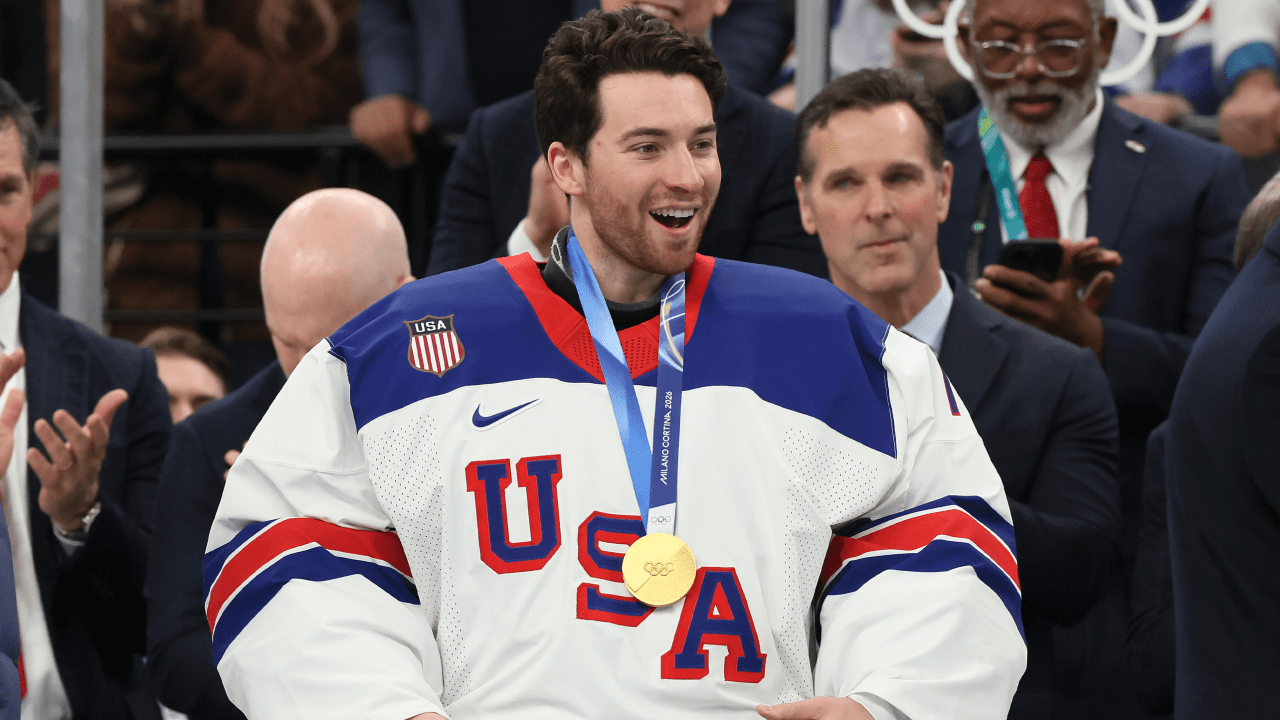
* * *
But it didn’t start that way.
It was late in the third period that the puck flew through traffic from the high slot, its path taking it over Swayman’s left leg, ticking off his knee and up into the goal. It was the fifth goal for Norway — not exactly a powerhouse team — in the preliminary round game at the World Championship, as it climbed back into a contest it should not have been able to climb back into.
And though the United States would end up winning, in overtime, on a goal by Tage Thompson, giving up five goals to Norway was not what Swayman had hoped for his experience at the World Championship.
It was, in some ways, more of the same. So he went back to basics.
“It was the one time where just him and I got on the ice for half an hour and we just did the most boring goalie drills you can think of,” Speer said. “Doing those basic drills, he just was like, ‘OK, this is it. I’ve got to feel that. That’s it. That’s the feeling.’”
It was a feeling he had felt before in the NHL, including during his outstanding run in the 2024 playoffs, in which he had a 2.15 GAA and .933 save percentage in 12 games, pushing the Bruins into the second round against the eventual Cup champion Florida Panthers.
It was the feeling that he had at his best, a best that he — and others — believe stands among the tops in the world.
It was the feeling he had been chasing.
Swayman understood the confidence that Speer had in him. And, in turn, the goalie trusted Speer, even though they had never previously met. As Swayman put it, “I didn’t necessarily have the belief in myself that he had in me at that time and I just told myself, like, ‘If he believes in me, why the [heck] can’t I?’ And it was that simple.”
Swayman saw he had devolved into hoping he would win, rather than believing he would, rather than knowing, the way he had always been before.
“And [Speer] was like, ‘Your chin is down, your eyes are on the puck, you’re going to stop it every time,’” Swayman said. “That was really, really good for me to hear that.”
It was what he needed, the concept that, “yes, you could be self-critical but also be nice to yourself,” as he put it.
“Goals go in all the time, right?” Speer explained. “And I talked to him about, what is a real emergency in your life? Your house is on fire. Something happens to your family. That’s real. But goalies will treat goals-against like that. It’s like they question themselves, they question who they are, on a goal or a bad game and they’re sitting there and they’re second-guessing everything. It’s like, you’ve made these saves, you’ve been amazing your whole career, be amazing. And he was.”
Daccord got one more start after that game against Norway. But it would be his last, with Swayman getting the final two games of the prelims, and on into the quarterfinal against Finland.
“I think winning that game, Sway was back after that,” Speer said, of the Finland win. “I think after that game he knew he was the guy. He even grabbed me after one of the games, said we’re winning the gold. I think it was the semis [against Sweden]. He said, ‘We’re winning,’ and I believed him. There was no question about it.”
There was, indeed, no question. Even when the final went into overtime, Switzerland and the U.S. tied 0-0.
“As the fans in Boston have seen, he’s a very charismatic, full-of-energy type of goalie and he’s at his best when he’s showing his emotions,” Daccord said. “I noticed right away that he was locked in [that game], just because of the way he was moving, the interactions we had, with his teammates, he just seemed ready to go. And he obviously played amazing.”
He was back.
“He came over for a reason, to prove everybody wrong or right or however you want to look at it,” Speer said. “[He got his] swagger back. One hundred percent. He knows he can be the best goalie in the world if the situation appears. He knows he can do it. And he can be. He’s an unbelievable goalie.”