
Twice each year, the NHL — and the Carolina Hurricanes — enter their version of “silly season.”
In the summer, as free agency opens and the new league year begins, all 32 NHL teams believe they can at least make the playoffs the following season. Contracts are expiring, new deals struck, contracts extended. Each team tries to become the best possible version of itself, and sell that optimism to a fan base pining to watch a parade the following June.
Advertisement
And then, there is trade deadline season in early March. This year, Friday, March 6 at 3 p.m. is the cutoff, the last possible moment any of the league’s teams can complete a trade call. In this part of the cycle, teams have completed about 75 percent of the season. The playoff picture is mostly in focus, and top contenders are looking to become the top contender.
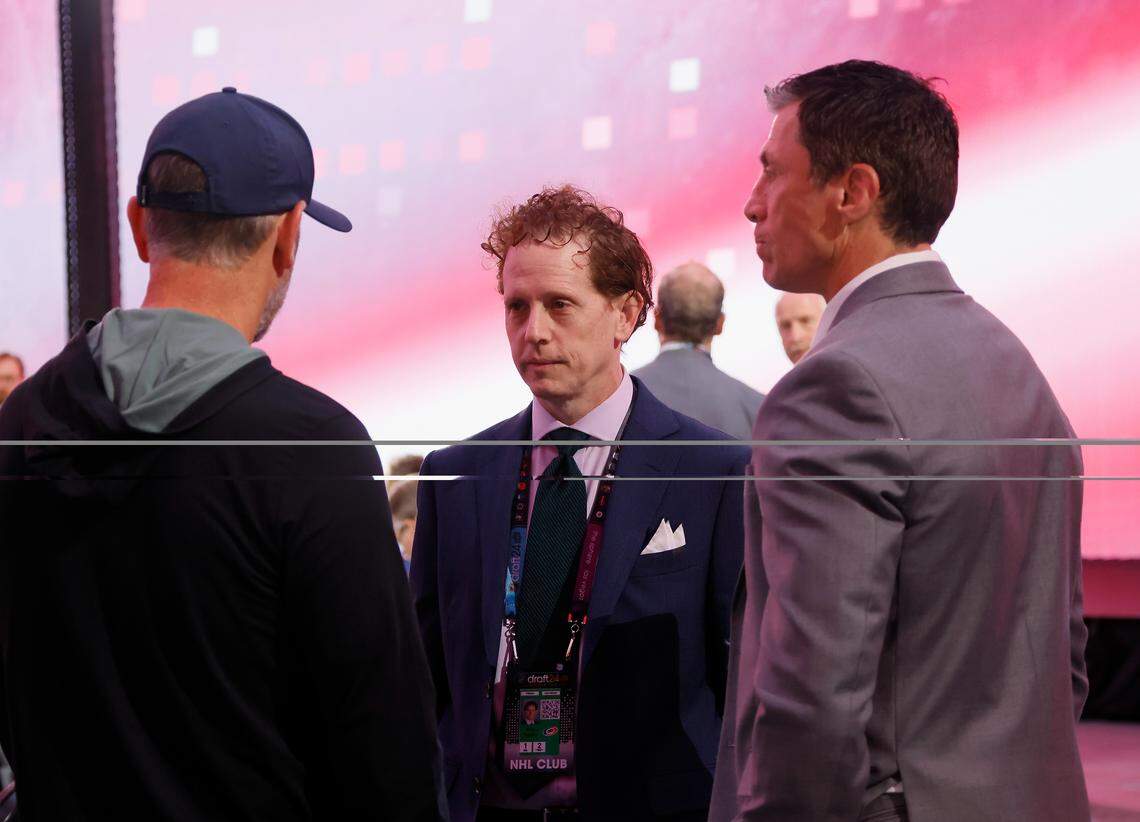
The Hurricanes have been no stranger to either scenario over the years, though most recently the latter has been true, and general manager Eric Tulsky, just shy of completing his second full year at the helm, has already proven to have a penchant for swinging big.

Carolina Hurricanes general manager Eric Tulsky smiles during a press conference on Tuesday, June 3, 2025, at Lenovo Center in Raleigh, N.C.
(Kaitlin McKeown/The News & Observer)
In the Hurricanes’ 5-2 win over Detroit on Saturday night at Lenovo Center, Carolina extended its points streak to 12 games and further cemented its status among the Eastern Conference elite.
Advertisement
One of the Canes’ mid-season acquisitions a year ago, Taylor Hall, got things rolling for Carolina on Saturday with the first goal of the game on a breakaway against Detroit’s Cam Talbot, and Shayne Gostisbehere set up Sebastian Aho back post on a power play for the Canes’ second of the night in the waning seconds of the first period. Hall and Gostisbehere each finished with three points.
Eric Robinson extended the Canes’ lead to 3-0, stuffing home the puck through Talbot less than five minutes into the second, and Carolina appeared to be on cruise control.
A pair of Detroit goals late in the second — a Simon Edvinsson wrister off the junction of the crossbar and post at 18:26, and a Patrick Kane wrister 47 seconds later following a bad Jackson Blake turnover — pulled the Wings within one at 3-2..
But Gostisbehere reestablished the Canes’ lead early in the third with a wrister from the left circle past Talbot’s glove, and Blake added another at 5:30 of the third to put the game out of reach. Frederik Andersen finished with 27 saves for his eighth win of the season, and he looked far more composed and confident than he had in starts prior to the Olympic break.
Advertisement
Saturday’s result — and indeed the past month’s results — aside, every contending team will keep a keen eye on the market.
The Hurricanes are among the contenders with the best financial situation, in terms of immediately available cap space. The Canes can take on salary that most buyers cannot, which makes them a great trade partner for sellers looking to shed salary.
Why?
Because a selling team may take less in actual return value (players or picks) if it doesn’t have to retain salary.
This would be important in the case of a “rental,” a player with an expiring contract looking to make a run at a league title before testing free agency over the summer. But it could also be important for longer-term roster construction, because …
Advertisement
Canes have upcoming salary cap additions
There is another consideration here when looking at the Canes’ gaping cap space: That gap is going to shrink significantly this summer. Currently, Logan Stankoven counts for about $814,000 toward the cap, and Jackson Blake another $905,000. Next year, Stankoven begins an eight-year deal worth $6 million per season, and Blake settles into an eight-year pact worth $5.1 million per season, for a total of $11.1 million, a combined net addition of $9.4 million.
If the Canes add salary with term at the trade deadline, it wouldn’t negatively affect roster construction in the short term, but it would certainly impact the way the team handles its roster business next summer and beyond.
The Canes are also in a unique position in the NHL in that not only is the roster as currently constructed completely under contract — and without any long-term injury designations — this season, but outside of Mark Jankowski (F), Mike Reilly (D) and Andersen (G), the Hurricanes’ players are all under contract next season, as well.
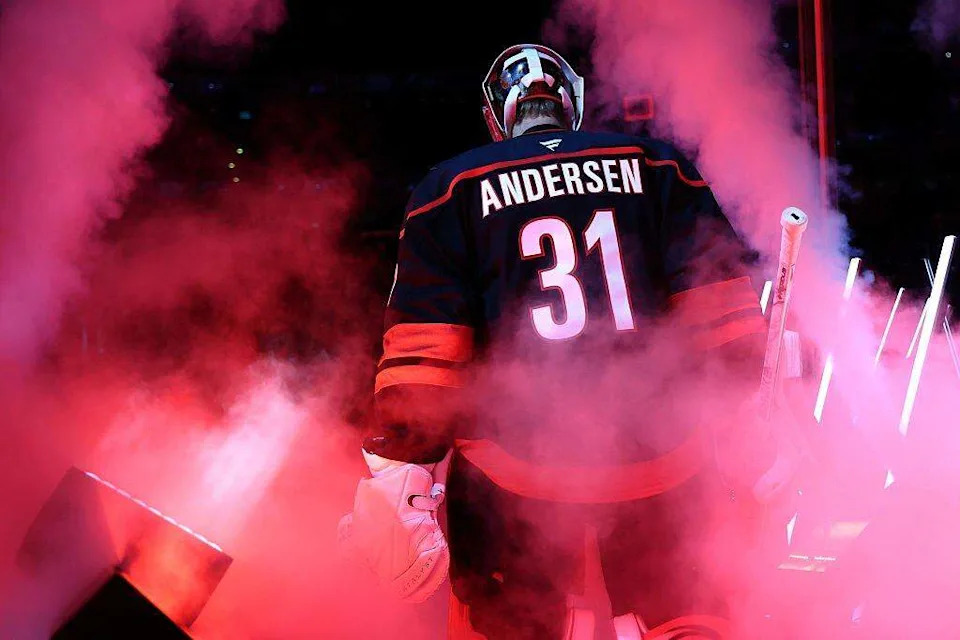
Frederik Andersen of the Carolina Hurricanes is introduced prior to the game against the New Jersey Devils at Lenovo Center on October 09, 2025 in Raleigh, North Carolina.
(Jared C. Tilton/Getty Images)
Beyond that? The Canes only have four players — Gostisbehere, Jalen Chatfield, Jordan Martinook and Jordan Staal — hitting free agency after the 2026-27 season.
Advertisement
The good news here, of course, is that the team’s core is locked up for a while, and given the team’s results the past several years, that’s a good thing. But …
Can the Hurricanes get over the hump?
Any team that has wallowed in squalor for a long period of time has a different outlook when it once again finds success. For the Canes, making the playoffs in 2019 after a nine-year drought was cause for celebration. A trip to the Eastern Conference Final that season — sweep notwithstanding — was gravy.
The team’s subsequent sustained regular-season success validated its turnaround, and a second trip to the NHL’s version of the Final Four in 2023 cemented Carolina’s status as a “perennial contender.”
Advertisement
But another sweep — a third ECF loss-by-sweep since their lone Stanley Cup win in 2006 — left a sour taste.
But … BUT … things were trending properly. The core was growing.
A year ago, another ECF appearance begat three more losses in a row, pushing the skid in that round to 15 before a Game 4 win over the Florida Panthers snapped the streak. A loss in Game 5, though, left the Canes with a 1-16 record in four ECF appearances; 1-12 under head coach Rod Brind’Amour.
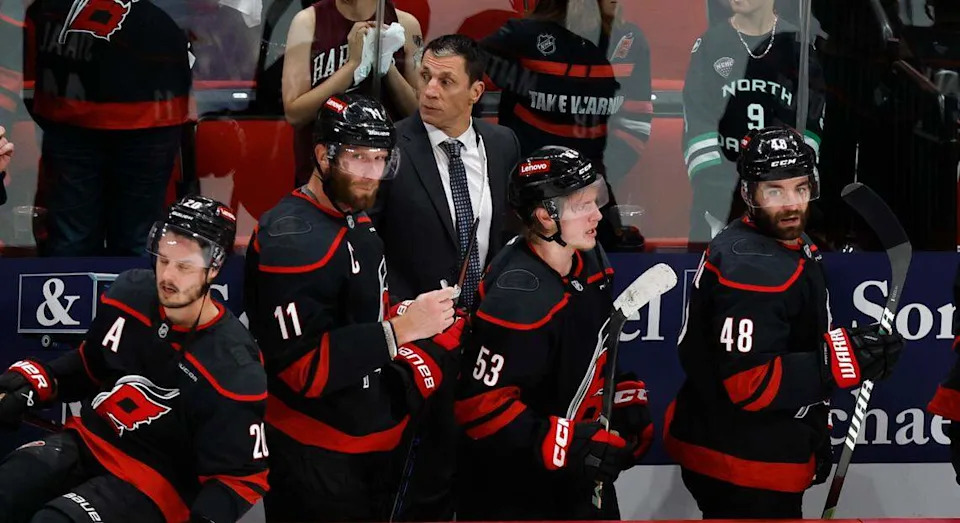
Carolina Hurricanes head coach Rod Brind’Amour walks towards the locker room after the Florida Panthers’ 5-2 victory over the Carolina Hurricanes in Game 1 of the Eastern Conference Finals at the Lenovo Center in Raleigh, May 20, 2025.
(Ethan Hyman/ehyman@newsobserver.com)
From playoff drought, to surprising run, to sustained success, to several “almosts,” the team’s trajectory suggests a breakthrough is imminent. But its results also beg the simple question:
Advertisement
“What’s missing?”
In the NHL, there really is no secret sauce. There are commonalities, of course, among Stanley Cup champions: Depth to handle inevitable injuries and add scoring punch; Strong special teams to handle the inevitable penalty calls (deserved or otherwise); Timely goaltending to protect inevitable defensive lapses.
Any moves the Hurricanes make should address one of those needs.
So, who’s out there?
Many factors go into teams’ trading decisions, including whether a player wants to cooperate (or has the contractual ability to dictate his path). And, for the players, skating for a title contender sometimes isn’t enough by itself. Family matters. Location matters. Belief in their quality of life matters. Teammates matter. Playing style matters.
Advertisement
Any list of potential trade targets has to take those factors into account, and much of that can be presumptive, based only on supposition.
That said, let’s “suppose.” Here is a look at a handful of players recently linked to the Hurricanes, or who should be. All salry figures courtesy Puckpedia.com.
Jordan Binnington, G, St. Louis
Cap hit: $6 million; Under contract through: 2026-27
A Stanley Cup-winning goalie for the floundering St. Louis Blues, he’s had a rough year statistically, but he showed during the Olympics what he can do when a team plays defense in front of him. And the Hurricanes, last we checked, play an elite defensive system. Binnington has also shown a knack for coming up big in pressure situations. While the Hurricanes have three goalies locked up for next season, they could afford Binnington’s contract outright and carry three goalies (Pyotr Kochetkov is out for the season) and deal with the logjam this summer, or trade Frederik Andersen (or Kochetkov) as part of the deal.
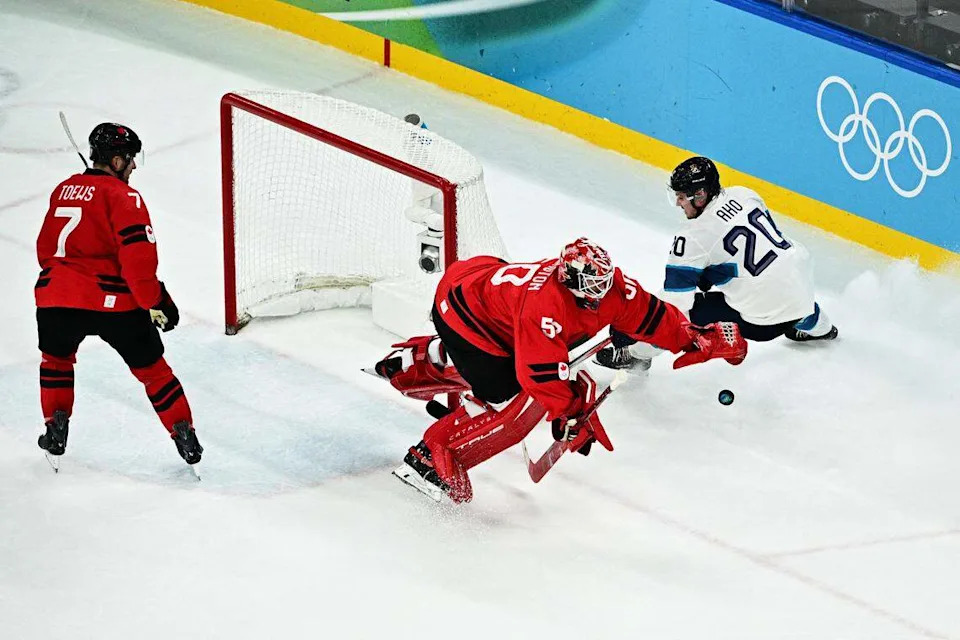
Canadian goalie Jordan Binnington dives for the puck as he defends against Finland’s Sebastian Aho during the men’s semifinal between Canada and Finland at the Milano Santagiulia Ice Hockey Arena during the Milano Cortina 2026 Winter Olympic Games in Milan, on Feb. 20, 2026.
(JULIEN DE ROSA/AFP via Getty Images)
Vincent Trocheck, C, New York Rangers
Cap hit: $5.625 million; Under contract through: 2028-29
Advertisement
Trochek is of course no stranger to the Hurricanes. Part of a surprise acquisition in 2020 from the Florida Panthers, Trocheck played two full seasons with Carolina, through 2022, before leaving for the Rangers in free agency that summer. His playoff numbers have been strong, he would add grit and snarl to the forward group, and he can win faceoffs. This year, Trochek has won faceoffs at a 56.5% clip while playing more than 20 minutes per game. The knock on targeting Trocheck would be what it might cost the Canes to acquire him. He is owed $5.63 million per season through 2028-29, when he will be 35 years old, and he will be in high demand after a successful Olympic experience.
Elias Pettersson, C/LW, Vancouver Canucks
Cap hit: $11.6 million; Under contract through: 2031-32
Pettersson has a great agent. He’s among the top earners in the National Hockey League, but hasn’t produced points commensurate with his salary. Part of that, of course, is where he plays: He has played in just two playoff series with the Canucks in seven seasons, and they won’t be in the postseason this year, either. His top point-production came in 2022-23 (102), and he has an underwhelming 35 points in 50 games this season. He also wins fewer than 50% of his faceoffs — not great for a 1C (or 2C) who would likely see time on a power play. Trading for Pettersson would feel like a high-risk, medium reward scenario and would likely require some salary retention.
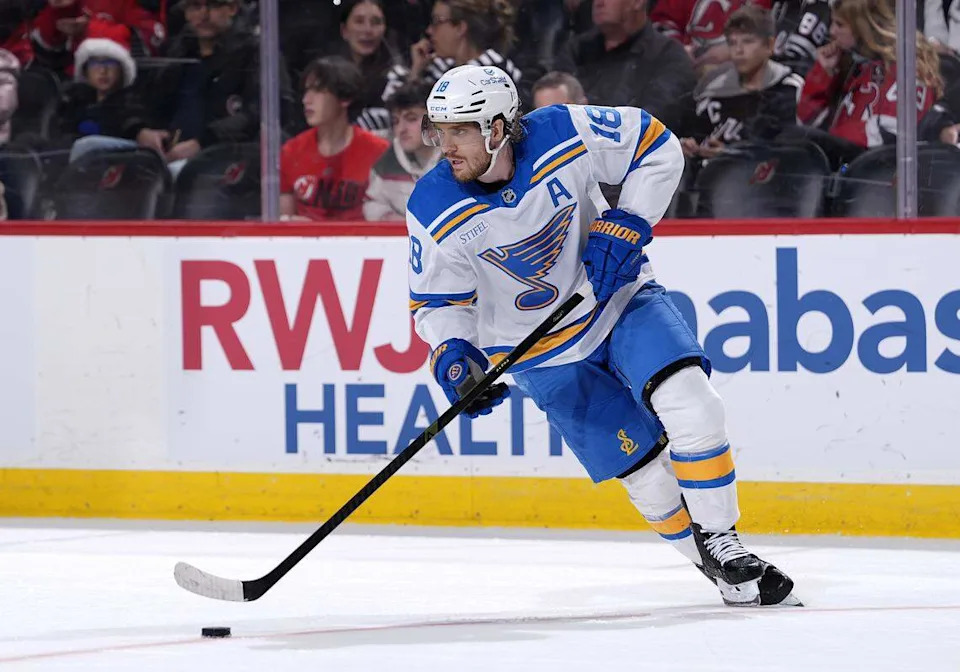
Robert Thomas of the St. Louis Blues controls the puck during overtime against the New Jersey Devils at Prudential Center on Nov. 26, 2025 in Newark, New Jersey.
(Elsa/Getty Images)
Robert Thomas, C, St. Louis Blues
Cap hit: $8.125 million; Under contract through: 2030-31
Advertisement
With the salary cap on the rise, this contract is more than doable for the Hurricanes, and good, young, right-shot centers in their mid-20s don’t grow on trees. But given all of that, the Blues, who are entering a significant retool, will want significant compensation. Think Alexander Nikishin and more. If the Canes make another deal for a defender beyond something for Thomas, that might make sense, but if this would be the only deal the team makes, giving up such a promising young defender would be tough to swallow. Thomas does have winning credibility: Stanley Cup, Memorial Cup, World Juniors. Thomas also plays in all situations, and would be a great fit in Brind’Amour’s system. Of all of the available centers, Thomas is the best fit. His price tag may be the deterrent here.
Ryan O’Reilly, C, Nashville Predators
Cap hit: $4.5 million; Under contract through: 2026-27
If in nine years, Thomas can say his career has mimicked Ryan O’Reilly’s, he should be quite pleased with that. O’Reilly is a veteran centerman who’s still finding scoreboard success this season in Nashville at a point-per-game clip. A former St. Louis skater, O’Reilly also has a Stanley Cup win in 2019, and adds a measure of grit to whichever team he’s on. He’s also almost a PPG player in the playoffs over his career. His cap hit would be favorable, the Canes wouldn’t have to ask anyone to retain money, and he wins faceoffs at a 55.1% clip while playing the most minutes among forwards on the Predators roster. O’Reilly would potentially be a great fit in Raleigh.
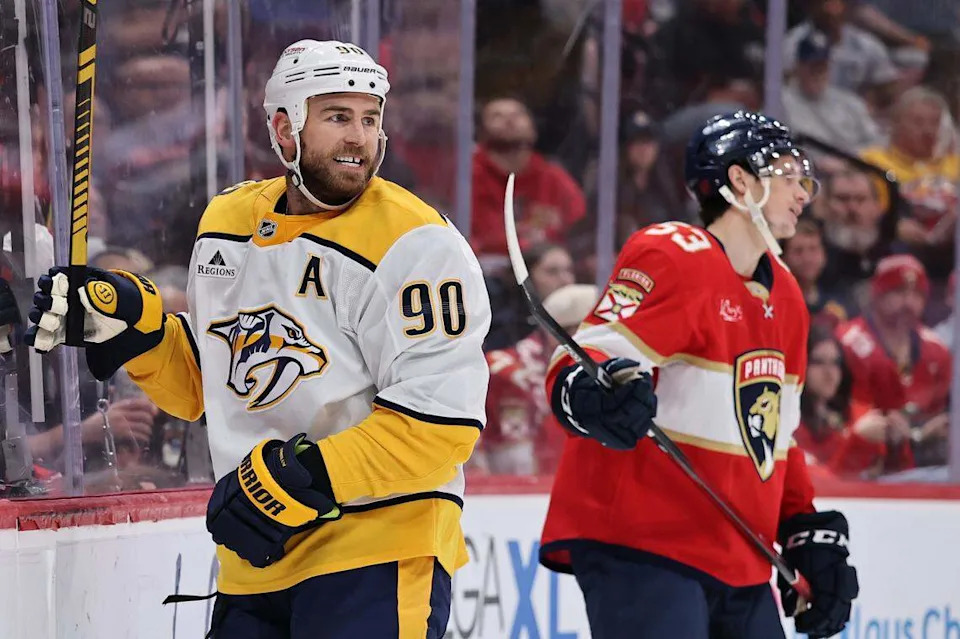
Ryan O’Reilly (90) of the Nashville Predators celebrates scoring against the Florida Panthers during the third period at Amerant Bank Arena on Dec. 4, 2025 in Sunrise, Florida.
(Carmen Mandato/Getty Images)
Charlie Coyle, C, Columbus Blue Jackets
Cap hit: $5.25 million; Under contract through: 2025-26
Advertisement
Coyle is really the only true “rental” among the forwards on this list, because the Canes typically don’t go for rentals. That’s not to say they wouldn’t try a short extension with the 33-year-old Coyle, but it will be interesting to see what he does as he hits free agency for just the second time in his career. His best season points total was 60 in 2023-24, but he is a valuable defensive center and better than average in the faceoff circle. The knock here may be that he doesn’t add something to the Canes’ roster that they don’t already have, beyond the ability to line up at center. One thing Coyle does have in spades: Playoff experience. Oh, and let’s not forget who the GM in Columbus is. Don Waddell, as much as anyone in the league, knows what the Hurricanes have in the cupboard for a potential creative return on a trade.
Dougie Hamilton, D, New Jersey Devils
Cap hit: $9 million; Under contract through: 2027-28
This reunion doesn’t seem to make much sense on quick glance, but here we are. First and foremost, though, the Devils would have to retain a significant portion of Hamilton’s contract if this were to even be an option. Hamilton would also have to want to return to Carolina, as he has a no-move clause in his contract with a 10-team no-trade list. Hamilton has been benign this season from a points production standpoint, and it’s fair to wonder if his best years are behind him, even at age 32. In 2022-23, Hamilton posted 74 points in 82 games. Since then, he’s totaled 78 over 138 games. Would he play better back in Raleigh? Maybe. Just seems like an odd fit, if it were to happen.
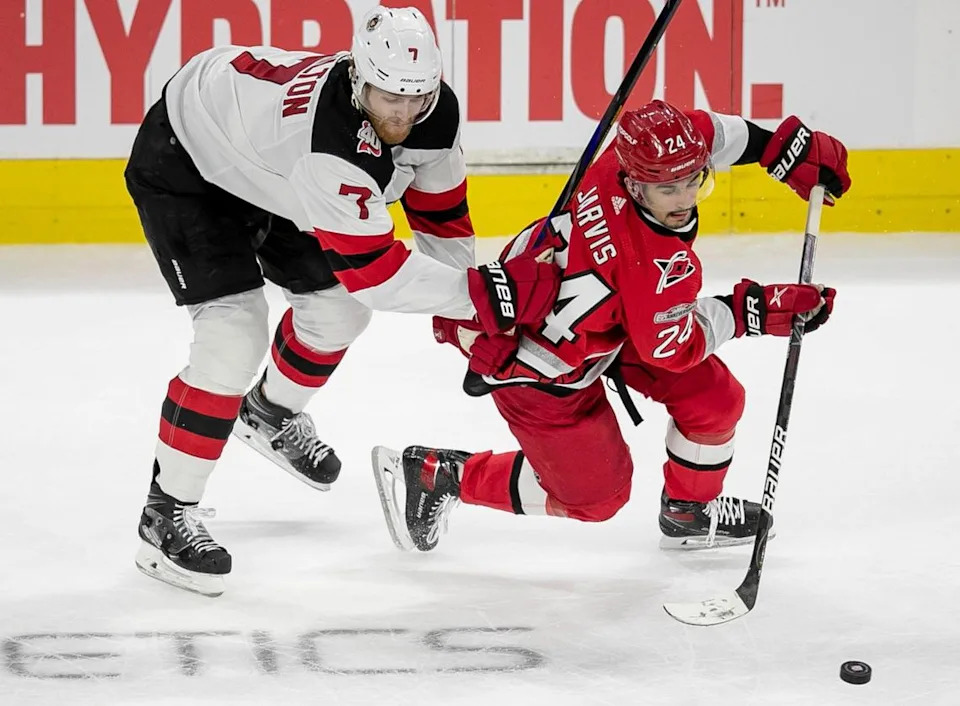
The Carolina Hurricanes Seth Jarvis (24) controls the puck ahead of New Jersey Devils Dougie Hamilton (7) in the second period during Game 1 of their second round Stanley Cup playoff series against the New Jersey Devils on Wednesday, May 3, 2023 at PNC Arena in Raleigh, N.C.
(Robert Willett/rwillett@newsobserver.com)
Oliver Ekman-Larsson, D, Toronto Maple Leafs
Cap hit: $3.5 million; Under contract through: 2027-28
Advertisement
Ekman-Larsson is one of those players who you sometimes forget is still in the league, even though he’s not that old. A mainstay with the Coyotes for 11 seasons, OEL was an elite defender playing for a perennially bad team in the desert. He plays defense with an edge and can bomb the puck from the blue line at even strength or on the power play, and provide solid PK minutes. At age 34, he’s not quite over the hill, and his cap hit is a friendly $3.5 million. He would do well on a second D pairing, and would be a good addition to a blue line for a playoff push, and also for a couple more regular seasons, especially if the team has to move a good young defender or two in another deal to acquire a forward.
Other names to keep an eye on: Joseph Woll, Toronto (G); Stuart Skinner, Pittsburgh (G); Justin Faulk, St. Louis (D); Tyler Myers (D); Jonathan Marchessault (C); Nazem Kadri, Calgary (C); Shane Wright, Seattle (C); Brayden Schenn, St. Louis (C); Evander Kane, Vancouver (W); Bobby McMann, Toronto (W); Patrick Laine, Montreal (W).
Hurricanes unlikely to stand pat
For all of the “maybes” and “what ifs,” there is one thing that feels certain: The Hurricanes are going to do … something.
Advertisement
Tulsky is a mad scientist with a lab full of potions and potables at his disposal, and he’s shown a willingness to mix a few of those together in his nearly two years at the helm of Carolina’s laboratory.
He’s not afraid of a few explosions along the way, either, so long as he doesn’t burn the whole thing down. And, more often than not, his concoctions have resulted in solid team chemistry — and positive results.
The Hurricanes are close. This close. Carolina is the only team in the NHL not to have lost in regulation in its past 12 games. The Canes are riding momentum toward the toughest stretch of the season for everyone — a 23-games-in-45-days sprint through April 14, a condensed schedule thanks to the Olympics. Teams will lean on their depth, both in raw numbers and on the scoresheet. They’ll rely on special teams to steal points whenever possible, and prevent stolen points from impacting playoff races. And they’ll rely on rotating goalies, with each keeper needing to give the contenders a chance to win, to stay at the top or in the hunt.
By the end of this week, the Hurricanes will know for certain which players will be available to them to fill each of these roles, and there’s a better-than-average chance at least one of those players isn’t yet on the team’s roster.