
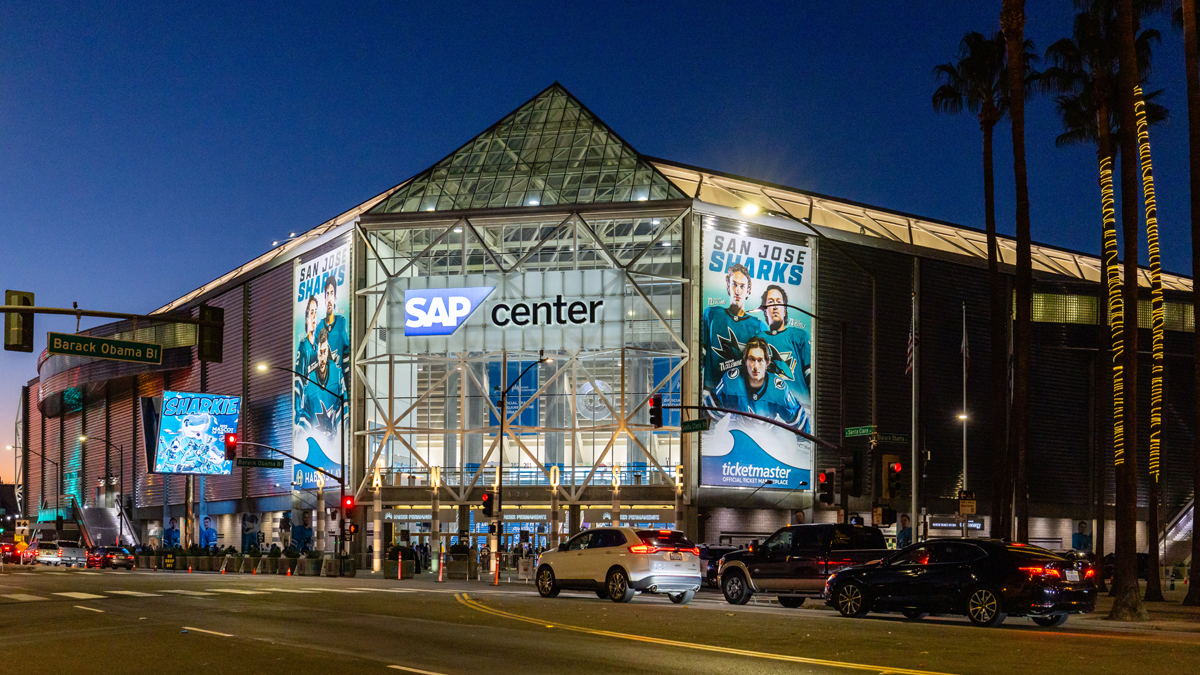
When SAP Center opened in San Jose in 1993, it was a state-of-the-art building. But nearly 33 years later, the Shark Tank desperately needs a makeover to keep up with the times.
So, last summer, the Sharks and the city of San Jose announced an extension of their lease, keeping the team in the building through the 2050-51 season, while also stating that they would spend over half a billion dollars to “re-imagine” SAP Center.
Sharks president Jonathan Becher recently spoke to NBC Sports California’s Alan Hoshida about why the overhaul of SAP Center is so necessary.
“Look, we all love this [place],” Becher told Hoshida. “This has been the heart of the Sharks for 30-plus years, it’s an iconic venue but it’s starting to show its age. The way you designed buildings in the 80s is different then you would design buildings now. And so you’re basically at a crossroads. Do you tear the baby down and try to build something new, which is really hard to do in Silicon Valley? Or do you say, ‘What would happen if I re-imagined how the building works?’
“What if I pretended I didn’t have 30 years of history and said, ‘How can we re-imagine the way the Tank works?’ How people approach it, how they get in, how they experience it, what the spaces look like. And so it’s the difference between changing the paint, like you might at your house vs. tearing it down to the studs and thinking [about] it all over again and we’re doing something closer to the second [option].”
Becher gave Hoshida a tour of SAP Center while explaining the planned changes for the next few years.
Among the most noticeable changes will be to the South Entrance — the main way Sharks fans enter the building — and to the team store, which will be greatly expanded.
“The whole front part of the building, as most people think about it, it’s called the South Entrance, right here off of Santa Clara [Street], is going to get a facelift eventually,” Becher told Hoshida. “As you said, the first part actually will be this space right here. And you look around and go, ‘How the heck could you put a team store in here?’ Well, first of all, you ought to know that we have one of the smallest physical team stores in the entire league, so we need to triple the amount of space.
“But if you look at the platform we’re on, it doesn’t feel like we can triple the space. Well, in fact, one of the things we’re going to do is, if you look out into the abyss, we’re going to extend this; we’re going to build over the open area and actually essentially double the size of this footprint as well. And we’re going to use some electronics and some navigation so that you can get more people in and more people out, so this becomes the primary team store.”
As Becher points out, SAP Center has a single concourse for fans to buy food, drinks and merchandise, so one of the biggest renovations will be to expand the main concourse to allow fans to flow more freely before, during and after Sharks games.
“If you travel around the league, if you go look at basketball and hockey [arenas], you’re now seeing two or even three-level concourse buildings,” Becher told Hoshida. “And so, we ask ourselves, ‘Is there a way to build another concourse?’ Or, ‘Is there a way to get people off the concourse and to other levels?’ So we’re going to use the Club Level beneath us in a better way. We’re going to think about how we use the arena level in a better way.”
Those are just some of the changes SAP Center will undergo in the coming years.
The San Jose Sharks have announced $425 million in planned renovations and upgrades to SAP Center, including:
• A larger team store footprint
• Wider concourses throughout the arena
• Additional lower-bowl seating
• Upgraded and newly built luxury suites pic.twitter.com/kcZJEczKe1
— Front Office Sports (@FOS) February 4, 2026
For Becher, the Sharks and the city of San Jose, the upgrades are paramount to improving the fan experience.
“At the time this building was designed, it was state-of-the-art,” Becher told Hoshida. “It was one of the bigger buildings in the league. Now, 35 years late, we’re actually the second smallest building in the league. And for various reasons that have to do with city codes — this is a city-owned building, we don’t actually own it — we can’t make the building any bigger. But what we can say is, ‘Look at all the under-utilized spaces and figure out how do we make them more productive? How do we re-imagine them?’ There’s that word again.”
Download and follow the San Jose Hockey Now podcast