
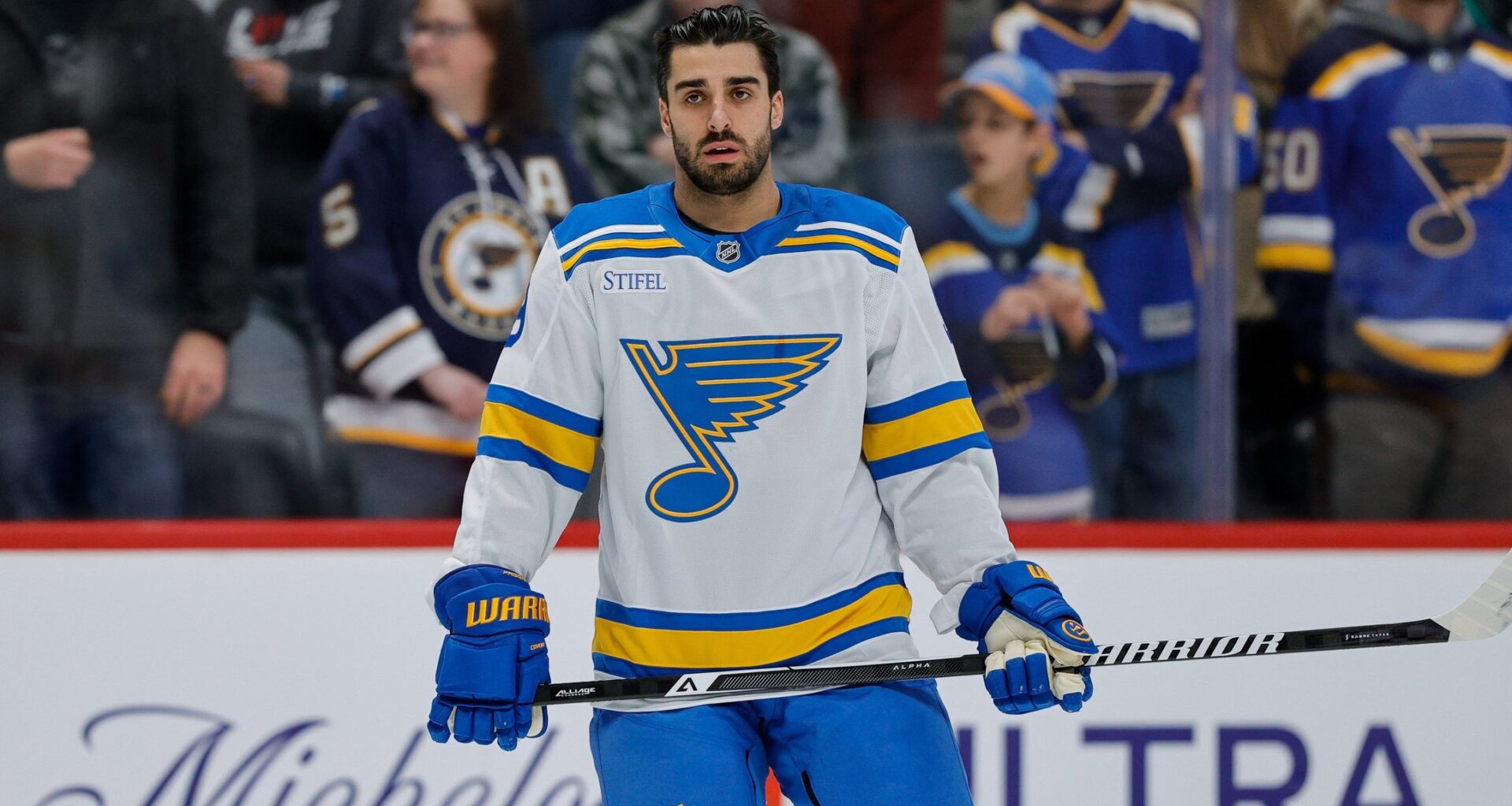
Very soon, the Robby Fabbri waiver claim will be buried under the sands of history. Typically, that process takes hundreds or even thousands of years. In the NHL, a single trade deadline can strike a waiver claim from your memory.
Turning back the sands of history, Fabbri’s story evokes a quote from the Roman philosopher and dramatist Seneca: “We are naturally disposed to admire more than anything else the man who shows fortitude in adversity.”
Nowhere else is this more true than in sports. In Fabbri’s case, fortitude is the defining characteristic of his career.
Fabbri was drafted 21st overall in 2014. He sported strong production in his draft year, which grew even as the St. Louis Blues elevated him to their NHL roster in his age-20 season.

More than that, though, he was a compelling story. Fabbri was one of those kids who couldn’t imagine any possible future for himself besides a career in the NHL. At the age of seven, his grandfather asked Fabbri what else he would do if he couldn’t play in the NHL. The boy rejected his grandfather’s premise.
Years later, Fabbri left the powerhouse Toronto Marlies for his hometown Mississauga Rebels. They eventually met in the OHL Cup finals. To hear Fabbri’s father tell it, “A lot of people said, ‘They’re not the Marlies, they’re not going to win.’”
Fabbri dragged his underdog Rebels to victory over a Marlies roster sporting Connor McDavid and Sam Bennett — maybe you’ve heard of them. While the re-telling of that story includes quotes from Fabbri’s father and agent, it’s hard to avoid buying into his homecoming and eventual victory over a generational opponent.
Just a year after his draft summer, Fabbri made St. Louis’ 2015-16 opening night roster. He quickly added to his rising-star resume, scoring around a 20-goal pace per 82 games. That continued for 51 games during the 2016-17 season.
That’s when the adversity hit.
On February 4, 2017, Fabbri tore his ACL. He was cleared to return to the ice after five months of rehab, effectively costing him an offseason of development. But, entering his age-22 season, it provided an opportunity to get back into shape.
Then, he tore his ACL again in the 2017 preseason. He spent 20 months away from regular-season hockey between the back-to-back injuries. Extended injury rehab is frustrating for anyone, especially for elite athletes. For a person whose identity revolved around the sport since the age of seven, those 20 months can get long, dark, and lonely.
Instead, Fabbri made the most of the opportunity. He went home to Ontario for the second rehab stint, which led him to meet up with Matt Nichol. Fabbri’s agent, Mark Guy, credited it as a turning point for Fabbri. He became more dedicated to his training and conditioning than ever before.
Fabbri also designed a line of hats (perhaps out of boredom) and got a French Bulldog.

All that perseverance in the face of adversity, though, doesn’t mean it turns around immediately.
Not only did Fabbri lose the entire 2017-18 season to a grueling rehab process, but he also missed out on a contract year. In the summer of 2018, the Restricted Free Agent (RFA) class — Fabbri’s peers from the same draft class — signed deals eclipsing $30 million. He had to settle for a prove-it deal: one year, $925,000.
These RFA prove-it deals are sometimes framed as a win-win for both parties. The team gets a year at a suppressed cap hit, while the player gets a chance at a raise the following year. In reality, the player takes on enormous risk with very little cash in the bank. In Fabbri’s case, his career earnings amounted to only three years on his ELC, plus the $925,000 of the one-year extension (and whatever he made from the hat deal, I guess).
That risk bit Fabbri hard. He played only 32 regular-season games, battled groin and shoulder injuries, and registered six points.

Here’s the good news: Unless you were steeped in the lore of Robby Fabbri before reading this article, none of this is the first thing that comes to mind. The crowning achievement of his career is his 2019 Stanley Cup victory with the Blues.
He only suited up for ten playoff games, averaging about nine minutes of ice time. He scored only one goal.
It’s not unreasonable to estimate that by now, having turned 30 in January, Fabbri has lost over $40 million in career earnings. But, if you asked seven-year-old Robby, would any of that really matter? I would venture to guess that the Cup ring makes it all worth it.
But what does Fabbri bring to the Wild at age 30?
In the big picture, Fabbri is similar to last year’s waiver pickup: Vinnie Hinostroza. Both players can support Minnesota’s fourth line. They provide more skill than a typical fourth-line grinder, but provide less defense than the bottom-line two-way prototype.
He still has an NHL shot and, when given opportunities in open space, he’s able to flash that skill that characterized his early years. His highlight tape from 2020-21 also shows a veteran’s instinct at the net.
However, his highlight reel from last year is concerningly short. It mostly features Fabbri cashing in on greasy chances, leaky goaltending, or defensive lapses.
Fabbri’s skill has waned from the promise of his rookie year in St. Louis. He’s never eclipsed the 18 goals he scored as a rookie, though he tied it in 2023-24 with the Detroit Red Wings.
There, he was an effective role player who provided third-line value. His minutes weren’t notably challenging or sheltered. He averaged nearly 13 minutes per game, including about two minutes per-night on the second power play unit. Fabbri likely won’t factor into Minnesota’s power play except as injury insurance.

The analytics from Fabbri’s 2024-25 season with Anaheim are distressingly bad. A minus-15 rating implies that Fabbri performed well below replacement level. This, combined with St. Louis’s decision to waive Fabbri despite their history and their place in the standings, is reason for concern.

Fabbri was banged up through his final season in Detroit, including an 11-game absence for a lower-body injury. Those injuries continued in 2024-25, when he missed 13 games for a knee surgery and suffered a hand injury in March.
It’s possible that the time to recover from those injuries will lead to a bounce-back to that third-line form he showed in Detroit. Still, it’s hard to square that with his being cut from St. Louis’s roster, given their poor showing this season. Even in a rebuilding year, a third-line quality forward would be retained or traded. If they waived him, that means no NHL team was willing to trade anything for Fabbri.
That means that the only explanation for Fabbri resurging in Minnesota would be the change of scenery. You have to squint a bit to see it, but it may be a shot worth taking. Minnesota’s current fourth line has been dreadful aside from Nico Sturm. Replacing one of Ben Jones, Tyler Pitlick, or Hinostroza with Fabbri could provide marginal gains.
More than that, the threat of competition for fourth-line wing minutes could elevate the play of all four players.
It’s also true that Fabri’s best hockey has come with a team fighting for a playoff spot (the ‘23-24 Red Wings), and his dreadful hockey came on floundering rosters in Anaheim and St. Louis.
Still, I don’t think that the key to unlocking Fabbri is a sheltered role. His minutes in Anaheim were measurably sheltered, given the quality of teammates and the competition (25th-percentile offensive difficulty per The Athletic’s model above). But, giving Fabbri a chance to play a role on a contending team could awaken another level in him.
On top of that, Minnesota’s systems may be a better fit for Fabbri. As outlined in Jack Han’s Hockey Tactics 2025 (which includes a page for the Ducks titled, “Spotlight: How Not to Defend”), Anaheim’s defensive systems were designed more to teach young players defensive fundamentals than to optimize for keeping pucks out of the net.
It’s possible that this created two problems for Fabbri. First, for an aging player who’s battled lower-body injuries, it demands too much skating on defense. Second, it creates a feedback loop in which every skater on the Ducks charts worse defensive analytics than their actual ability.
Minnesota plays a more typical zone defense, which does not require players to chase their man around the entire zone. It also keeps wingers from defending the slot.
Between the change of scenery and a better systems fit, it seems the Wild’s pro scouting staff has talked itself into the possibility of a Fabbri rebound. For the price of a pro-rated $775,000 cap hit, it’s a reasonable bet.
More than that, though, it’s one final chance for Fabbri to show his fortitude. In the face of adversity, getting cut, and now Father Time, Fabbri still refuses to blink. At age seven or age 30, there’s still no other option for him besides playing in the NHL.
Once again, bouncing back from multiple injuries, Fabbri gets a chance to win a Stanley Cup.