
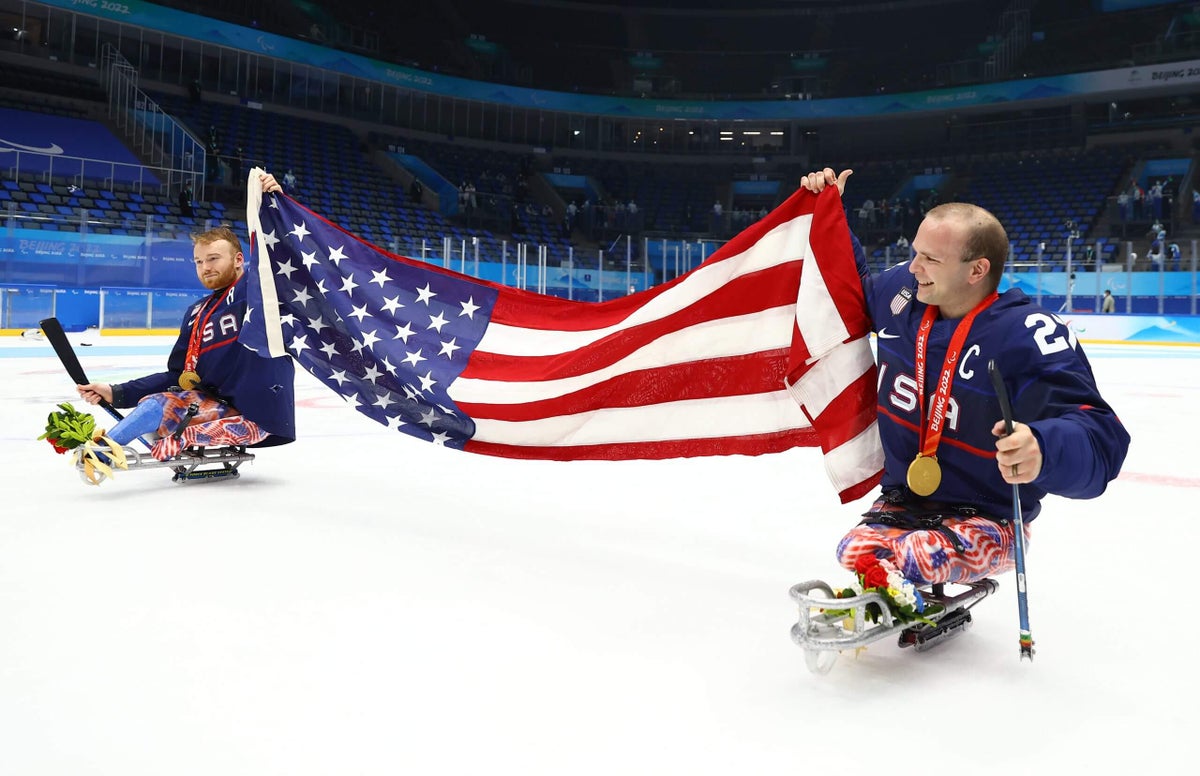
SUPERIOR, Colo. — It’s mid-practice as the Team USA sled hockey team huddles up at center ice and Josh Pauls starts yelling about how a drill went.
The first part went perfectly, but Pauls finds issue with team members allowing a skater to get right back to the neutral zone.
“Your job isn’t done just because you got rid of the puck,” Pauls says in the middle of one of their pre-Paralympics residency practices at a rink here.
There’s a small chuckle from someone standing near one of the benches.
“So, 15 years ago, Josh would not be doing that,” says Bill Sandberg, who’s served as equipment manager for the team.
Sandberg points to the back of the group, signaling where Pauls would’ve been stationed mid-practice when he first started playing for the team. Sandberg remembers the teenage Pauls who, as the youngest member of the team, never spoke unless he was spoken to. While Pauls didn’t initially make the 2010 Paralympic team, the 17-year-old eventually made it to the Vancouver Games after a late dropout.
“I was lucky to be there,” Pauls said.
Sandberg said the young Pauls never complained about the process.
“It’s very rewarding for me to see someone 15 years later I knew as a 15-year-old kid going into his fifth Paralympic Games,” Sandberg said.
But Pauls isn’t merely just going to his fifth Games. He will be chasing his fifth straight sled hockey gold medal as Team USA looks to keep a streak alive that started at the 2010 Games. A fifth would further cement an already dynastic run. Saying it aloud might sound like a lot of pressure, but for Pauls, it would be a “cherry on top.”
“Four in a row doesn’t ever happen,” said Pauls, who is the only remaining player on the current roster from the 2010 squad. “Neither does five in a row. So, like, we’re just gonna see what happens. I think we’re training as best we can. The results will speak for themselves.”
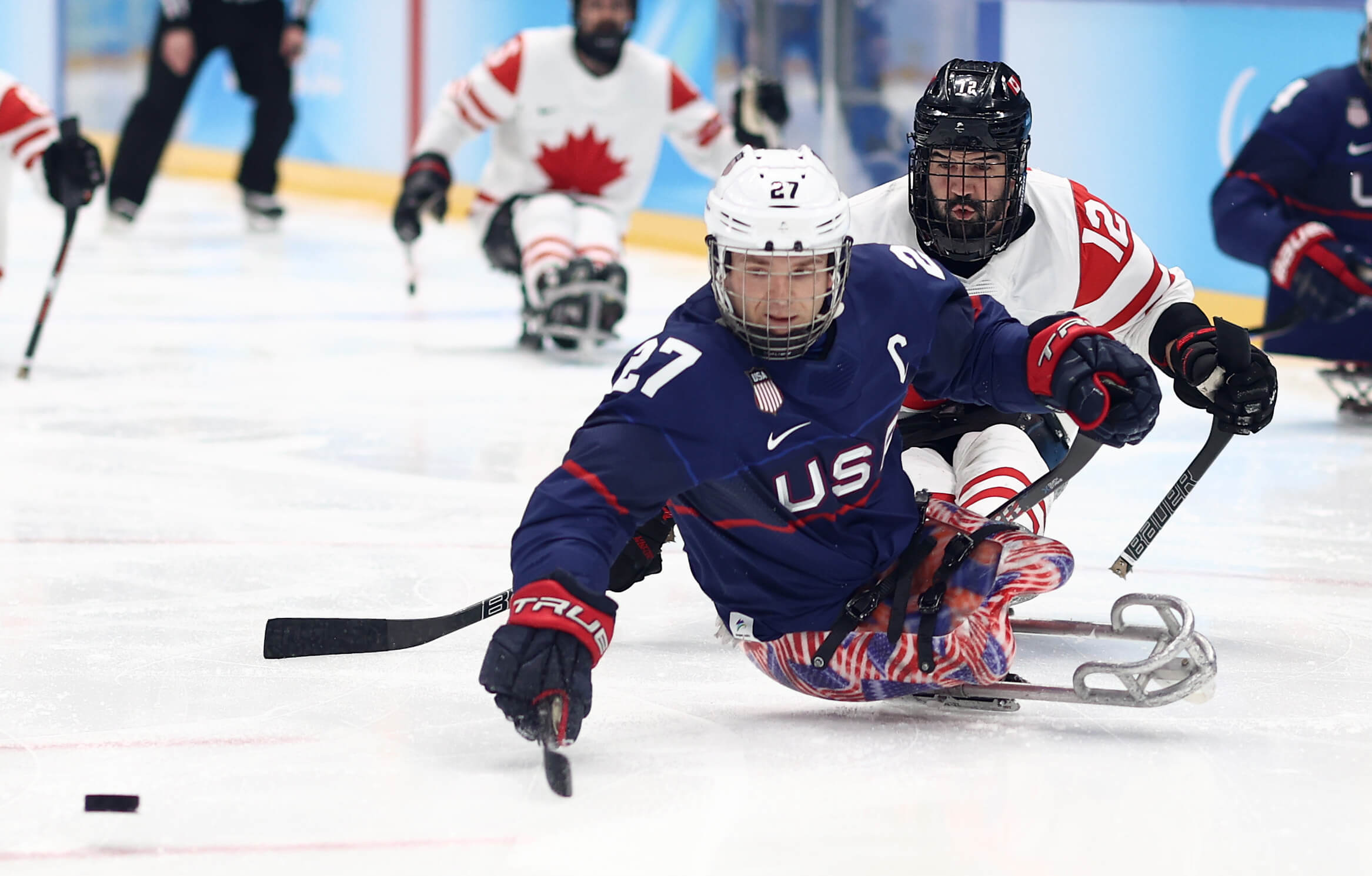
Josh Pauls is competing in his fifth straight Paralympics and going for his fifth straight gold medal with Team USA. “The results will speak for themselves,” he says. (Ryan Pierse / Getty Images)
Sixteen years of dominance has told quite a story already.
Back in 2018, Landon Uthke and Liam Cunningham were just kids playing for the Minnesota Wild sled hockey team. Sitting inside a Chicago hotel lobby during a club tournament, on the TV was Canada vs. the United States in the para ice hockey gold medal game.
You already know the ending.
But if you don’t know or don’t remember the game, the United States rallied from down one goal in the final minute of regulation. With 37 seconds remaining, Declan Farmer scored the tying goal to force overtime. It was Farmer again who scored the gold-medal goal.
“It’s gonna be us one day, hopefully,” Uthke remembers thinking of him and Cunningham.
“That was pretty awesome and kind of flipped my switch, like, ‘I want to do this,’” Cunningham said.
The 18-year-olds and two longtime friends are now first-time Paralympians, in Italy alongside the players they grew up watching. It’s an indication of the sport’s growth that they could be watching the game on TV and that there are four team members of Team USA under 20 years old playing in these Games. Beyond Pauls, the roster is a mostly even split of first-, second-, third- and fourth-time Paralympians.
“With the Paralympics being televised, that was a big deal,” said Dan Brennan, the general manager of the sled national team since it was incorporated into USA Hockey in July 2006. “The opportunity for youth players when they first see it, to know that if they keep working hard and get better, they could go to one of our camps. We’ve created a direction to the national team that wasn’t there before.”
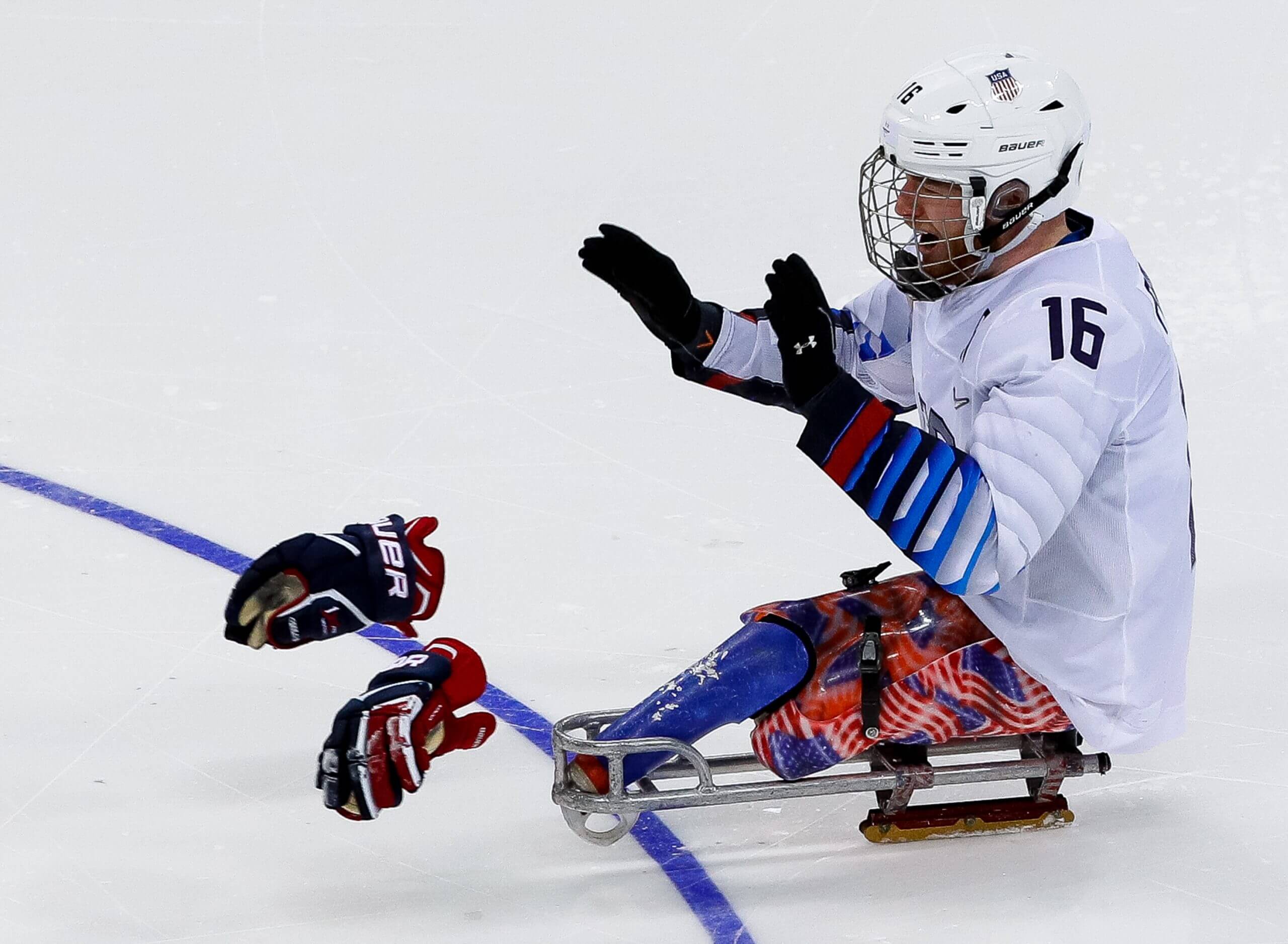
Declan Farmer celebrates his overtime winner against Canada in the gold-medal game at the 2018 Games. His late-game heroics that day kept the American streak going. (Buda Mendes / Getty Images)
The number of players trying out has gone from 17 in Brennan’s first trial to 90 players and 13 goalies, which was enough to move to an invite-only format. There are regional camps staffed by national coaches.
While the United States won its first of five total Paralympic gold medals in 2002, its dominant run didn’t begin until 2010 — and even then, the Americans weren’t favored, as they didn’t start winning regularly until late 2009. New faces started coming in over the next quad, including Farmer, who at 16 years old made his Paralympic debut in Sochi and helped the United States become the first sled hockey team to win back-to-back gold medals. Farmer, now a four-time Paralympian, was the first U.S. sled hockey player to score over 200 career goals, and over his tenure with the team has become one of its leaders alongside Pauls.
“We’re just still hungry,” Pauls said. “We’re never satisfied with where we’re at. And I think it starts with Declan. It’d be easy for the best player in the world to say, ‘OK, cool, I’m as good as I’m going to be, or I’m still better than everybody even if I’m not working.’ (Farmer is) constantly pushing to be that little bit better, get that 1 percent every practice. And it’s that hunger that has continued our success.”
Part of that success is their residency program in Colorado in the two months ahead of the Games with players all training together — on top of the multiple players already in the state who train together regularly. All of the work they’ve put in contributed to the dominance over the years, three-time Paralympian Jack Wallace believes.
About halfway through the residency program, the group headed into the mountains for a retreat, a chance to get away from the hours of ice and gym time. The plans instead: chilling, watching the Olympics, and maybe even playing some pond hockey.
Then it was back to the grind as the weeks ticked down to the Games and the chance to make even more history.
“It would make us pretty much infamous in any sport,” said Griffin LaMarre, one of the team’s goalies, of winning a fifth-straight gold. “You think about a dynasty, a dynasty is what, three championships? And we’re about to almost double that if we win gold. So I think it solidifies the U.S. sled hockey program as one of the greatest sports programs to ever do it, and obviously one of the best Olympic or Paralympic stories in the world.”
That quest begins Saturday with the United States’ first game coming against Italy in Group A (1:05 p.m. ET), which also features China and Germany. Each team will play each of the other three teams in its group in the preliminary round. The two top teams from each group will advance to a knockout stage for the medals.
But even with the streak looming over their Games, Pauls and Farmer are confident of the legacy the group has created while also focused on being the best team in its current iteration.
Pauls knows that well. Yes, there will be new experiences this year, like being one of two flag bearers — along with Laurie Stephens, a seven-time Paralympic medalist in para Alpine skiing — chosen to represent the United States at the opening ceremony. But it’s the little moments, both current and past, he’s trying to soak up.
On the bus ride back after the 0pening ceremony in 2010, an Italian athlete pulled off Pauls’ hat.
“Trade?” Pauls remembers the athlete asking.
Trading team gear, swag and pins is a huge part of the Paralympic and Olympic experience, and Pauls got an early taste of that in his first games.
Sixteen years later, the hat was pulled from the top shelf of one of Pauls’ closets with the intention of making it back to its origins four gold medals later.
As Pauls said, “It’s really cool to kind of get a full circle moment.”