
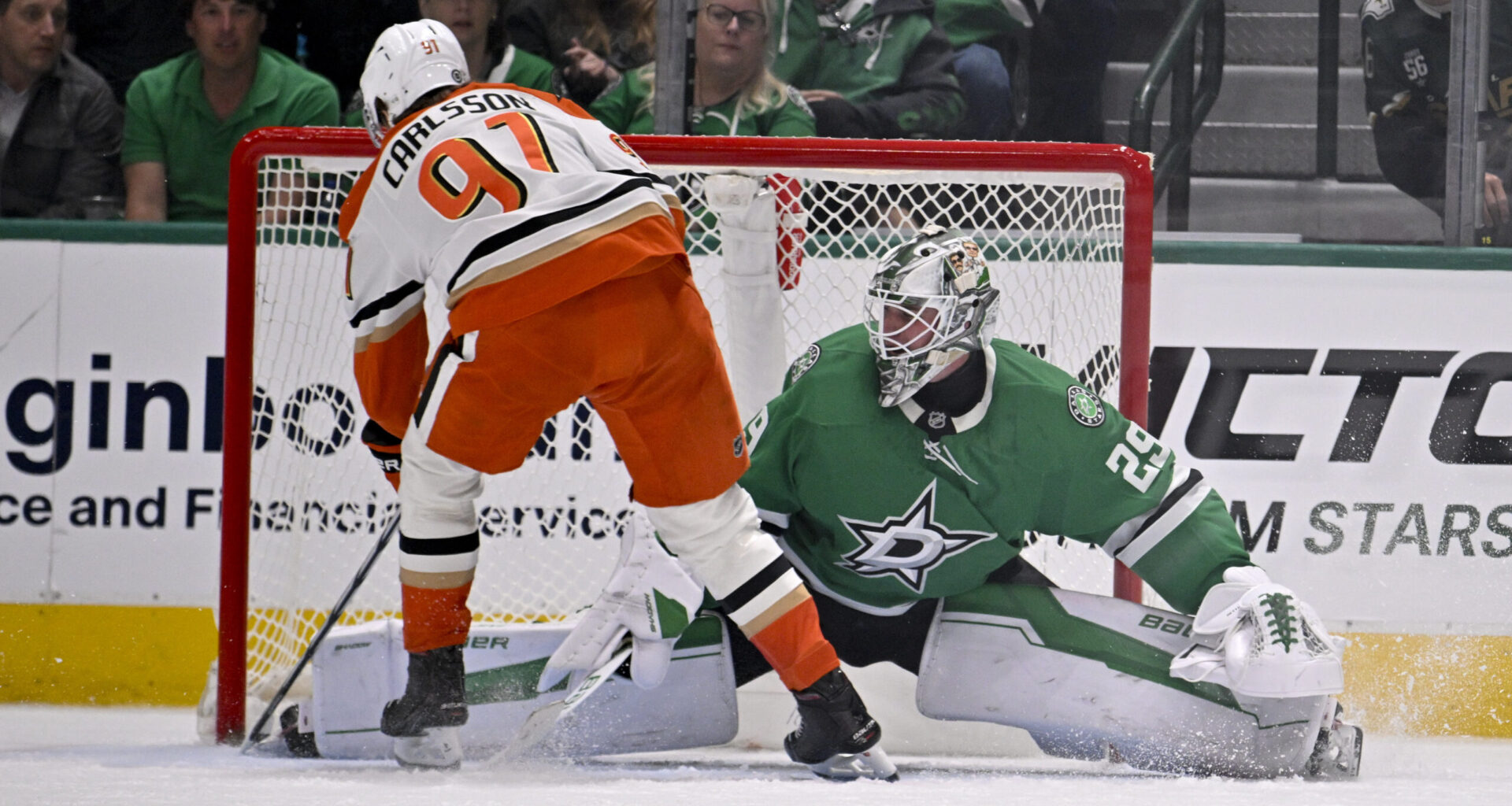
At the quarter mark of the season, expectations around the Anaheim Ducks had already begun to shift. Early projections centred on ending the franchise’s seven-year Stanley Cup Playoff drought. However, as the Ducks continued to climb the standings, the conversation evolved. The question was no longer simply whether Anaheim could make the playoffs, but whether they could finish among the Pacific Division’s top teams.
Now, with roughly three quarters of the season complete, that shift has become reality. As we look at the standings, the Ducks sit first in the Pacific Division with a 35–25–3 record, and several projection models give them over a 90 percent chance of making the playoffs. Some sportsbooks have even installed Anaheim as the division favourite, reflecting how dramatically expectations have changed over the course of the season.
This moment represents a turning point for the organization. The rebuild that defined much of the past decade appears to be over. The Ducks are no longer building toward contention. They are now trying to win.
The John Carlson Trade Signals the Window Is Open
The clearest sign that Anaheim believes its competitive window has arrived came at the trade deadline. General manager Pat Verbeek acquired veteran defenceman John Carlson from the Washington Capitals in exchange for a package headlined by a conditional first-round pick.
Carlson, one of the most productive defencemen of his generation, immediately becomes one of the most accomplished players ever acquired by Anaheim at the deadline. Even at age 36, he entered the trade with 46 points in 55 games, continuing to produce offensively while logging top-pair minutes.
More important than Carlson’s on-ice impact, however, is what the trade represents strategically.
For several seasons the Ducks accumulated assets and patiently developed their young core. By moving a first-round pick for an established veteran, Verbeek delivered a clear message to the roster. That message being that the rebuild phase is over.
Instead of selling at the deadline, Anaheim acted as a buyer for the first time in years. The organization is now signalling confidence that its young core is ready not only to reach the playoffs but to compete once they get there.
Carlson’s puck-moving ability should also help address one of the Ducks’ biggest weaknesses: exiting the defensive zone cleanly and transitioning quickly into offence.
The Young Core Driving the Ducks’ Rise
While the Carlson trade added experience, the foundation of Anaheim’s surge remains its young core.
Several players have emerged this season as legitimate building blocks.
Anaheim goal!Scored by Leo Carlsson with 17:38 remaining in the 3rd period.Assisted by Olen Zellweger and Trevor Zegras.Anaheim: 2New York: 3#NYRvsANA #FlyTogether #NYR
— NHL Goals (@nhlgoals.bsky.social) 2025-03-29T04:12:11.415519Z
Leo Carlsson continues to establish himself as the franchise’s number-one centre. Still only 21 years old, he is already producing at a top-line pace while facing the toughest matchups on most nights.
Cutter Gauthier, meanwhile, has developed into one of the league’s most dangerous young scorers. His ability to change a game with a single shot has made him one of Anaheim’s most dynamic offensive weapons.
Beckett Sennecke, the rookie winger, has also become one of the biggest surprises of the season. Leading all rookies in goals for stretches of the year, he has rapidly entered the Calder Trophy conversation.
Behind them, the next layer of the core has taken significant steps forward.
Defenceman Jackson LaCombe has developed into Anaheim’s most reliable puck-moving defender while logging heavy minutes in all situations. His growth has been crucial for a blue line that has often relied on mobility and transition play.
In goal, Lukáš Dostál continues to solidify his role as the franchise’s long-term starter. When he is playing at his best, the Ducks are capable of beating any opponent.
Taken together, this group forms the foundation of Anaheim’s competitive window. Importantly, most of these players are still early in their careers, suggesting the team’s ceiling may continue to rise in the coming seasons.
The Analytics Perspective Reveals A High-Event Team
While Anaheim’s place atop the Pacific Division may surprise some observers, the underlying analytics provide useful context for their success.
The Ducks rank among the league’s stronger offensive teams at five-on-five. Models tracking expected goals place Anaheim inside the top ten in expected goals for, reflecting the quality of chances they generate.
However, the same data reveals the team’s biggest vulnerability.
Anaheim ranks near the bottom of the league in expected goals against, meaning they allow a high volume of dangerous opportunities. In simple terms, the Ducks often play a high-event style of hockey.
That identity shows up clearly in several advanced metrics.
Metric
NHL Rank
Goals For
13
Goals Against
31
Expected Goals For
7
Expected Goals Against
29
Expected Goal Share
18
This profile places Anaheim firmly in the category of teams that can score with anyone but sometimes struggle to defend consistently.
It also helps explain the Carlson acquisition. A veteran defender capable of controlling play and improving puck movement could meaningfully stabilize the team’s defensive results.
Models and Markets Believe in the Ducks
Projection models across the analytics community now see Anaheim as a legitimate playoff team.
HockeyStats currently gives the Ducks approximately:
93 percent probability of making the playoffs
roughly 1 percent Stanley Cup odds
a projection of around 97 points
Those numbers position Anaheim among the Western Conference’s playoff tier rather than the fringe bubble teams.
Even more telling is how betting markets have responded. Several sportsbooks have listed the Ducks as Pacific Division favourites, something that would have seemed improbable just a few months ago.
The shift illustrates how dramatically the perception of this team has changed.
What Comes Next
For Anaheim, the final stretch of the season now carries far greater stakes than simply securing a playoff berth.
The Ducks are in position to compete for the Pacific Division title, which would dramatically improve their first-round playoff outlook. Winning the division would likely give them home-ice advantage and a more favourable matchup.
However, the playoffs will present a different challenge. Teams that rely heavily on offence can sometimes struggle in the tighter, more structured environment of postseason hockey.
Improving defensively will be crucial if Anaheim hopes to make a deep run.
Still, regardless of how the postseason unfolds, one thing is already clear. The Ducks have reached the next phase of their rebuild.
After years spent developing prospects and accumulating assets, Anaheim now has a young core capable of driving success at the NHL level. With the addition of Carlson and a roster increasingly filled with impact players, the Ducks are no longer a team preparing for the future.
They are a team trying to win right now.
Main Photo: Jerome Miron-Imagn Images