
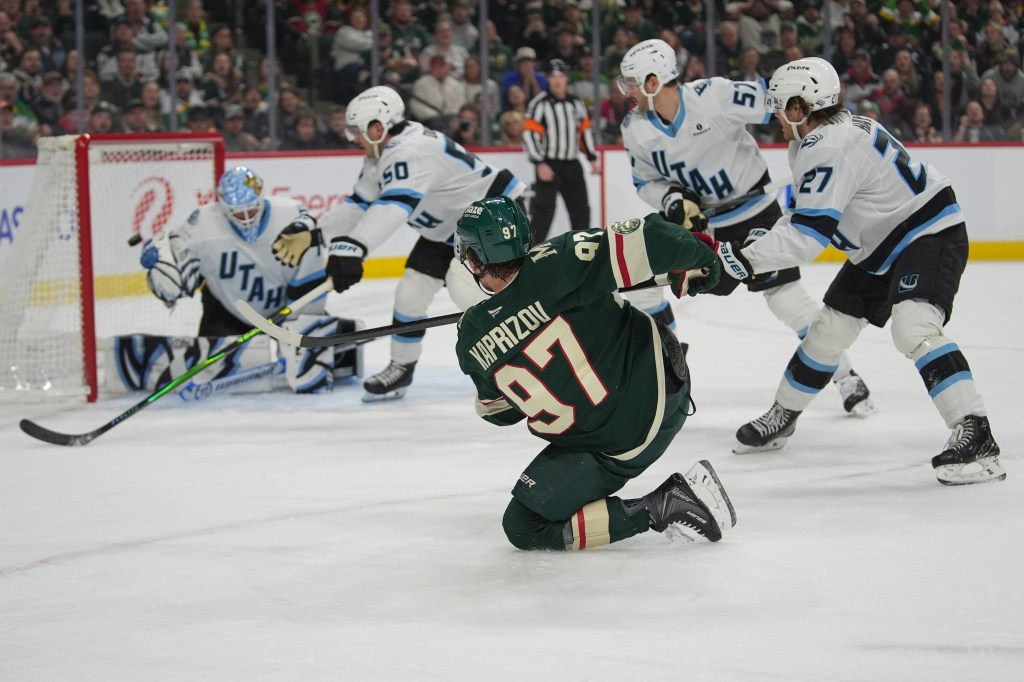
Generally speaking, a 5-minute major penalty and a 5-on-3 power play are sure-fire momentum changers in a hockey game. If the attacking team scores, they get a vital notch on the scoreboard. If the defending team can kill the penalty, they usually get back to full strength flush with confidence that can swing the tide their way.
Early in the Wild’s eventual 5-0 blowout of Utah on Tuesday, Minnesota got a two-man advantage for a minute. When a Mammoth player broke his stick on the ensuing faceoff, it became a de facto three-man advantage. Minnesota got looks and good puck movement, but Utah managed to kill it off. A team that has often had the Wild’s number for the past two seasons looked to grab the momentum and dominate Minnesota again.
It didn’t happen, for two reasons.
First, the Wild stayed even-keeled and confident in their special teams, which have been among the NHL’s best in the second half of the season. Second, Kirill Kaprizov did the things he does, scoring an amazing goal from one knee to give Minnesota a first-intermission lead that it would not relinquish.
“Obviously, you want to score. At one point, it was pretty much a 5-on-2,” Wild defenseman Quinn Hughes said. “I think you’re more just frustrated, so there’s no sagging. You just want to get back out there and make a play.”
For Wild coach John Hynes, the team’s penalty kill has thwarted 11 of the last 12 opponent power plays heading into Thursday night’s meeting with Philadelphia, and he found little to complain about even if the Wild didn’t score with the lopsided man advantage.
“I think Kirill could’ve had three goals on that (power play),” Hynes said, tipping his cap to the Utah goalie for being the best Mammoth penalty killer. “So, I think when you generate the looks, whether you just miss or the goalie makes a big save, I think that’s important. … I thought we executed, it just didn’t go in the net.”
Kaprizov leads the team on the man advantage, scoring 16 of his 37 goals with an opponent in the penalty box before Thursday’s game.
Minor league move coming for Wild
Most Wild prospects start their careers in Iowa before hopefully making their way one state north to the NHL club in Minnesota. The Wild’s AHL team plays in Des Moines, while their ECHL team — pro hockey’s version of Double-A baseball — has played in Coralville, Iowa, since 2021. That will change next season.
Earlier in the week, owners of the Iowa Heartlanders announced the team will suspend operations for the 2026-27 season, citing financial concerns.
The Heartlanders, who play in the 4,800-seat Xtream Arena, located just a few miles from the University of Iowa campus, were in the cellar for ECHL attendance last season, averaging just over 1,500 a game, while the league-wide average is around 4,400. The Wild are currently looking for their next ECHL home base.
“It’s disappointing, but we’re working on it,” general manager Bill Guerin said. “It was great there, but I get it, it’s a business and if it can’t survive, it can’t survive. It’s such a great arena and a great community. … Hopefully they can revisit in a year or two and see if something can be done.”
There has been some exploration of an ECHL team in the Twin Cities, but most agree that with youth hockey, prep hockey, junior hockey, college hockey and the NHL all currently playing in the market, it would be challenging to find a consistent ticket base for a new minor league team.
The building also houses Hawkeyes volleyball. But with Xtream Arena losing its hockey tenant, some have advocated Iowa becoming the eighth member of the Big Ten hockey conference, although there is seemingly little interest in adding a sport within the athletic department there. As recently as 2020, Iowa cut four varsity sports, eliminating its men’s gymnastics, men’s and women’s swimming and men’s tennis programs.