
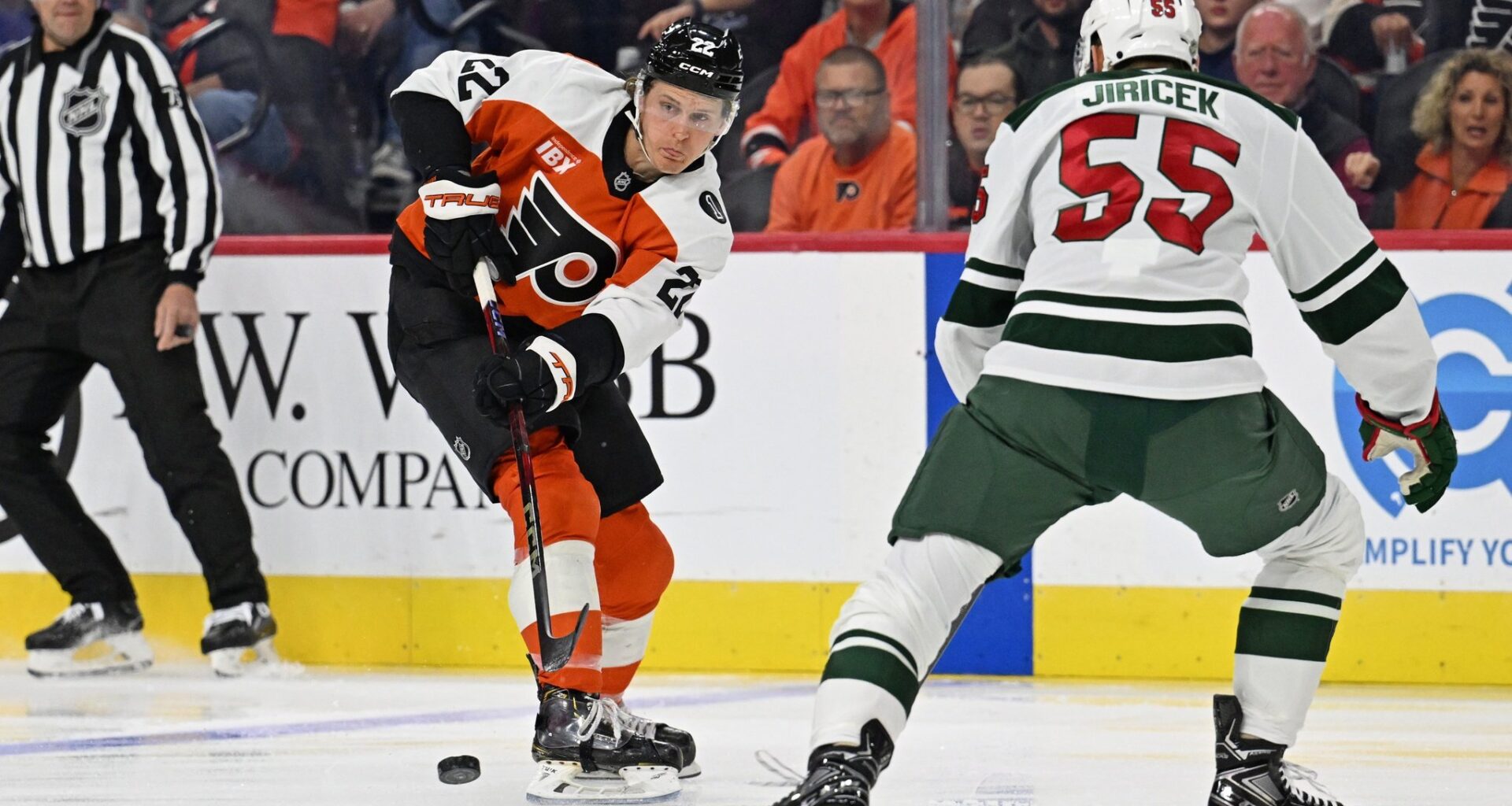
The David Jiříček Trade Tree will never look good. The Columbus Blue Jackets have already gotten first-round goalie Pyotr Andreyanov out of the deal, with a second-rounder in 2027, and third- and fourth-round picks to play with in the 2026 Draft. They could either unearth quality players or cash in that draft capital to land anyone who wants to play in Columbus.
Meanwhile, the Minnesota Wild have Bobby Brink and 2025 fifth-rounder Justin Kipkie, a defenseman who has four goals and 13 points in 35 games with the Arizona State Sun Devils.
It’s hard to defend the Jiříček trade based on the outcome. The Wild got 31 games out of him, and at no point seemed ready to trust the sixth-overall pick in the 2022 Draft. The issues that led Jiříček to fall out of favor in Columbus, his skating and decision-making, cropped up in Minnesota, making that a failure of scouting, development, or both.
Brink is an intriguing young player. Despite a down season, he’s a solid two-way player who drove offense in 2024-25. He’s a quality third-liner, and teams need those to win. The Florida Panthers’ stars pack a punch, for sure, but they wouldn’t have won two Stanley Cups without depth like Eetu Luostarinen and Evan Rodrigues stepping up.
We can be high on the 24-year-old Brink’s prospects in Minnesota, but still acknowledge that adding Brink isn’t an ideal outcome for the draft capital the Wild spent. Maybe a random sample of a first, second, third, and fourth-round pick will yield a Brink-type player. But the opportunity cost of using that capital is gone, as is the potential to land a top-six forward or top-four defenseman with it in the draft.
And yet… if the Jiříček trade scares off Bill Guerin and the Wild front office from making similar moves in the future, it’ll be a shame. As much criticism as the trade is getting now, it was the right call at the time, and it’s the kind of deal they should be willing to make again.
The bet Minnesota made wasn’t just a bet on Jiříček. It was a bet on elite talent, and whatever flaws Jiříček had, he had elite talent. The typically conservative Corey Pronman compared him to Alex Pietrangelo in his draft rankings. Elite Prospects ranked him as the third-best offensive defenseman and the best defensive defenseman in his class.
Of course, at some point, we have to stop looking at where a player was drafted or ranked in their draft year and focus on what they are capable of doing now. But that point isn’t two days after turning 21, which was where Jiříček was at when the Wild acquired him.
The Wild were also in the exact right spot to take on a high-reward project like Jiříček. With Minnesota’s legitimate Stanley Cup aspirations, they’re clearly not in the development business anymore. But at the time, they had Zeev Buium on the cusp of joining the NHL, with prospects like Danila Yurov, Jesper Wallstedt, and Liam Öhgren waiting in the wings. Minnesota’s big aspirations were to land a top-line center, not an all-world defenseman in Quinn Hughes.
They didn’t have a big, skilled, right-shot defenseman like Jiříček in their pipeline. They saw a need and cashed in on much lower-percentage lottery tickets to address it with the highest upside young player they could acquire. The logic was sound, even if the scouting wasn’t.
Buying low on a player with a strong draft pedigree is a solid way to go about adding talent. The classic Wild example is trading for a 20-year-old Nino Niederreiter, who had just two goals and an assist in 64 games before the New York Islanders decided they were through with him. He went on to have three 20-goal seasons and score arguably the biggest goal in franchise history.
Minnesota did the same thing with Kevin Fiala, who was struggling through his age-22 season in the NHL when the Wild acquired him. Fiala became a star for the Wild, and they parlayed him into Brock Faber and Öhgren, a fourth of the pieces for the Hughes trade.
Jiříček was a misfire, but if Minnesota can’t find a way to trade for a star like Auston Matthews this offseason, they should seek to make a similar bet on a center. Jiříček’s draftmate Shane Wright could be a strong buy-low candidate. Kent Johnson is in the middle of a dismal season for the Columbus Blue Jackets, but he has a 57-point campaign under his belt. There’s risk involved, but if they are right, Minnesota will have an elite talent on its hands.
The NHL is a results-based business, and what will matter most is that Jiříček didn’t work out in St. Paul and didn’t return the value Minnesota shipped out for him. But the process also matters, and the Wild’s process was solid. Even if it didn’t work out this time, they should pounce on similar opportunities in the future.
Think you could write a story like this? Hockey Wilderness wants you to develop your voice, find an audience, and we’ll pay you to do it. Just fill out this form.