
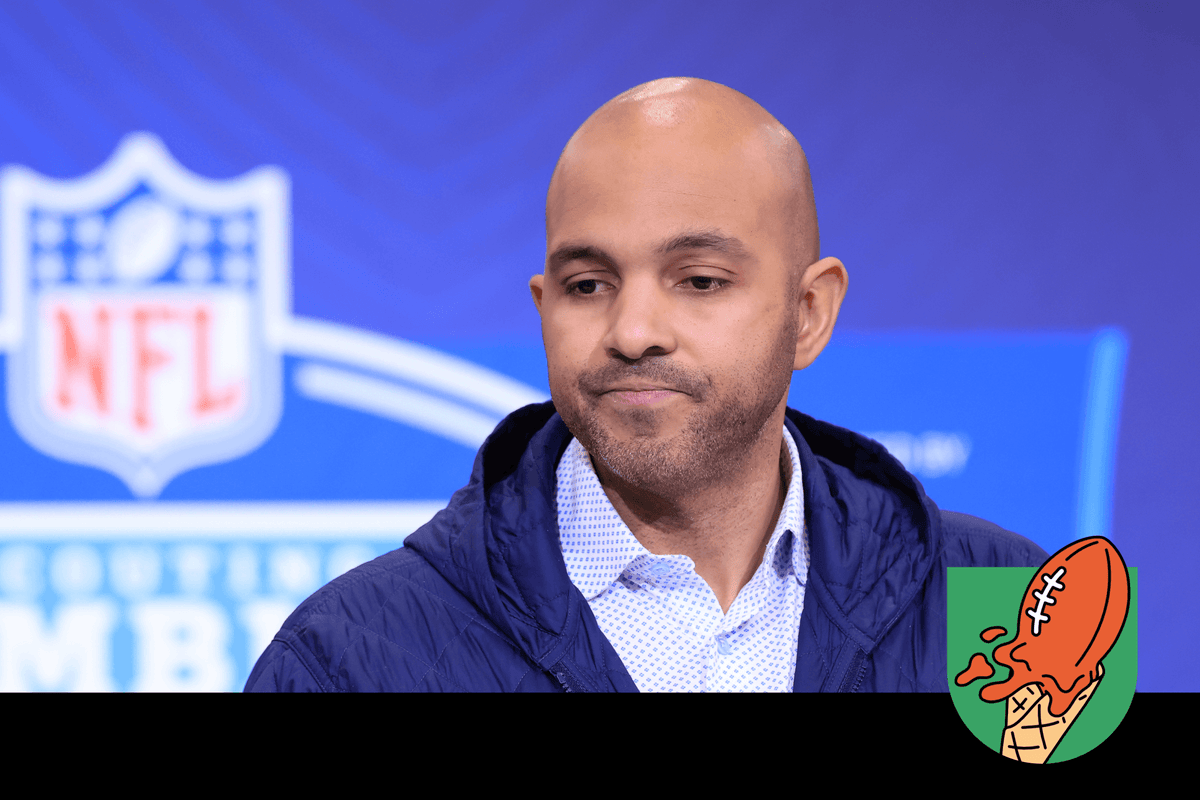
You might not recognize the man pictured above. That’s former Bears assistant general manager Ian Cunningham, whom the Falcons named their GM in January. The move led to controversy in Chicago.
This article is from Scoop City, The Athletic’s NFL newsletter. Sign up here to receive it directly in your inbox.
Bears denied compensatory draft picks
Six years ago, the NFL passed 2020 Resolution JC-2A to reward teams for supporting the development of minorities in coaching and front-office positions.
Specifically, a team would gain a third-round pick in each of the next two drafts if any of its minority employees were hired as either a head coach or “primary football executive” by another NFL team. In the resolution, “general manager” is in parentheses next to “primary football executive.” That’s important.
So when Cunningham, a minority candidate, took Atlanta’s general manager job, the Bears expected those draft picks. Rightfully so. And Cunningham agreed.
“I would think they get the two third-round picks,” he said at the NFL combine. “I wouldn’t be sitting here if it weren’t for them giving me that job and helping me grow.”
The NFL had a different idea. It designated Matt Ryan, Atlanta’s new president of football, as the Falcons’ primary football executive. Since a GM isn’t necessarily atop a team’s org chart, the Bears were out of luck.
Wait a minute. In January, Ryan himself said, “The general manager role is going to be exactly the same as what it’s been here before.”
So while Cunningham reports to the Falcons’ president, his position is identical to that of Terry Fontenot, the GM he is replacing. Cunningham has nearly two decades of experience in front-office jobs with the Ravens, Eagles and Bears, while Ryan has a few weeks.
“I’m not doing the scouting. I’m not running those meetings,” Ryan said in that same news conference. He later said Cunningham will also lead the charge on free agency. “I’ll be involved in whatever way Ian needs me. … He is running the ship.”
Both Cunningham and Fontenot are minorities, hired for the same job by the Falcons. Fontenot was lured from the Saints in 2021, so New Orleans got two third-round picks. At the time, Atlanta’s team president and CEO (not “president of football,” a new position) was its former GM, Rich McKay.
As recently as 2024, Fontenot reported to McKay. “The day-to-day operation of the football team is run by the head coach when it comes to all the coaching and all the players and everything he does,” McKay said in January that year. “And by the general manager when it comes to all of the players, player’s selection and all that. They both report to me.” That’s not a “primary football exec,” but Ryan is?
Weeks ago at the NFL combine, I saw Cunningham fielding questions about Atlanta from the podium. Every other attending team’s “primary football executive” was doing the same. I didn’t see Matt Ryan. Unfortunately for the Bears, their picks might not appear either.
Should Chicago have those comp picks? Ryan has final say, after all. But then again, didn’t Rich McKay? Doesn’t Arthur Blank? Where do you draw that line? So many questions the NFL hasn’t answered.
Teams also get comp picks for losing players to free agency, which is why the Eagles’ midseason trade for Jaelen Phillips was even smarter than it first appeared. On to that topic.
2027 comp-pick projections
Dak Prescott, Trey Hendrickson and Tom Brady. Each was drafted with a compensatory pick, the NFL’s way of making it up to teams whose players leave in free agency.
Every year since the dawn of free agency, the NFL awards at least 32 compensatory picks, scattered from Round 3 onward. Though the league cut the draft to seven rounds in 1994, there are about eight rounds’ worth of total picks.
Earlier this week, the league handed out 33 selections for this April’s draft: 32 for players lost in 2025 free agency and one to the Lions for developing Jets head coach Aaron Glenn. No team received more of these picks than Howie Roseman’s Eagles, who added four, the maximum allowed each season.
Based on this year’s free-agency cycle, they are also slated to get about three more in 2027. Below is how Over The Cap projects comp picks for next April:
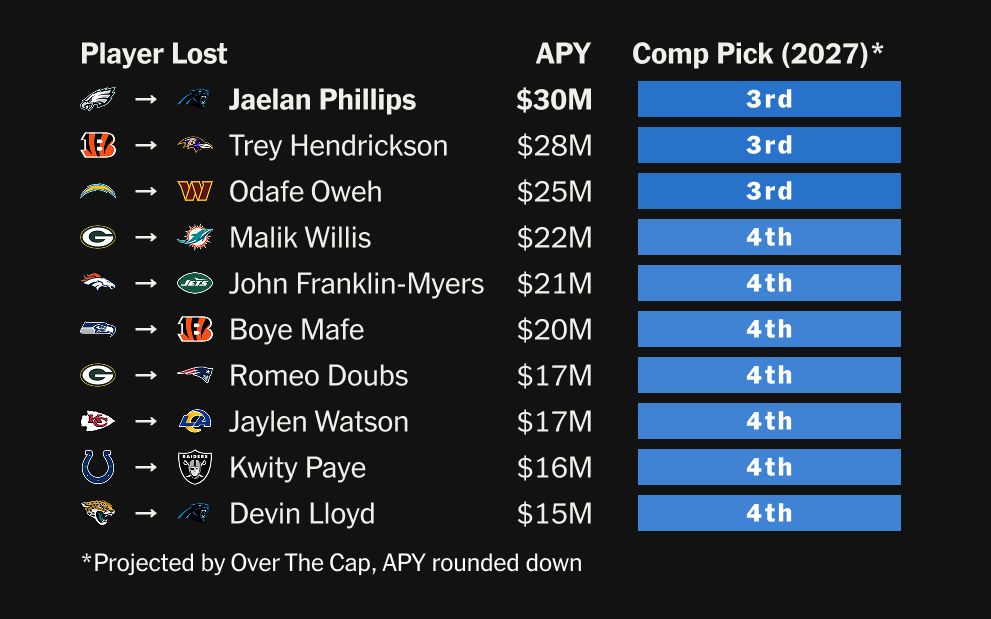
Now let’s talk about the Eagles’ midseason trade for Phillips. They sent Miami a 2026 third-round pick in early November, which wasn’t a cheap price for a player on an expiring contract. The 26-year-old edge rusher became a perfect fit, though, reigniting their pass rush while playing in their final nine games, including the playoffs.
This week, the Panthers signed Phillips with this cycle’s most lucrative free-agent contract so far, meaning the Eagles are currently in line to get one of 2027’s best compensatory picks. In total, they moved a 2026 third-rounder for a stretch run with Phillips and a 2027 third-rounder in return. Roseman stays winning.
That said, no one is better at this than the Ravens, who’ve had a league-leading 63 comp picks since the system began. That includes four this year. Here’s how it works in more detail:
If a team loses more qualifying unrestricted free agents than it signed in the previous offseason, it can gain a pick one year later. Cutting players doesn’t count.
The NFL uses a secret formula to calculate which comp picks go to which teams, but Over The Cap has largely figured it out. It’s based heavily on the average salaries of all qualifying free agents, though individual honors and playing time also factor.
We also have a more thorough explainer here. Let’s shift gears to the draft, which free agency changed in a big way. Over to Ted.
What Ted’s Seeing: Ty Simpson, QB2?
The consensus belief is that Alabama’s Simpson is the No. 2 quarterback in this draft class behind Indiana’s Fernando Mendoza, but opinions are all over the place about whether Simpson should be a first-round pick.
Did he show enough in his 15 college starts to warrant such an investment? Let’s look at the film.
Part of Simpson’s appeal is that you can see him executing translatable plays at a high level. Many of his best passes are highly accurate anticipation throws over the middle of the field, where some young quarterbacks struggle. Simpson doesn’t hesitate.

Simpson played in a “pro-style” passing game at Alabama under offensive coordinator Ryan Grubb.
In that clip, Simpson had a dagger concept (dig/vertical combo) called, the most popular third-and-long concept in the NFL. As he got his head around, he saw the linebacker run with the inside vertical. Then he saw the next underneath defender bite on the underneath route, so he ripped a perfect pass to the dig route.
One red flag: Size. At the combine, Simpson measured in just a little over 6-foot-1, which puts him in the 20th percentile among combine quarterbacks. He also came in at just 211 pounds, in the 17th percentile.
In the last 20 years, only six quarterbacks 6-1 or shorter and under 215 pounds have started more than 40 games in the NFL: Drew Brees, Russell Wilson, Baker Mayfield, Michael Vick, Kyler Murray and Bryce Young.
I outline plenty of other concerns in today’s story on Simpson, unlocked for you to read here. Based on all those factors, I see him as more of a third-round pick who will get pushed up to the second because of a weak overall class. Back to Jacob.
Extra Points
🏈 Vikings sign Kyler Murray. Alec Lewis explains why Minnesota targeted the 2019 No. 1 pick. “Could J.J. McCarthy win a competition with Murray? It’s highly unlikely.”
🔥 Patriots x A.J. Brown? Chad Graff explores whether a trade for the Eagles receiver is still possible for New England.
👀 $100 million question. Can Daniel Jones stay healthy for the Colts? James Boyd explores the questions facing the 28-year-old quarterback after his second big payday.
❗New-look Bills? Hardly. As Tim Graham writes, Buffalo’s offseason has so far done little to alleviate the pressure on Josh Allen to be Superman.
👔 Bryce Huff retires. The 27-year-old 49ers defensive end announced it yesterday afternoon, sharing plans to start a company.
▶️ Yesterday’s most-clicked: NFL insiders, unfiltered on the Ravens’ Maxx Crosby debacle.
📫 Enjoyed this read? Sign up here to receive The Athletic’s free NFL newsletter in your inbox.
Also, check out our other newsletters.