
With the first wave of free agency having come and gone, each team’s pressing needs become clearer the closer we get to April. For the Chicago Bears, the needs are vast, but luckily, most of them are on one side of the ball. While it’s easy to classify them as “busy” at the start of the acquisition period, cap space was limited. To this point, general manager Ryan Poles hasn’t shown an appetite to stretch the budget much further.
While fans can still expect a few moves to trickle down in between now and draft weekend, it’s best to keep expectations low until they can take stock of their roster post-draft. With plenty of familiar faces gone and many new faces set to arrive, we’ll take another stab at upgrading the Bears’ roster through the draft in Aaron Leming’s Mock Draft 2.0 using the NFL Mock Draft Database’s Consensus Big Board.
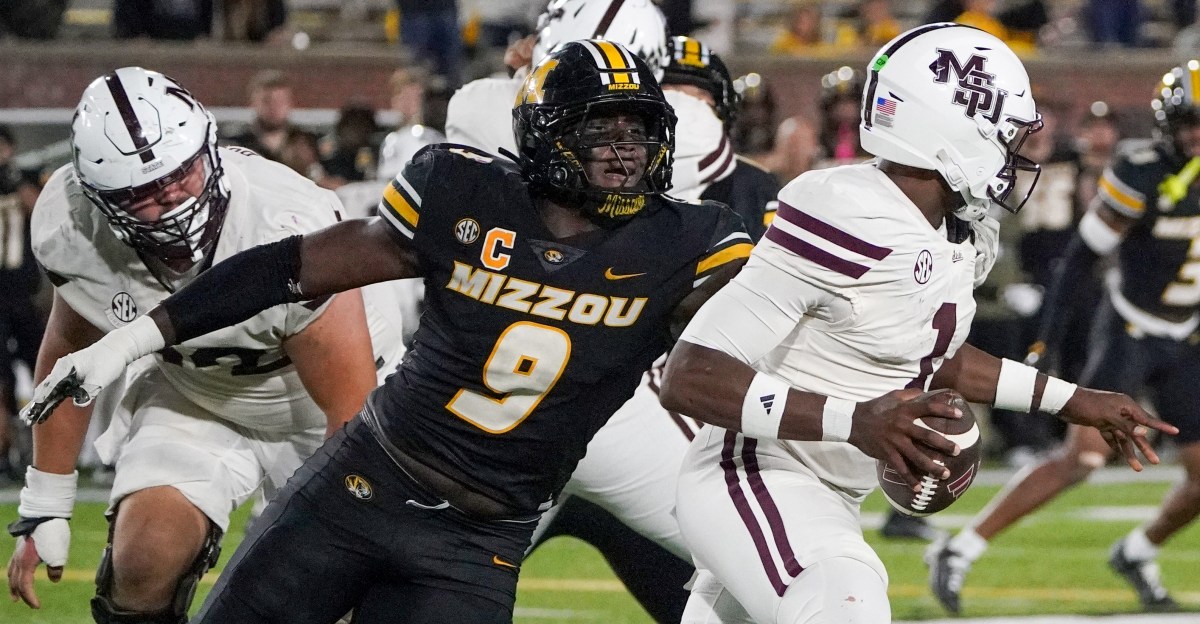
Round 1 (#29) DE Zion Young (Missouri)
Trade with Kansas City Chiefs: #25 for #29, #109, and #210
Don’t get me wrong, I still like Peter Woods. That said, after not running or doing any testing at the NFL Combine last month, his performance at Clemson’s Pro Day last week was less than ideal. His testing metrics, combined with his lack of size or length, might put him out of the first-round conversation as a whole. I’ve also concluded that barring projections to go in the Top 15, falling to No. 25, I’m not a huge fan of the Bears’ options in the first round. Hence, trading down a few picks to try and add some additional value on Day 3.
Following the Bears’ free agency activity, their needs heading into the draft seem pretty clear. Assuming a playmaker like Dillion Thieneman isn’t available, an edge rusher might be their best option. That said, the list of players who fit the Dennis Allen mold further shrinks the overall pool. I don’t love Young, but there’s plenty that he does well. I’m still not sold that he’ll be an elite sack artist, but even if he averages 8-10 sacks per year and fills a Montez Sweat role at a cheaper rate, that should be a big value for this defense. In the short term, he’ll slot in as DE3 and share rotational snaps until he earns a bigger role in the second half of the year. What I do love is NFL Media’s Lance Zierlein’s NFL comparison of Young to Za’Darius Smith. That’ll play.
Round 2 (#57) S Kamari Ramsey (USC)
Round two feels like the sweet spot for the Bears’ current needs. Safety, defensive tackle, cornerback, center, and even receiver could all make sense over the next two picks. They’ll start in the back half of the round, but there should still be plenty of viable Week 1 starting talent available.
For as much as I love A.J. Haulcy, his draft stock has risen since my first mock. That means I needed to take it down a peg and target someone deemed a little more realistic in this slot. Ramsey is a fun player who can play both strong and free safety. In Allen’s defense, the ability to interchange his safeties is huge, which is why bringing back Jaquan Brisker was never an option.
Chicago could opt to let Elijah Hicks win or lose the second safety job in camp, but ultimately, Ramsey’s talent would prevail, and he could be the second piece of a completely remade safety room.
Round 2 (#60) DT Gracen Halton (Oklahoma)
Via Buffalo Bills For WR DJ Moore
One of the best things that general manager Ryan Poles has done so far this offseason is finding a way to get a second-round pick for Moore. That’s nothing against the veteran receiver, but because of his contract, many doubted they would be able to get Day 2 value in return. So, kudos to Poles for pulling that off and making his job a little easier in late April.
Round 2 is a sweet spot for Allen-preferred edge rushers, and while No. 60 might be a little early for a player like Halton, sometimes, need wins out. As an Oklahoma fan, I would be a big fan of this move. Although he’s a little undersized, he’s a freak athlete who has an immense ceiling. Some might view his numbers as underwhelming, but it’s key to remember that Sooners head coach (and defensive play caller) Brent Venables loves to rotate his defensive linemen. Halton was caught up in the mix of an extremely talented defensive tackle room, and outside of David Stone, he was the best they had to offer.
Because of the added depth currently on the depth chart, Allen and the defensive coaching staff could bring him along slowly and feature him on passing downs early. He’s a well-rounded player, but he should make his money getting after the quarterback at the NFL level.
Round 3 (#89) C Logan Jones (Iowa)
The retirement of center Drew Dalman came as a complete surprise. Luckily, the Bears acted fast when they traded for veteran Garrett Bradbury. Admittedly, I’m still not a big fan of his overall game, but Bradbury is a scheme fit, and it’s clear that head coach Ben Johnson still values having a veteran snapping the ball with a third-year quarterback. With that in mind, Bradbury is already on the wrong side of 30 and has plenty of mileage during his NFL playing career. In a best-case scenario for the Bears, he’s a one-year stopgap while they develop his replacement in 2026.
That’s where Jones comes in. The coaching staff should have their pick of quite a few names starting on Day 2 and extending into the middle of Day 3. Tony Pauline reported that not only were the Bears at Georgia Tech’s Pro Day, but they were among a few teams that requested that Keylan Rutledge work out at center. They’ll want an athletic center with leadership ability and a strong understanding of pre-snap adjustments. Relying on any rookie with a young quarterback is a risky proposition, but Jones projects as a rock-solid NFL player with a high enough ceiling to feel good about taking him in the third round. Even if he doesn’t play a snap in 2026, this is a needed move. More importantly, this is where fans should trust offensive line coaches Dan Roushar and Kyle Devan to identify the best talent and develop them into game-ready players by the time their names are called.
Round 4 (#109) WR Ja’Kobi Lane (USC)
Is receiver an immediate need for the Bears, even after trading Moore? Probably not. How would Johnson get another weapon to develop in Year 2 of reshaping this roster? Absolutely.
While I’m not someone who thinks trading Moore wasn’t an immediate loss, I would also argue that this is a great opportunity for Johnson and his offensive coaching staff to groom a long-term replacement who better fits what they are trying to do on offense. Lane’s projections have been all over the place, but he fits the mold of a Ben Johnson receiver. He ran an impressive 40, and while Makai Lemon catches most of the early-round headlines, Lane is no slouch himself. Even if he spends the majority of his rookie season as the fourth or fifth receiver, adding another talented player to the pipeline will surely pay off in the future.
Round 4 (#129) CB Tacario Davis (Florida)
It’s hard to shake the feeling that even after letting Nashon Wright walk for pennies, they are in the market for another cornerback capable of supplanting Tyrique Stevenson. Admittedly, I’m someone who believes that Stevenson has received the short end of the stick during his time in Chicago. Barring a complete change of heart, it’s tough to see many paths to him sticking around past 2026. Some might argue that there are two intriguing names already in the pipeline behind Stevenson, Zah Frazier, and Terell Smith. Still, I would argue that Smith is not a great scheme fit, and Frazier is a complete unknown, who missed his entire rookie season as an older prospect.
Now that we have that set up, let’s talk about Davis. At 6’4 and 33 ⅜ inch arms, some have compared him to Nahshon Wright. That said, 4.41 40-time and fluid hips remind me more of Tariq Woolen than Wright. Either way, his physical profile is a 100% match for what Allen looks for in corners, and while nobody knows how long Al Harris will stick around for, it would be great to get him another ball of clay that could develop into a starting cornerback. Admittedly, I have a question about Allen’s “prototype” at defensive end, but if there’s one spot I fully trust him in, it’s defensive back.
Round 6 (#210) DT Landon Robinson (Navy)
Will the Bears go 91 spots in between selections? I lack the creativity to mock up any more trades in my second mock draft. These final three picks are difficult to project, and at this stage in the process, a blocking tight end might make the most sense, but it would be hard to pass up a player like Robinson in the sixth round. After adding Halton in Round 2, the depth chart does get a little murky, but as we’ve learned, most service school prospects take a year or two to get into NFL shape and become productive players. Robinson would be somewhat of a gamble, especially with his size not being overly ideal, but man, there’s a lot to like on tape and within his testing numbers.
Round 7 (#239) TE Will Kacmerek (Ohio State)
It might have taken eight picks, but the Bears have finally found their blocking tight end of the future. With Colston Loveland and Cole Kmet locked in for the next handful of seasons at a combined not-so-cheap price, getting value out of a late-round blocking tight end is needed, especially after veteran Durham Smythe followed former offensive coordinator Declan Doyle to Baltimore on a one-year deal.
Similar to Smythe, Kacmerek might never hold a ton of value as a pass catcher, especially in the open field, but we’ve seen a jump in value on the free agent market when it comes to this type of “Y” tight end role. It will take the Ohio State product some time to iron out some technical deficiencies, but this feels like a great value in the final round of the draft.
Round 7 (#241) RB Desmond Reid (Pittsburgh)
Some might say I lack creativity in the seventh round, which might be fair. That said, taking a swing at the next Tarik Cohen with their final pick in the draft is a good time. D’Andre Swift is heading into the final year of his contract, and with this not being a great running back class, adding a fun chess piece for an explosive offense seems like a good way to spend the last pick of their 2026 draft class.