
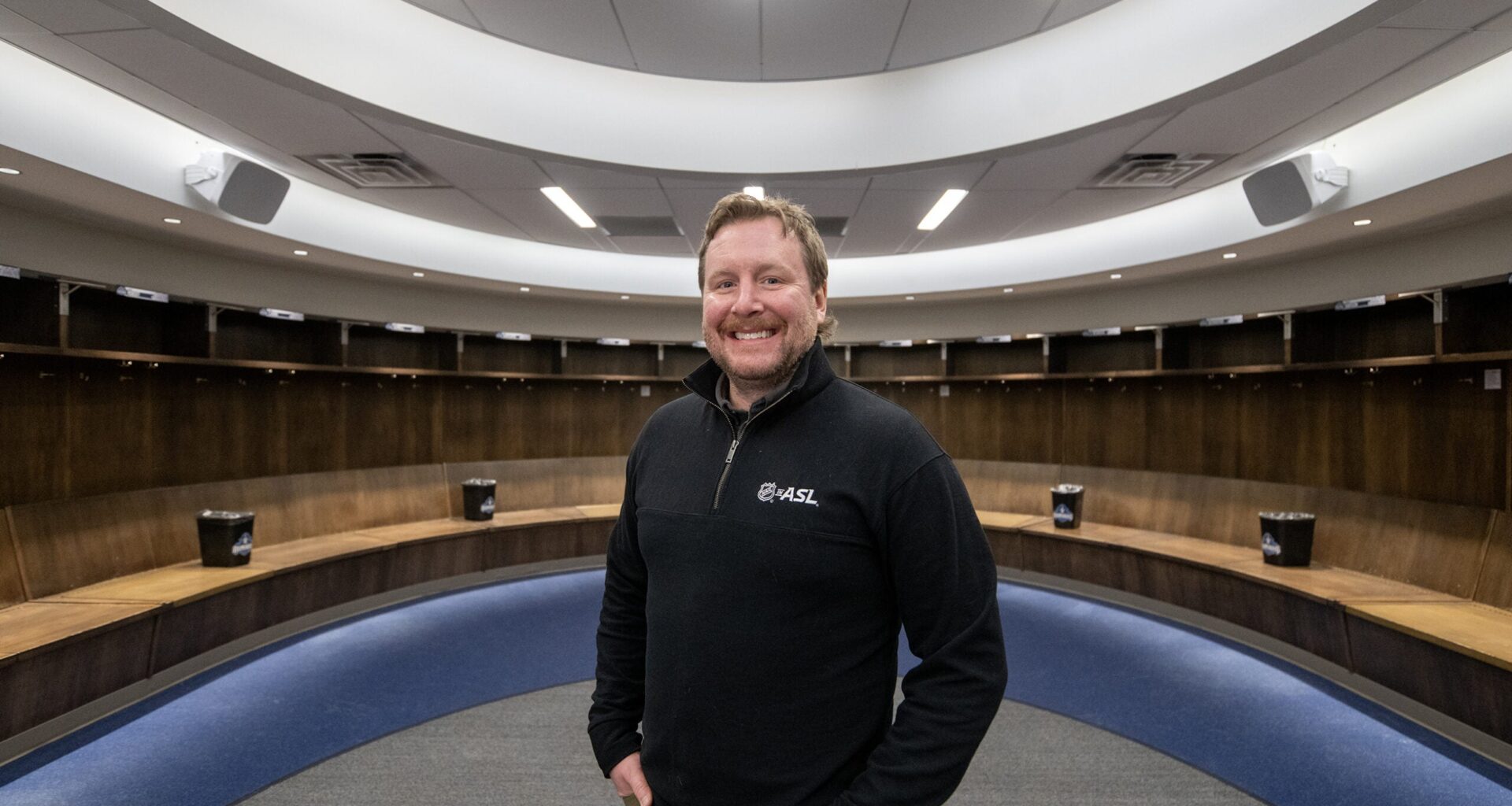
Brice Christianson knew he wasn’t like most kids when he was growing up in Wisconsin’s Fox Valley.
The Appleton native is a CODA, or a Child of Deaf Adults — both his mother and father are Deaf.
Christianson is hearing but he learned American Sign Language ASL even before he learned how to speak English.
Understanding Wisconsin, Together.
WPR’s “Wisconsin Today” newsletter keeps you connected to the state you love without feeling overwhelmed. No paywall. No agenda. No corporate filter.
As the “only CODA on the block,” he said he sometimes felt lost or misunderstood when he was growing up.
“I didn’t have an identity,” Christianson said. “As a CODA, you’re not hearing, you’re not Deaf, you’re in between.”
Connecting with his Deaf father was also difficult at times — but not when it came to sports.
“I think sports gave my dad an identity, and then when I was born, he wanted to connect with me,” Christianson said.
Some of Christianson’s earliest memories involve sports. He’ll never forget when his dad kept him awake to watch Joe Carter’s legendary walk-off home run in game six of the 1993 World Series, or watching Brett Favre’s first game with the Green Bay Packers when he threw a game-winning touchdown pass in the 4th quarter.
“I remember jumping up and down with my father, my mom, my siblings,” Christianson said.
When he got the chance to go to games at Lambeau Field, Christianson would sign to his father in ASL what the announcer was saying or what fans around him were talking or cheering about.
“At Packer games, I just wanted to make my dad feel included and also make him proud,” he said.
Now, decades later, the 42-year-old Milwaukee resident has dedicated his life to making sports broadcasts more accessible to people in the Deaf and hard of hearing community through his company, P-X-P.
“It’s paying homage to my Deaf parents,” Christianson said. “My father, he instilled in me a passion of sports, and we grew up in an inaccessible world. I mean, it’s still inaccessible, we’re getting better, but P-X-P really is all about creating access for Deaf sports fans, for creating a community where people can celebrate their love for sports.”
The Milwaukee Admirals are hosting an “ASL Night” on March 27 in partnership with P-X-P.
There will be ASL commentators on the video screen in the arena during the game, and ASL interpreters located throughout the concourse during the game.
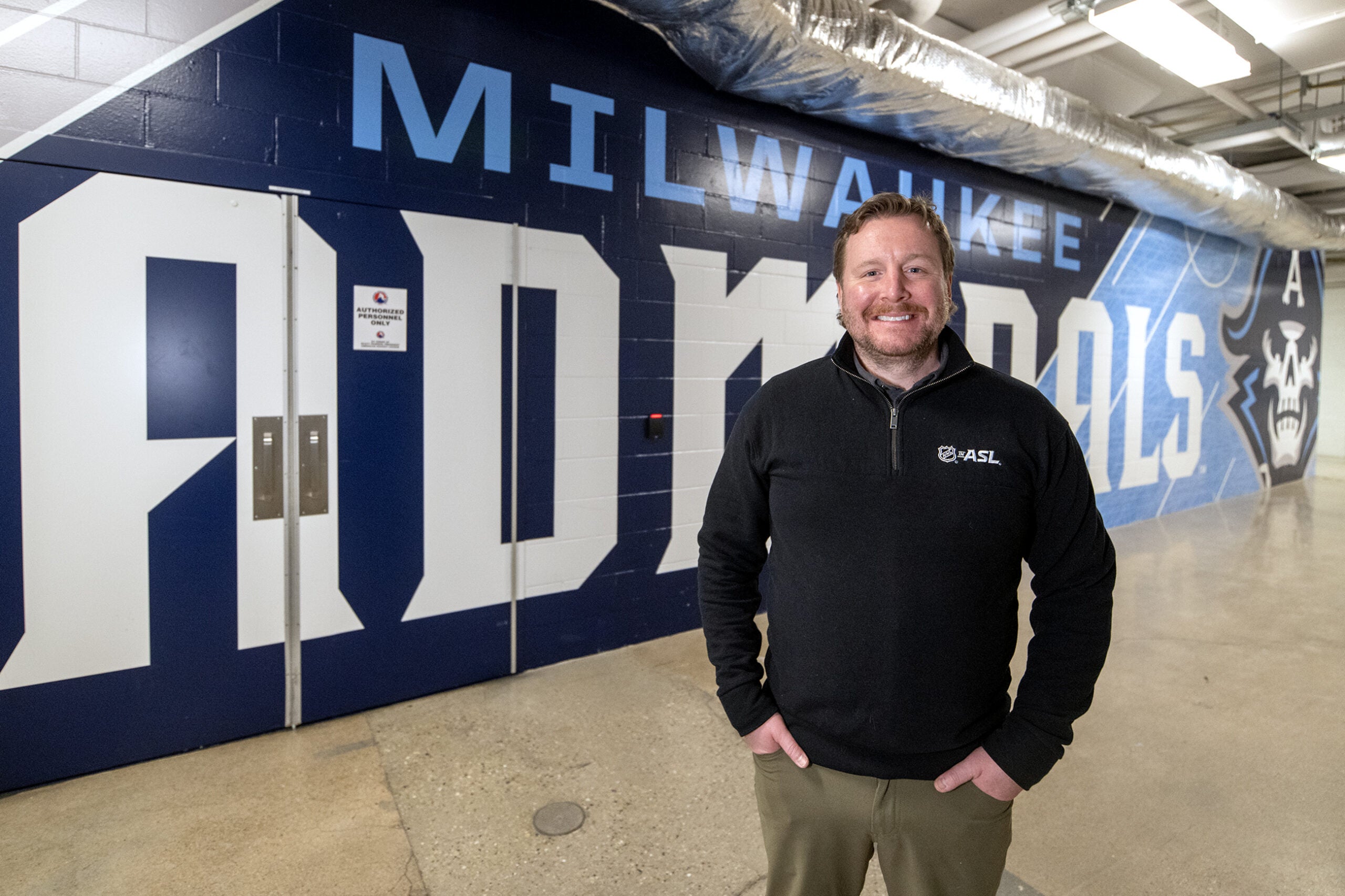 ASL Interpreter Brice Christianson on Thursday, Jan. 22, 2026, at Panther Arena in Milwaukee, Wis. Angela Major/WPR
‘There was this spark’
After graduating from high school, Christianston landed a job working at a hospital. That’s when his passion for interpreting ASL took off, after he interacted with a patient who was Deaf.
“There was a spark, this fire of like, ‘Oh, I like this connection, this is familiar,’” Christianson said.
He decided to attend the University of Wisconsin-Milwaukee for its American Sign Language interpreting program.
“Stepping on campus for the first time at 26, I felt this sense of exhilaration and excitement,” he said. “I felt for once, I was comfortable in my own skin, and I had found my purpose.”
Christianson worked as an ASL interpreter at some concerts and events in Milwaukee after graduating. That’s how he connected with someone who works at Fiserv Forum, the home of the Milwaukee Bucks.
He made the Bucks a bold pitch and asked if they wanted to have an ASL interpreter for press conferences.
“I was thinking that nothing was going to happen,” he said.
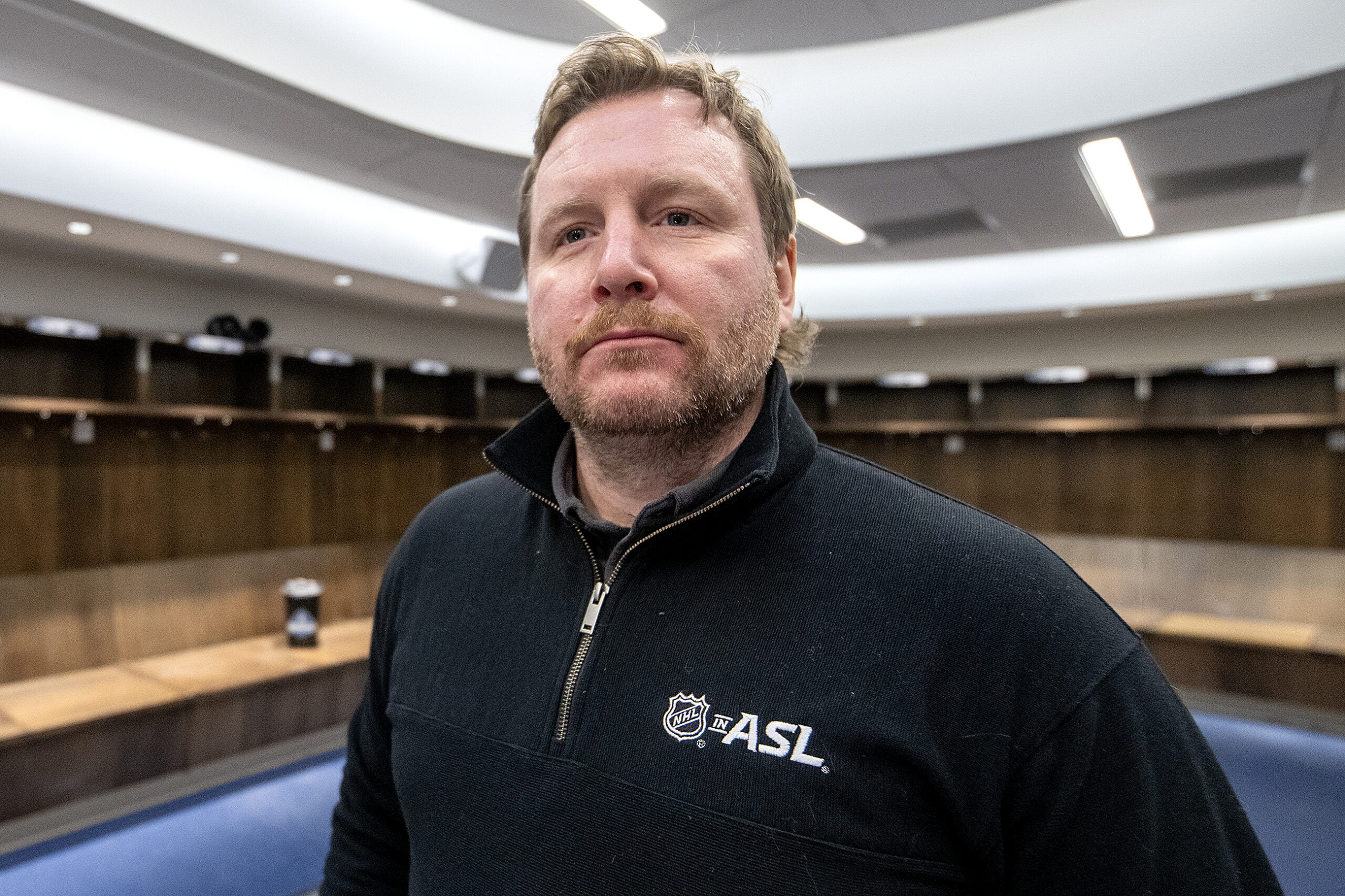 ASL Interpreter Brice Christianson on Thursday, Jan. 22, 2026, at Panther Arena in Milwaukee, Wis. Angela Major/WPR
A few days later, he got the nod of approval from the team. Soon after, he was interpreting pre-game and post-game press conferences in ASL, standing just feet away from former head coach Mike Budenholzer.
He remembers the first press conference he did in 2019 like it was yesterday.
“I couldn’t even enjoy the game, just sitting there realizing how massive an opportunity this was,” he said. “And looking back, I don’t even think I realized what I was stepping into.”
Christianson interpreted many press conferences in ASL for the Bucks. He was also there with the team during their 2021 NBA Championship run.
“That was my dream, was to provide access for my favorite sports teams,” he said.
But after working with the Bucks, he wanted more.
Christianson officially launched his business P-X-P in 2022. He reached out to a few major sports leagues — and the National Hockey League signed on as partners that year.
He began with the NHL by interpreting Commissioner Gary Bettman’s state of the league address in 2022. Soon after, Christianson worked with the league to help launch “NHL in ASL,” a new broadcast platform for people in the Deaf and hard of hearing community.
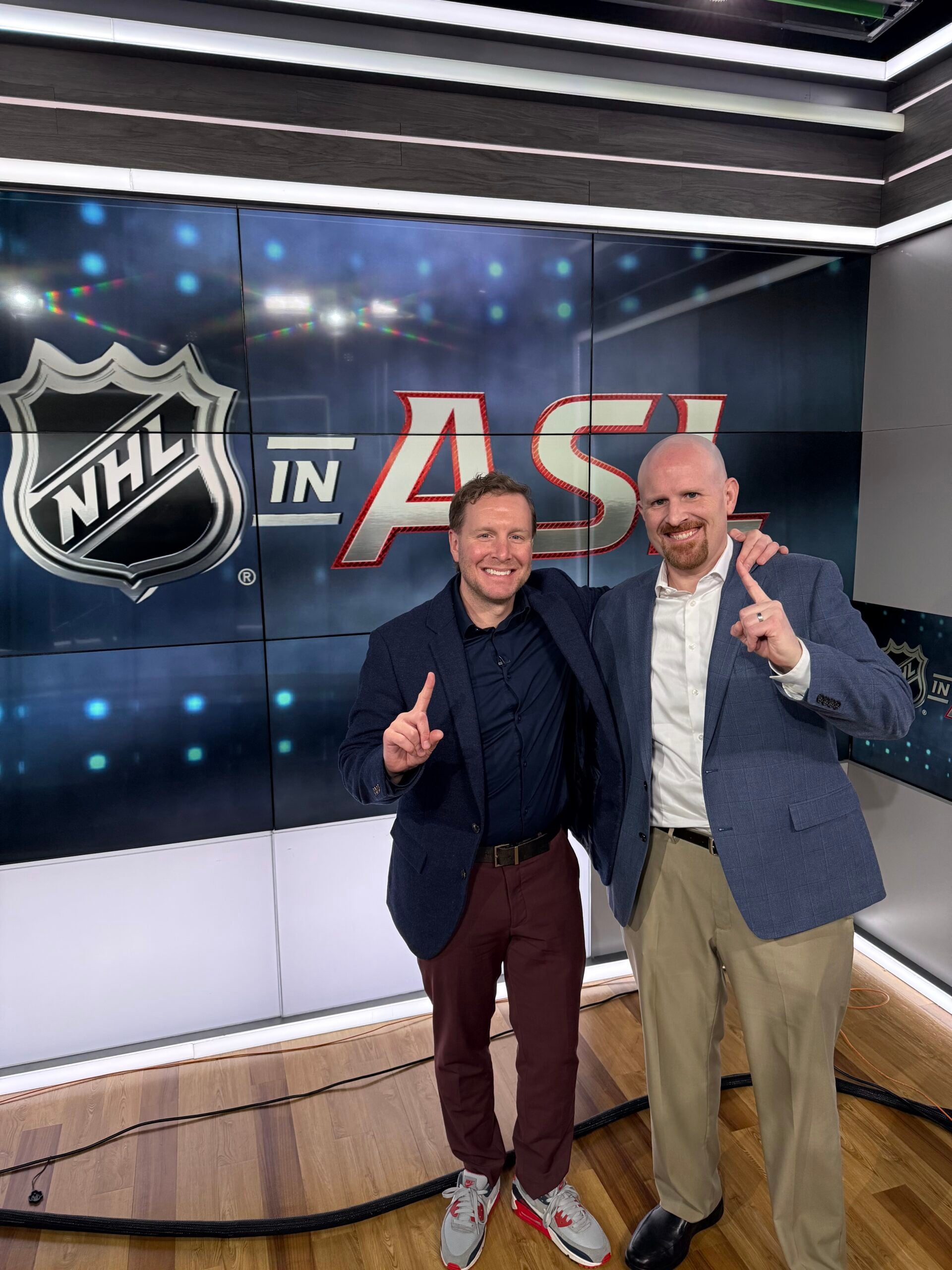 Christianson is seen here with Jason Altmann, the chief operating officer of P-X-P. Photo courtesy of Brice Christianson
People viewing an “NHL in ASL” broadcast will see the hockey game on the left side of the screen. Two Deaf commentators — Jason Altmann, the chief operating officer of P-X-P, and Jeffrey Mansfield — provide their own play-by-play analysis and color commentary on the right.
There’s also a “crowd intensity meter” at the bottom of the screen so fans can get a sense of how loud it is inside the arena.
Christianson works behind the scenes as a producer. He watches what the commentators are signing and then relays that to the production team so they can put infographics on the screen.
“I’m acting as producer, as interpreter, and essentially just trying to coordinate everything,” he said.
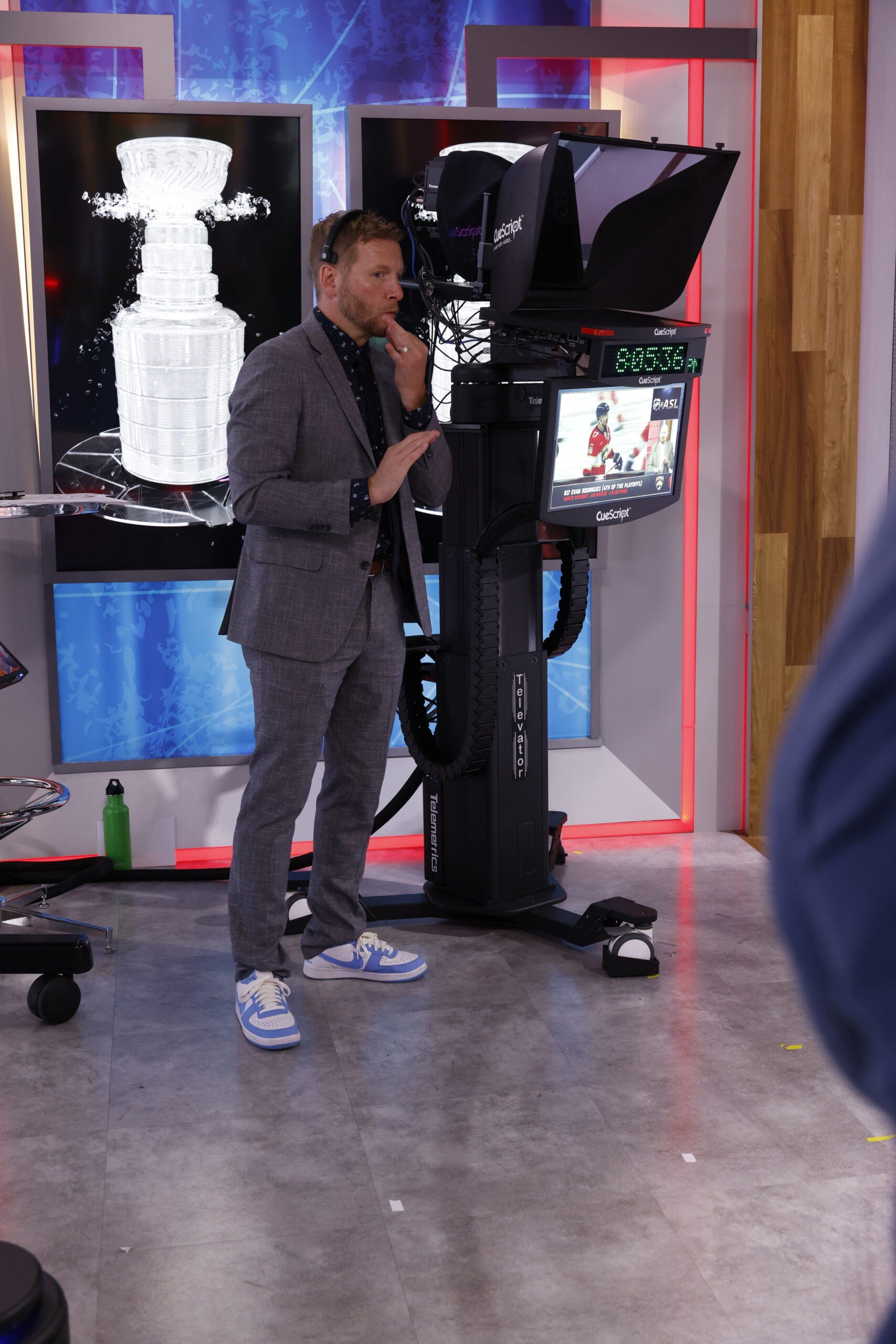 NEW YORK, NY – June 10: ASL interpreters appear on the NHL Studio set during Game Two of the 2024 NHL Stanley Cup Final on June 10, 2024 at NHL Headquarters in New York City, New York. Michelle Farsi/NHL
Rachel Segal, the NHL’s Group Vice President of Social Impact and Strategic Integration, is an executive producer on the show. She said the idea to do an alternative telecast in ASL was originally a “pie in the sky idea.”
“So it really took a lot of trial and error, especially since there was no roadmap for this to begin with,” Segal said.
P-X-P has broadcast nearly 20 NHL games so far in partnership with the league, including the 2024 and 2025 Stanley Cup Finals. Segal said she has been encouraged to see all the positive reactions to the broadcasts.
“I think that’s what got me the most, was it not only was revolutionary in terms of accessibility for sports broadcast, but it was revolutionary in terms of opening up a whole part of the broadcasting industry to a new subset of people that would have not had that opportunity before,” Segal said.
Oasiz Wiesblatt, a center on the Milwaukee Admirals, also grew up as a CODA, as both of his parents were Deaf.
“I think it’s really special for him (Christianson) to involve everyone,” Wiesblatt said.
“I think that’s what needs to be done,” he added.
And Christianson’s vision doesn’t end with hockey.
“Ideally, I want to see more leagues and more sports buy into this,” Christianson said.
‘They get to live and breathe it’
Around 30 million people ages 12 and older in the United States have hearing loss in both ears, according to the National Institute on National Institute on Deafness and Other Communication Disorders.
Christianson said Deaf sports fans do have the option to turn the subtitles on their TV when watching a game. While that provides some access, he said it’s limited.
“What you’re telling the Deaf and hard of hearing community is that we want you to be like us,” Christianson said. “We want you to read — and so what they have to do is watch the game, read the captions and then look up.”
Live interpreting offers true access, he said.
“ASL is their language, and they get to live and breathe it,” he added.
“They’re doing great,” he said, “they just need more access.”

“Wisconsin Life” is a co-production of Wisconsin Public Radio and PBS Wisconsin. The project celebrates what makes the state unique through the diverse stories of its people, places, history and culture.