
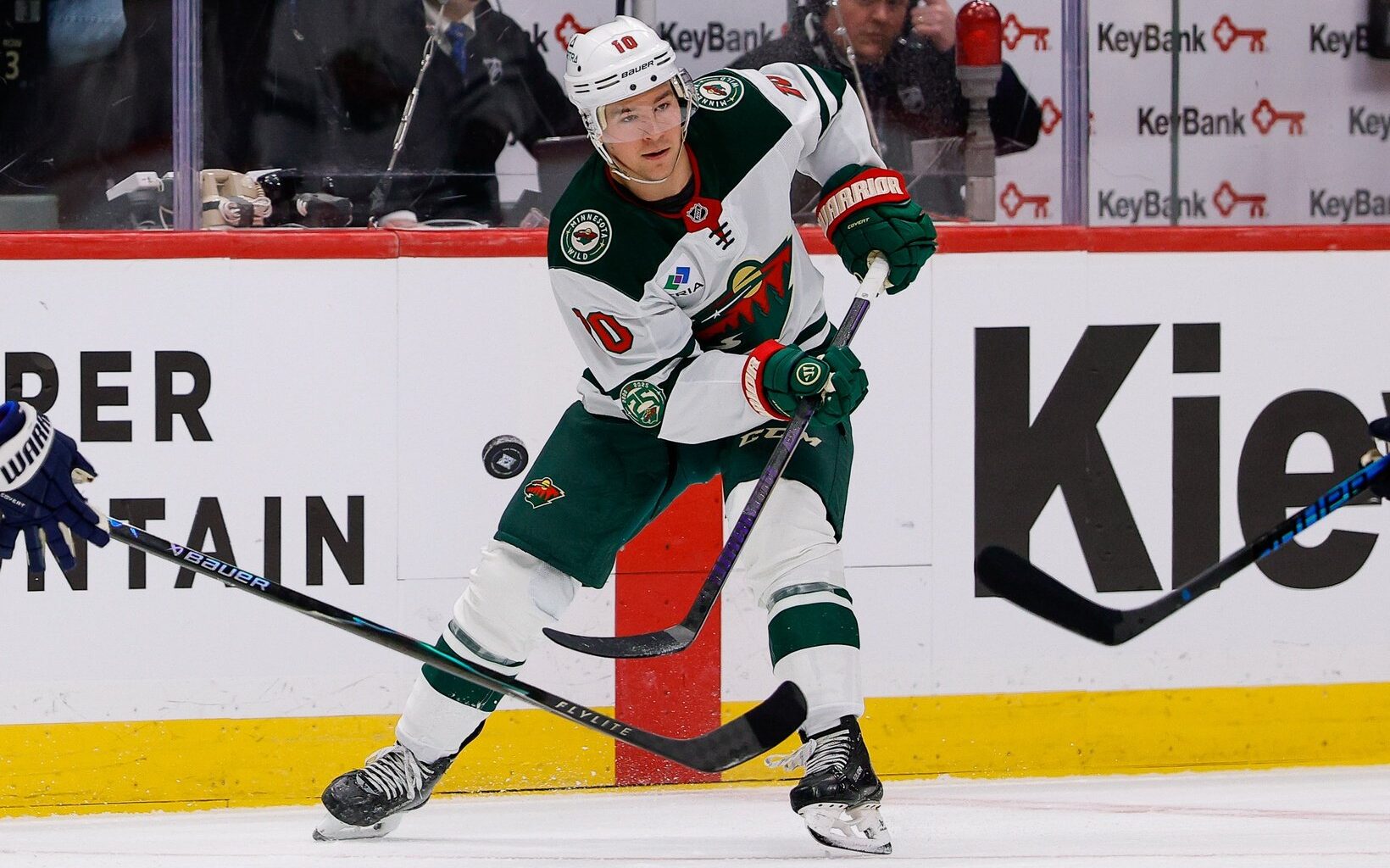
I’m sure, by now, that you’ve heard of Bobby Brink.
He’s a Minnesota native, and he is NOT allowed to go to the box office. Apparently, everybody is supposed to feel really strongly about Bill Guerin forbidding Brink from spearheading friends-and-family ticket purchases.
On top of that, he’s a scrappy, undersized, two-way winger — and his middle name is Orr. Bobby Orr Brink — as in Bobby Orr. Who doesn’t love that? And, did you know he won a state title in 2018 in our very own Minnesota State High School Hockey Tournament?
If the interviews for his feature in The Athletic haven’t already wrapped up, they must be on the schedule for this summer. Dinner will probably be mentioned, somehow.
Dry humor aside, the acquisition is one of Minnesota’s most fun off-ice moves in recent memory. It’s also a great value on the ice. Ignoring what Minnesota gave up to acquire defenseman David Jiricek, replacing Jiricek with Brink is undoubtedly an upgrade.
Even after accounting for the positional value of a right-handed defenseman over a winger, the only way Minnesota loses this trade is if Jiricek can access the ceiling his athletic tools provide. Even if Jiricek blossoms later, Brink can play on any NHL roster. That’s all that matters with the Wild opening a Stanley Cup window.
But, with Brink’s contract expiring on June 1, 2026, it raises a new question for the Wild: Should they keep Brink around for the Stanley Cup push, or trade him for assets and free up the cap space?
It’s a simple question. What’s complicated is to weigh the cost of Brink’s extension, his trade value, and the options for spending the cap space he opens if traded.
Jumping to the end, it’s nearly impossible to know which players Minnesota could bring in to upgrade on Brink. NHL GMs won’t make that information public because it undermines their leverage in trade negotiations. While it’s fun to dream that the Wild could acquire Auston Matthews if they just opened up some cap space by trading Brink, it would be risky to assume that quality of player will be available.
With the NHL salary cap increasing drastically in each of the 2025, 2026, and 2027 offseasons, cap space has been easy to find. That’s led teams to retain their best players at higher prices. In effect, cap space has become less valuable relative to other assets — whether that’s a draft pick, prospect, or roster player.
Does that mean that Brink has a one-way ticket to getting overpaid? Fortunately, no.
Since the former Flyer is only 24, he won’t hit unrestricted free agency (UFA) until the 2029 offseason. As a restricted free agent (RFA), any team that signed Brink to a free agent deal this offseason would be required to pay draft pick compensation to the Wild. That depresses his market value to all teams across the league.
Minnesota only needs to match an opposing team’s offer, so Brink’s agent has limited leverage in negotiations — despite a rising salary cap.
If any other team offers Brink a contract with an AAV above $5.08 million (projected based on last year’s numbers and cap inflation), they would be forced to give the Wild their 2027 1st- and 3rd-round draft picks.
It seems unlikely that any team would part with that much draft capital to bring in Brink. He’s an effective, but not elite, two-way player on pace for 19 goals over 82 games this season. In his age-24 season, it’s unlikely that Brink will drastically improve his game.
Effective middle-six wingers aren’t a rare commodity in the NHL, and Brink has dealt with injuries over his young career. At 5-foot-8, GMs across the league will also likely discount him for that reason — whether they’re right or wrong for it.
So, $5.08 million per year seems like it sets a ceiling on Brink’s market value through the 2028-29 season.
Brink is eligible for arbitration, which means he doesn’t need to bring a competing offer to the Wild to get a fair deal. He can take his negotiation to arbitration, in which his agent and the Wild present arguments to a neutral third party. The arbitrator determines the salary, and then either the team or the player – whichever party did not file for arbitration – chooses whether the deal will be for one year or two.
Per Shayna Goldman at The Athletic, Carolina Hurricanes general manager Eric Tulsky believes arbitration rulings are mostly based on statistical production.
For example, Guerin might point out that Brink’s 14 goals in 58 games are on pace with Kailer Yamamoto’s 20 goals in 2021-22, his age-23 season. Yamamoto received a 2-year contract worth about 3.76% of the cap — about $3.91 million adjusted to the 2026-27 salary cap. Brink’s agent might highlight Kaapo Kakko’s deal. He signed for 4.74% of the cap last offseason, but scored at a much slower pace.
Organizing these arguments is the job of Brink’s agent and the Wild staff, and using them to come to a dollar value is the arbitrator’s job. For our purposes, we can use PuckPedia’s contract comparables tool to narrow down the list.

Some of these are not effective. For example, centers are likely to be paid more than Brink because of positional scarcity.
Players who signed after age 26 are also poor comps, since many are close to UFA status. Those contract years aren’t subject to team-friendly dynamics created by offer sheet compensation, so older players typically get a premium for including those years in their contract — even if they sign under RFA status. For example, Lawson Crouse’s 5-year contract included 3 UFA years, which explains his AAV climbing to 5.21% of the salary cap.
Minnesota could choose to do this with Brink. However, inflating his AAV for the sake of long-term price security doesn’t align with their Stanley Cup window.
Narrowing this list down to six names, it appears that Brink’s comparable deals average out to about 3.7% of the cap. However, I feel that Pavel Dorofeyev, Eeli Tolvanen, and Kailer Yamamoto are also poor comparables due to their age — especially Dorofeyev, whose AAV is an outlier.
That also squares with PuckPedia’s tool. Kakko, Puljujarvi, and Marchenko are Brink’s 2nd-, 3rd-, and 5th-ranked comps behind Anthony Cirelli (a UFA deal and a center) and Thomas Novak (26 years old with only 47 NHL games before signing).

These average out to about 4.25% of cap — a projected AAV of $4.42 million under the ‘26-27 cap.
That lines up with Brink’s value according to Dom Luszczyszyn’s player value model at The Athletic. Depending upon whether Brink gets a two- or three-year extension, his on-ice value would be about $4.91 or $5.22 million. Take a haircut off of that value since he’s an RFA, and a contract price around $4 or $4.5 million seems reasonable.
The only other factor that could increase that value is the cap environment. Of the three comparable extensions, Kakko’s is the only one that was signed after news broke about the NHL’s exploding salary cap. If the Wild or the arbitrator are sympathetic to this argument, Brink could push his value closer to $5 million per year.
That likely won’t be an issue, but it’s a possibility the Wild should prepare for. Since arbitration contracts are typically based on statistical comparisons rather than market forces like the salary cap, Brink would likely need another team to offer him a contract at that $5 million average.
They would also need to be willing to pay Minnesota a 2027 2nd-round pick to go through with the signing. There probably isn’t a team out there willing to do that. If there were, they likely would have acquired Brink at the trade deadline instead of the Wild.
Given that Brink is only 24 and that the three middle-six wingers are set to hit free agency this offseason (Mats Zuccarello, Vladimir Tarasenko, and Marcus Johansson), extending Brink seems like a sensible decision. He will provide above-average on-ice value relative to his contract, he’s under team control for three years, and he fills a role that Minnesota will suddenly need in ‘26-27 and beyond.
Brink can be a valuable piece in any trade for an elite upgrade, if one becomes available. Like the Quinn Hughes trade, cost-controlled roster players in their mid-20’s are appealing to teams parting with a superstar. It also solves the issue of making cap space for that upgrade, because Brink’s $4 to $5 million cap hit would travel with him to his new team.
If that trade never materializes, Minnesota gets to keep a feel-good story around at a value for three years.