
Free agency usually clarifies a team’s plan for the NFL Draft.
In the Minnesota Vikings’ case, here is that “clarity” in a nutshell: They’ll have to target, draft and hit on young players at multiple positions.
Unlike the previous two years, Minnesota has not spent aggressively in free agency. That doesn’t mean they can’t get creative come late April. That’s the theme of our second mock draft of 2026.
A month ago, a cornerback felt like a good fit in the first round. This time around, the Vikings still secure a cornerback, but they do it after a move that would become one of the draft’s most significant storylines if it happened.
Here is the latest projection, featuring two simulated trades and nine overall picks:
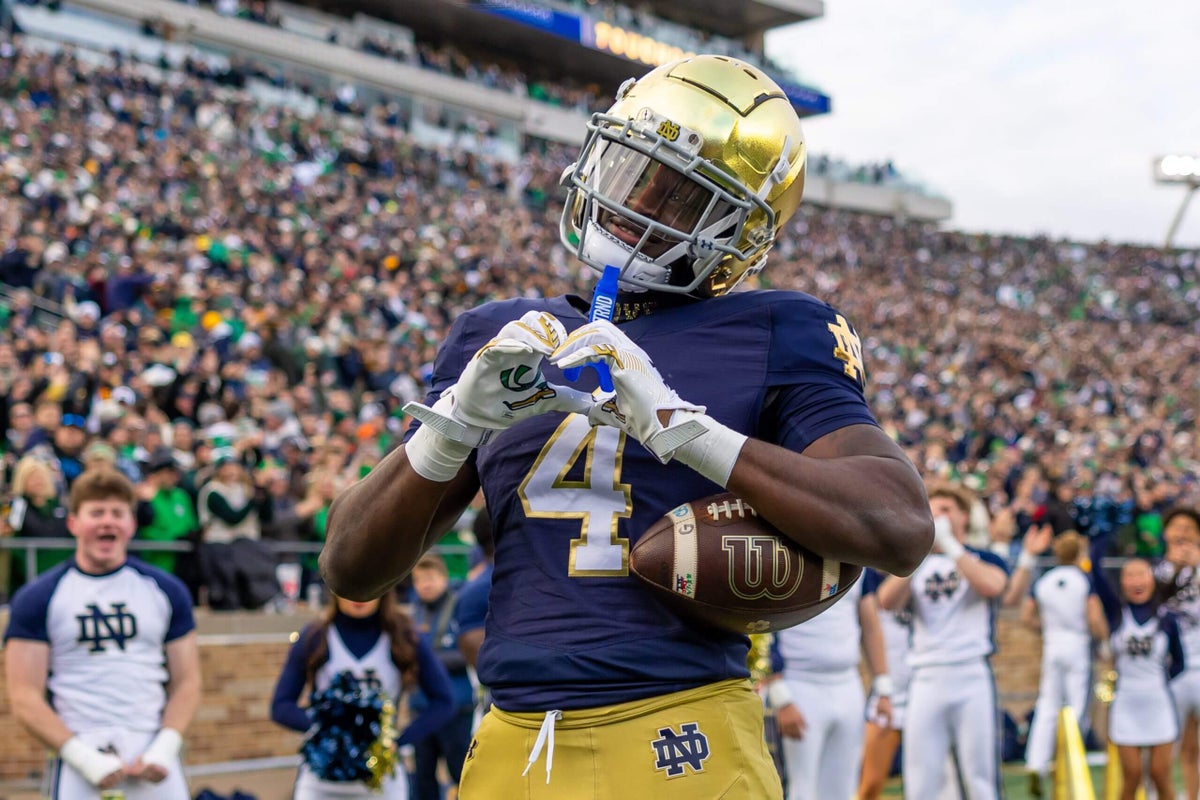
Round 1, No. 11 (via Dolphins): Jeremiyah Love, RB, Notre Dame
Mock trade: Minnesota sends No. 18, a 2027 third-round pick and a 2027 fifth-round pick to Miami for No. 11
We’re starting this off with a bang. The Vikings have been patient in free agency, so why not take a big swing on an electric player?
Will Love fall to No. 12? It’s a fair question. Dane Brugler, The Athletic’s draft expert, had him third in his most recent ranking of the top 100 draft prospects. Most major draft analysts project him as a top-10 pick, but there’s always a chance when teams are privy to more information than the public.
It’s worth noting that when colleague Mike Sando polled NFL executives on the top 10 picks, they all projected the New Orleans Saints and Kansas City Chiefs to select him at either No. 8 or 9. Yet both of those teams recently paid premiums for free-agent running backs.
Love’s fit in Minnesota is tantalizing. He has home-run hitting ability, which is currently lacking from the Vikings’ running backs room (made up of Aaron Jones and Jordan Mason). He is also an exceptional pass catcher. You can imagine how productive he’d be in a system that requires defenses to play vertically. The Vikings have eyed Bijan Robinson and Jahmyr Gibbs in past years. Love can reach those levels.
The Dolphins are in full rebuild mode. Scooping a couple of extra picks for the highly-regarded 2027 draft feels like a palatable enough return.
Round 2, No. 49: Lee Hunter, DT, Texas Tech
Vikings defensive coordinator Brian Flores loves big guys who move like little guys. Hunter is a match. He has a 6-foot-9 wingspan, but his first step features more lateral agility than you’d expect from a 318-pounder.
Because the Vikings already have versatile players on the front (such as Jalen Redmond and Tyrion Ingram-Dawkins), using a premium pick on a man in the middle makes sense.
Hunter, 23, performed for the Red Raiders in the team’s biggest games at the end of the 2025 season. There’s still room for development, though, with his technique and how he leverages his pads.
Hunter might be gone before No. 49. But if he’s there, and if the Vikings are committed to adding youth on the spine the way they’ve discussed, Hunter would be hard to pass up.
Round 3, No. 82: Sam Hecht, C, Kansas State
Center remains one of the Vikings’ most important needs.
Why did the team not add a veteran option in free agency after Ryan Kelly retired? Because the team brass didn’t view the free-agent crop as leaps and bounds better (and worth millions more) than a depth player like Blake Brandel.
Still, the team has studied the draftable center prospects. Hecht might have the highest floor. He dominated at the Senior Bowl. He is a fluid mover and wins with technique in pass protection.
Is he a future star? That’s probably lofty for the 22-year-old, but he’s sturdier than former Minnesota center Garrett Bradbury, and he would round out an offensive line that must improve for the offense to progress in 2026.
Round 4, No. 127: Jaishawn Barham (via 49ers), Edge/LB, Michigan
Mock trade: Minnesota sends Nos. 97 and 235 to San Francisco for Nos. 127 and 139
Why trade down 30 spots? To be able to secure both Barham and cornerback Hezekiah Masses, two prospects who fit Flores’ prototypes.
Barham is a versatile former off-ball linebacker who transitioned to the edge. He’s athletic and violent. Michigan’s defensive coordinator in 2025, Wink Martindale, has ample NFL experience. Martindale leaned into Barham’s strengths. Flores could do the same.
Barham, 22, who began his college career at Maryland, might need a developmental runway. That should be more doable than it was for current Vikings edge rusher Dallas Turner if Barham goes in the fourth round.
Round 4, No. 139: Hezekiah Masses (via 49ers), CB, California
There’s almost too much to like about Masses.
In 2025, he led all of college football with 18 passes defensed and snatched five interceptions. He provides run support and plays with swagger. And the Vikings have loved Cal defensive backs in past years, including Nohl Williams, whom the Chiefs nabbed last year.
This would be Minnesota’s chance at stocking the cornerback cupboard with more youth. Masses would pair nicely with free-agent addition James Pierre. They both attended Deerfield Beach High School in South Florida.
Round 5, No. 163: VJ Payne, S, Kansas State
Should the Vikings be targeting a safety earlier than this? Maybe. The team thinks Jay Ward is due for a breakout, and Pierre’s presence allows for more three-cornerback looks, if that’s how they want to use their personnel.
Regardless of where they draft, getting a safety seems paramount.
Payne, 6 foot 3 and 203 pounds, is smooth and long. He anticipates and coverage is where he does his best work.
Harrison Smith hasn’t decided whether or not to play another season, and the Vikings value his impact enough not to push him for an immediate answer.
Payne would offer short-term depth and special teams ability at a minimum.
Round 6, No. 196: Riley Nowakowski, TE/FB, Indiana
As defenses have gone lighter to defend a more pass-heavy league, bigger-bodied blockers are en vogue. This is where Nowakowski does his best work. He’s 6 foot 2, 250 pounds and half tight end and half fullback.
Vikings legend C.J. Ham is retiring, so finding another backfield type to set up running lanes would suit a revamped offense with the help of assistant head coach Frank Smith.
Round 7, No. 234: Skyler Gill-Howard, DT, Texas Tech
Texas Tech’s spending splurge wasn’t confined to Hunter or likely first-round pick David Bailey. The Red Raiders also added Gill-Howard, who is smaller but has enough burst at the line of scrimmage to cause problems.
The Vikings already have Ingram-Dawkins. Undrafted free-agent signing Elijah Williams made hay last fall, too. Taking a shot on one of Hunter’s college teammates, who might have impressed in the College Football Playoff had it not been for an ankle injury, could be interesting.
Round 7, No. 244: Tyren Montgomery, WR, John Carroll
Could the Vikings take a receiver much earlier? Yes.
Do they need to? If they acquire Love, who would become a focal point of the passing game, then no.
Montgomery suits the style that Vikings receivers coach Keenan McCardell seeks. He’s shifty, tracks the ball in the air and wowed evaluators at the Senior Bowl. And he can get better, especially under McCardell. When you’re drafting players in the seventh round, you’re throwing darts from long range. Montgomery is worth a heave.