
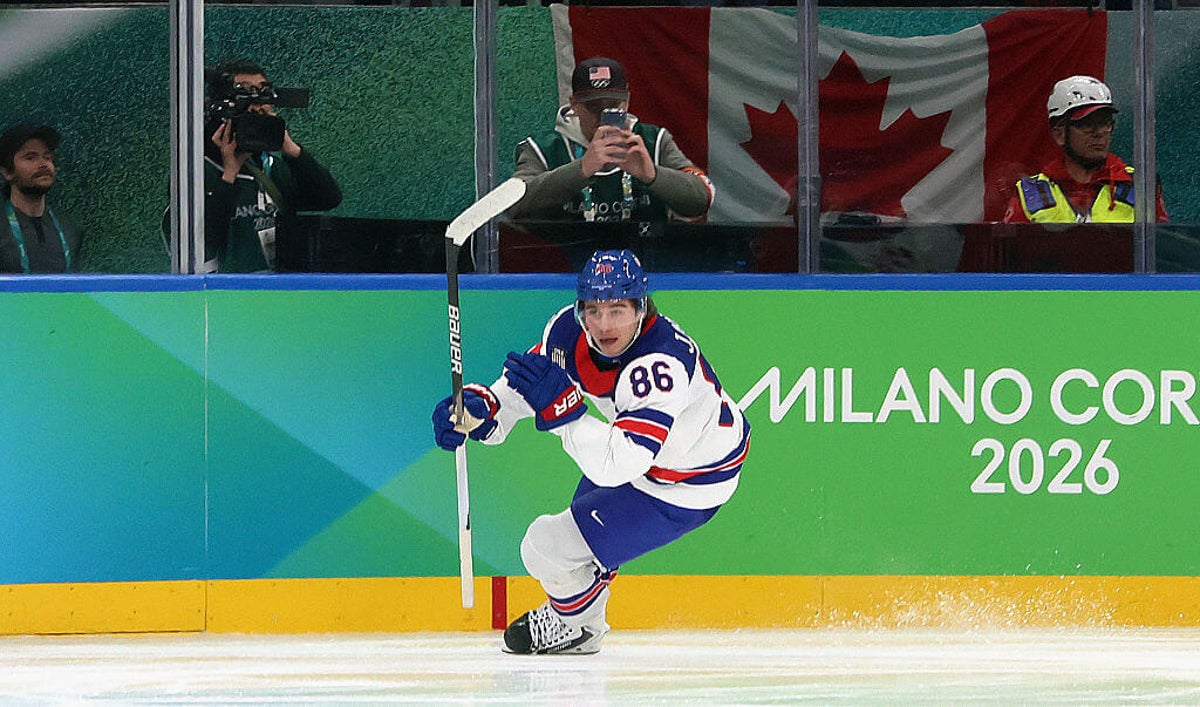
The saga of the ownership of Jack Hughes’ “golden goal” puck that clinched the gold medal for the United States men’s hockey team over Canada in the 2026 Winter Olympics in Milan seems to be over, and it will reside in the Hockey Hall of Fame in Toronto.
This became a point of contention for Hughes after he returned from the Olympics. During an interview on TNT’s Feb. 25 NHL broadcast, he was asked where the puck was. “I honestly have no idea where that puck went,” Hughes said. “I know who doesn’t have it is me. I sure as hell don’t have it.”
Two days later, a Hockey Hall of Fame representative shared on social media that the puck was among items collected from the Olympic hockey tournaments and would soon be on display at the venue.
BREAKING: Artifacts from the 2026 Olympics including:
USA: Women and Men’s GWG puck from both OT Gold medal games; Hilary Knight (jersey)
Canada: MVP McDavid (jersey)
Sweden: Nylander (jersey)
All artifacts collected from the Olympic Games will be on display soon @HockeyHallFame pic.twitter.com/7vrWoesJAT
— Kelly Masse (@KellyHockeyHall) February 27, 2026
In an interview with ESPN on Tuesday, Hughes again addressed the matter, this time expressing a desire to get the puck back.
“I’m trying to get it,” he said. “Like, that’s bulls— that the Hockey Hall of Fame has it, in my opinion. Why would they have that puck?”
That stance softened by Wednesday after learning the puck would remain at the HOF:
“It’s like the most special place in hockey,” he said. “I’m honored that it’s there, but obviously I think things were taken crazy. That’s the way I felt. I didn’t know where the puck was. It is what it is.”
Let’s try to answer some of the lingering questions surrounding Hughes’ puck despite the issue seemingly being resolved.
How did the Hockey Hall of Fame get the puck?
In a statement to The Athletic, the HHOF said it secured the puck thanks to its collaboration with the International Ice Hockey Federation, one of the organizing bodies of the Olympic hockey tournaments. It seems someone from the IIHF snagged the puck amid the U.S. team’s celebration.
The IIHF has provided the HHOF with important Olympic hockey tournament pucks since the 1998 Winter Olympics, including Sidney Crosby’s iconic 2010 golden goal (on Tuesday, Crosby said he was “happy” that puck was at the HHOF), as well as Natalie Darwitz’s gold medal-winning goal puck from the 2008 World Championships.
What is the HHOF doing with the puck?
Hughes’ puck is included in the HHOF’s “Olympic ‘26 Exhibit,” which debuted on Monday, according to the Hockey HOF’s website. Among the items included are:
All three men’s gold medal game pucks, including Cale Makar’s tiebreaker and Hughes’ overtime golden goal
Women’s United States gold medal game pucks, featuring Kristin O’Neill’s opening goal and Megan Keller’s overtime golden goal
Game-worn jerseys, sticks and gloves, including artifacts from Sidney Crosby and Hilary Knight
“Established to honour and preserve the history of hockey, the Hockey Hall of Fame recognizes those who have made outstanding contributions to the game,” the HOF said in a statement. “Our mission is to collect, preserve, research, exhibit, and promote artifacts, images, and stories that are significant to hockey’s worldwide legacy. We hold tremendous respect for the men and women who create these unforgettable moments on the ice, and we remain committed to preserving their achievements in a manner that is responsible, secure and accessible to fans everywhere.”
Who owns pucks and other game-used equipment?
It really depends on the event and the item. Generally, equipment provided by a team, league or organizing entity (pucks, balls, jerseys, etc.) is ultimately owned by those organizations and they can decide what is done with those items, whether they’re given to players, halls of fame or other charitable entities or sold off.
For Olympic and World Championship hockey tournaments, the IIHF holds claim to some items if the organization wants them to be displayed in the HOF.
According to the HHOF, “Items are formally transferred to the Hall through IIHF’s established artifact donation process and added into our permanent collection. These artifacts are preserved, exhibited and shared with fans worldwide through our museum and international outreach programs, ensuring that defining Olympic and World Championship moments are preserved, and remain accessible to the global hockey community.”
MLB and the NHL treat balls/pucks that go into the stands as abandoned property belonging to the fan who retrieves them. The NBA owns its game balls and team uniforms, hence its auction program with Sotheby’s, which is how the auction house sold one of the three jerseys worn by the Dallas Mavericks’ Cooper Flagg during his rookie debut appearance. MLB, the NFL and the NHL have their own in-house auction programs for a variety of game-used items. The NFL has no stated policy on its balls, but teams often ask fans to trade game balls that end up in stands for non-game-used versions since they’re limited and go through a special treatment process.
But here’s an example of how a football used in a Super Bowl ended up on an auction block. The ball used during “Ambush,” the onside kick to open the second half of Super Bowl XLIV, which the New Orleans Saints recovered en route to beating the Indianapolis Colts, originally left the field and went to the Pro Football Hall of Fame. Then, a year later, Hunt Auctions sold the ball thanks to a partnership with NFL Auctions.
Why do players sometimes get to keep important game-used items?
Players in professional leagues are allowed to hang on to jerseys and other items from games, even as important as the Super Bowl. For example, Tom Brady owns all of his Super Bowl-winning jerseys. Rob Gronkowski told The Athletic how he’ll never give away any of his Super Bowl-winning jerseys. In the hockey world, Alex Ovechkin got to keep his NHL all-time goal record puck, but Wayne Gretzky’s record puck resides in the HHOF.
Does Megan Keller want the puck she scored with, too?
Hughes brought Keller’s name into the puck mix earlier this week saying, “I don’t see why Megan Keller or I shouldn’t have those pucks.” Despite that, there was no outcry from Keller for her puck during an interview with The Athletic earlier this month.
How much are these pucks worth?
Estimates for the Hughes puck are truly all over the place.
Ken Goldin, founder and CEO of Goldin Auctions, gave a wide estimate for the puck when asked by Sportico, saying it could be sold between $100,000 and $500,000. SCP Auctions’ David Kohler told TMZ that the puck could sell for $1 million, citing sales of items from the 1980 U.S. men’s Olympic gold medal team, such as Steve Christoff’s gold medal ($375,000) and Mike Eruzione’s tournament-used stick ($290,000).
What did Hughes want to do with the puck?
Hughes didn’t want the puck for himself. He hoped it would end up with his father, Jim.
“I know he’d just love, love having it,” Hughes said. “When I look back in time in my career, I don’t collect too many things for myself, but my dad’s a monster collector for the three of us. I know he would have a special place for it,” Hughes said.
Will the HHOF give it to him if he decides he wants it again?
No.
Philip Pritchard, the Hockey Hall of Fame’s vice president and curator, told ESPN: “Unfortunately, in the easiest words, it was never Jack’s puck to own. It’s been donated to us now. For every artifact that’s been donated, we have a paper trail and signed paperwork of where it’s come from.”
Hughes said Wednesday that he now has no plans to reach out to the HOF about the puck.
The Athletic maintains full editorial independence in all our coverage. When you click or make purchases through our links, we may earn a commission.