
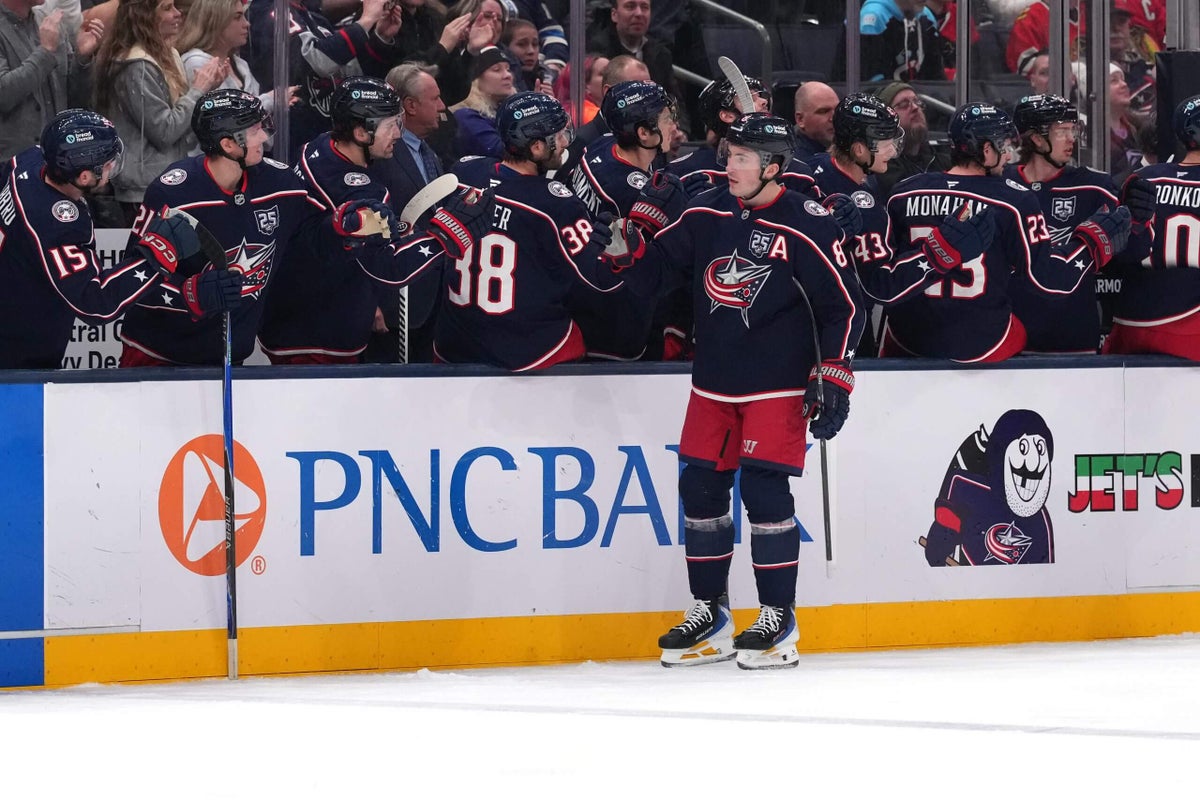
Sometimes, a good coach is all a team needs to unlock the best version of themselves. That’s exactly where the Columbus Blue Jackets find themselves: A legitimate rising power in the East under new coach Rick Bowness, who has the team humming at a 16-2-4 clip since taking over. At long last, it feels like the Blue Jackets have arrived.
That was plain to see on Tuesday in a measuring-stick game against Carolina. Not only did the Blue Jackets handily win 5-1, but they also carried the run of play by a considerable margin with 62 percent of the expected goals. That’s a big deal against the league’s Corsi kings and one of the major indicators that this team is the real deal.
That game wasn’t a one-off either. The Blue Jackets have been an elite five-on-five team since Bowness took over and they seem to get better with each game. From the time Bowness was hired on Jan. 12 to the trade deadline, Columbus earned 53.5 percent of the expected goals, the seventh-best mark in the league. The addition of Conor Garland, who has a strong history of driving play, has only added to that. It’s only been six games, but what a run it’s been with a league-leading 60.3 percent xG. That brings Columbus’ full Bowness tenure to 55.4 percent, good for fourth in the league and just 0.1 percentage points behind Carolina.
It’s the first time Columbus has been above 55 percent over any 20-game stretch since 2019-20, the last time the Blue Jackets made the playoffs. That level is usually the barometer of an elite team and Columbus looks to be trending in that direction. The run has pushed Columbus’ projected Net Rating up from plus-9.5 the day Bowness was hired to its current plus-29.5, the eighth-best mark in the league behind the league’s expected contenders.
That Columbus was sitting at plus-9.5 to begin with, despite its weak record at the time, suggests the Blue Jackets were a potential sleeping giant if they ever got their act together. Under Bowness, they’ve awoken.
This is a team that is starting to play as deep as it looks on paper. It’s not just Zach Werenski dragging a team of mid; it’s everyone stepping up, with the average Blue Jackets jumping from a Game Score of 0.47 to 0.72.
The top four looks the best it has in a long time, with Damon Severson finally playing up to his contract and Denton Mateychuk blossoming into a legit top-four option. Dante Fabbro, looking closer to last year’s version of himself, has anchored the third pair well. Up front, Charlie Coyle continues to stun with 29 points in 22 games, but it also helps to have Kirill Marchenko and Adam Fantilli rising to a point-per-game rate on top of that. Mason Marchment has been an awesome fit and Mathieu Olivier has been amazing on the team’s shutdown line. Even the fourth line has been incredible, with Danton Heinen in particular not allowing anything while he’s been out there.
From top-to-bottom, almost everyone is doing their part, doing it well and doing it better than before.
Most importantly, it’s everyone prioritizing strong team defense. Before Bowness, Columbus allowed 2.82 xGA/60, the third-worst mark in the league. Since his arrival, that’s down to 2.06, the best mark in the league.
Combine that commitment to off-puck play with Columbus’ not-so-secret weapon, Jet Greaves in goal, and it’s the difference between a Blue Jackets team that’s just happy to be there and one that can do serious damage in the postseason. Greaves is up to ninth in GSAx this season and carries real series-stealing potential given his prior track record in that realm.
The potential for all this was there from the start of the season. Under Bowness, the Blue Jackets are realizing it. The only problem: Columbus currently sits outside a playoff spot. With the way the Blue Jackets have been playing of late, though, it wouldn’t be a shock to see them not only get in, but potentially even have home-ice advantage in the opening round.
16 stats1. Glowing comps for Denton Mateychuk
One of Columbus’ most pleasant surprises this season has been Mateychuk. Looking at his current list of top comps shows some very intriguing upside for the 21-year-old sophomore as not just a top-four option, but potentially a future top-pair defenseman. Of Mateychuk’s top 10 comps, six turned into real difference-makers: Kris Letang, Alexander Edler, Josh Morrissey, Ryan Ellis and Roman Josi.
2. Matthew Schaefer is back to dominating
While Matthew Schaefer’s scoring has stayed consistent for most of the season, the rookie phenom hit a bit of a rookie wall just before the Olympic break in terms of driving play. Over his prior 25 games, Schaefer’s xG rate was just 39.5 percent while allowing 3.47 xGA/60, way down from his team-leading 53 percent and 2.34 xGA/60 to start the season.
The good news is that Schaefer is all the way back since the much-needed break, thanks mostly to an elite offensive drive. Since the break, Schaefer leads the Islanders with a 60 percent xG rate on the back of earning 3.79 xGF/60. The latter mark is the fourth highest in the league behind Lane Hutson, Mattias Ekholm and Rasmus Dahlin. Add 10 points in 10 games to that and Schaefer’s average Game Score during the stretch is 1.88, one of the best marks in the league.
3. Washington’s strange season despite being elite at five-on-five
The Capitals have scored 55.1 percent of the goals at five-on-five, the fourth-best mark in the league. And yet they look extremely likely to miss the playoffs and are on pace for just 89 points. Exactly how peculiar is that? Since 2007-08, there have been 74 teams with a five-on-five goals percentage of 55 percent or higher. On average, they earned 111 points. Just three teams — 2008-09 Penguins, 2012-13 Rangers and 2014-15 Kings — paced for under 100 points and only the Kings, with a low of 95 points, failed to make the playoffs.
Teams this good at five-on-five are almost exclusively contenders. The Capitals are just a trivia question.
4. Devils need Jack Hughes’ A-game off the rush
The Devils have been a resounding disappointment this season, and from the outside, it looks like it’s because they’re trying to be something they’re not. Case in point: Jack Hughes’ rush game.
For the last four years, that’s been New Jersey’s fastball; this year it’s been noticeably more muted. Hughes has spent parts of the season hurt and the team has looked more like itself since the break. But on the whole, if you’re looking for the smoking gun of New Jersey’s lost season, this is it: In each of the last three seasons, Hughes has entered the zone with control over 82 percent of the time, over 21 times per 60 and earned at least 6.7 scoring chances off those rushes. This year, he’s down to a 72 percent carry-in rate, 18.6 carry-ins per 60 and just 4.6 scoring chances generated, according to data tracked by Corey Sznajder.
If Jack isn’t Jack, the Devils end up looking like they did this season. Optimizing Hughes’ best is priority No. 1 for next season.
5. Toronto’s dump-and-chase stubbornness
Only two Maple Leafs have carried the puck into the zone more than 55 percent of the time this season: Easton Cowan (62 percent) and William Nylander (58 percent). Only the Rangers and Predators have fewer such players.
For Nylander, that’s down from 73 percent the last two seasons, while Auston Matthews, who’s usually above 60 percent, sits at just 53 percent this season. The Leafs might be getting older and slower, but the inability to enter the zone certainly looks like a choice. The next Leafs coach can’t be this archaically predictable.
6. Too little, too late for Stolarz and Bobrovsky
One reason among many that the Leafs and Panthers will miss the playoffs this year is because of goaltending. Before the Olympic break, Anthony Stolarz had allowed 8.6 goals above expected over 17 games, while Sergei Bobrovsky had allowed 19.8 goals above expected over 40 games. It’s hard to win games starting off with a half-goal deficit and both goalies found themselves in the league’s bottom 10 as a result.
Naturally, now that it’s too late for both teams to get back on track, both goalies have reverted to their previous ways since the break. In six games, Stolarz has saved 6.8 goals above expected and boasts a .921 save percentage, while Bobrovsky has saved 3.5 in six games with a .905. This time, they’re both in the top 15.
At the very least, that leaves some hope for both goalies returning to form next season.
7. Ottawa’s defense without Jake Sanderson
The Senators were dealt a devastating blow to their playoff chances with the loss of Jake Sanderson, who was putting up some Norris-caliber numbers before getting hurt. Sanderson was a big part of Ottawa’s defensive identity, taking care of the toughest assignments extremely well and allowing Thomas Chabot to thrive in a secondary role. With the injury, we now get to see just how big Sanderson’s impact is in that regard and early returns have been telling.
Ottawa has only played four games without Sanderson, but in that time, the Senators’ xGA/60 is 2.58, up from 2.14 with Sanderson in the lineup. Artem Zub, Sanderson’s usual partner, has seen his xGA/60 rise from 1.99 to 3.44 playing with Chabot instead, who has seen a similar rise from 2.33 to 3. It’s a small sample, but it’s one to keep an eye on as long as Sanderson is out of the lineup.
8. Detroit’s new shutdown pair
It’s always interesting to see how teams integrate new players into the lineup and Justin Faulk sure fits the bill in Detroit. Faulk filled the Red Wings’ biggest deadline need and was naturally going to play with Ben Chiarot on the second pair. What I didn’t expect: That pair being used as Detroit’s shutdown pair over Moritz Seider and Simon Edvinsson.
It’s a puzzling move given how strong the top pair has been in that role this season. While it’s freed them up tremendously (64 percent xG share for Seider since the trade), I’m worried about whether it’ll be a worthy trade-off given Chiarot’s previous inability to handle that burden. Faulk should help more than past options, but the pair has an expectedly low 43 percent xG together in that role.
That’s an improvement over Chiarot’s pair with Axel Sandin-Pellikka (41 percent in secondary matchups), but it still doesn’t seem justifiable with a pair on the team that can handle the job much better. Finding the right balance in the top four will be key to Detroit maintaining its spot in the playoff race; I’m not convinced this is the right path forward.
9. The suddenly surging Blues
The Blues have been one of this season’s biggest disappointments this season and entered the Olympic break with a 20-28-9 record. What we’ve seen since, though, looks a lot closer to the Jim Montgomery magic from last season that many fans hoped would continue with the Blues now on a 7-2-1 run.
While it may be a bit annoying for fans hoping for a high pick, it is encouraging to see the players expected to be difference-makers this year looking the part again. The team’s new-look top line has been especially encouraging with Robert Thomas, Dylan Holloway and Jimmy Snuggerud all scoring above a point-per-game pace while crushing opponents at five-on-five. Since being put together six games ago, they have a 65 percent xG and have outscored opponents 8-0. In net, they’re finally getting some saves with Joel Hofer leading all goalies with 10.6 goals above expected in just six games (and Jordan Binnington has rebounded nicely, too).
It may feel like a pyrrhic victory this late into the season, but it bodes well for next season that the Blues can return to the playoff hunt.
10. Greener pastures for MacKenzie Weegar
Playing for a losing franchise is tough. It’s a combination of the mental toll piling up, playoff hope vanishing, and the burden of responsibility without enough support. That’s what it looks like for a lot of players from Canada’s saddest organizations and escaping those fates has looked good on MacKenzie Weegar in particular. Weegar has been a difference-making player for a long time, but struggled immensely in Calgary this year.
Sometimes it’s the player, sometimes it’s the environment; Utah bet it was the latter and so far the Mammoth look right on the money to believe in Weegar. He immediately stepped onto Utah’s top pair, taking on tough minutes and is back to looking like himself again. While he may only have one point in six games, Weegar has a 58 percent xG rate while allowing just 1.59 xGA/60. His average Game Score has jumped from minus-0.25 to 0.69. He’s back, and that’s massive for a Utah back end whose biggest need was a two-way sidekick for Mikhail Sergachev.
11. Mikhail Sergachev returning to form
In the season’s first half, Sergachev really struggled on Utah’s top pair. He was bleeding chances and struggling to control play to the level he showed last season. Just before the Olympic break, though, he started to turn the corner with more consistent efforts. Since the break, he’s been lights out with an average Game Score of 1.65 backed by a 60 percent xG rate while outscoring opponents 6-2. If Sergachev is back to playing like a legit No. 1 with a legit No. 2 beside him in Weegar, the Mammoth could make some real noise in the playoffs — especially if they sneak onto the Pacific side of the bracket.
12. The rise of Elias Salomonsson
There hasn’t been a lot that’s gone right for the Jets this year, but one thing that has is the play of rookie defenseman Elias Salomonsson. The 21-year-old has played 24 games for the Jets, but the most important have been the 20 he’s played since Neal Pionk got hurt.
During that time, he leads the team with 58.3 percent of the expected goals while outscoring opponents 12-6, both of which lead the team’s defenders. That’s not in sheltered minutes either; he’s been paired with Dylan Samberg in the top four, taking on equally tough minutes to Josh Morrissey’s pair. The Jets look like they have a good one here.
13. Matt Savoie is figuring it out
It takes time for young players to learn the ropes in the big leagues and Matt Savoie’s defensive work this year is a great example of that.
Over the first two months of the season, Savoie had a 45.2 percent xG rate undermined mostly by allowing 3.22 xGA/60, one of the 10 worst marks in the league. But every month, he’s become a little better and he’s been especially good since the Olympic break. In 10 games, Savoie has a 59 percent xG and has seen his xGA/60 drop to 2.53. He’s also getting the results to show for it and the effect of having the puck more has also been great for his production with 10 points in 11 games — eight of which have come at five-on-five.
That’s been enough to warrant another look next to Connor McDavid on the top line over the last three games. The duo had a failed experiment together back in November, but have tilted the ice heavily together over the past week with 67 percent of the expected goals.
14. How Artemi Panarin has bolstered the Kings’ power play
Aside from one random season where they finished second, Los Angeles’ power play has always been a pressure point during this era of playoff contention. The Kings finished 26th in goals-per-60 last season and were trending for a similar finish this year, landing at 27th before the Olympic break, scoring just 6.0 goals-per-60.
The main reason for that is the team lacked true star talent; so, how much could the addition of Artemi Panarin change that equation? Turns out the answer is a fair bit, as expected. Since adding Panarin, Los Angeles’ power play is up to 8.9 goals-per-60, the ninth-best mark in the league. That’s no fluke either, with 10.4 expected goals per 60, the second-best mark in the league, and well up from where they were before the trade (7.0, 23rd).
One other noteworthy tidbit: Brandt Clarke is up to 22 points in 31 games since becoming a permanent fixture on the Kings’ top power-play unit. That’s a 58-point pace. Not bad.
15. Rasmus Andersson vs. Zach Whitecloud
Back in January, Vegas traded a first-round pick and a conditional second for the privilege of upgrading from Zach Whitecloud to Rasmus Andersson. The only problem? It hasn’t been much of an upgrade.
In Calgary, Andersson had a 45 percent xG rate and while that’s up to 49.4 percent with Vegas, that’s actually right on par with the 49.5 percent the Golden Knights were already getting with Whitecloud, who’s up to 52.7 percent with the Flames. Andersson adds a little more production, sure, but even with that, his average Game Score in Vegas has been minus-0.18, way down from his 0.60 in Calgary. As for Whitecloud, he’s been at 0.63 with the Flames, playing on the top pair with Kevin Bahl. Ouch.
16. How much has Andersson’s value dropped since the trade?
According to AFP Analytics, Andersson is projected to sign a seven-year deal this summer as a UFA with a cap hit coming in at $9 million. That would’ve been easier to see coming in Calgary, but I wonder how much his weaker play with the Golden Knights brings that number down.
Teams have a lot of cap space and not a lot of players to sign, which makes pricing the few worthwhile players tricky. A desperate team might just give Andersson $9 million, no questions asked. But Andersson’s work with Vegas has been alarming enough to wonder whether he still qualifies as “worthwhile.” His projected Net Rating is down to just plus-0.1, which is just average second-pair defenseman territory. On a seven-year deal, I’ve got his current market value at just $4.5 million, with the second half of the deal looking particularly rough.
Unless his next team can really optimize his strengths and limit his weaknesses, Andersson’s next deal could end up being one of this summer’s biggest mistakes.
— Data via Evolving Hockey, Hockey Stats, Hockey Stat Cards and All Three Zones.