
It was only three seasons ago, before the beginning of the 2023-24 season, that I worried, in the pages of another publication, that men’s college basketball might be doomed. This was not an unreasonable worry.
It looked like everything was conspiring against the sport. Widespread loosening of transfer rules and eligibility requirements had made it nearly impossible to track who played where. The Wild West era of realignment, entirely orchestrated by and constructed for college football, had torn apart some of college basketball’s biggest rivalries and left it seemingly a second-class citizen whose fate lay entirely at the whim of a handful of football-obsessed television executives.
The sport had zero household names, with only one of the at-the-time top four projected NBA Draft picks even playing college basketball, and only one player on the preseason All-American team even projected to be selected in the first round. (That player was Kyle Filipowski, not exactly the sort of electrifying player your kid puts up a poster of.) That March, the women’s Final Four, highlighted by Angel Reese and Caitlin Clark, would earn better television ratings than the men’s for the first time.
Men’s college basketball had no juice. It looked increasingly abandoned by the larger culture and, all told, kind of pointless. Being a die-hard college basketball fan — as I am, and will forever be — felt like being one of the last people still using typewriters or going to a skating rink. We were the last people who still hadn’t left the bar.
It no longer feels that way. As someone who has adored men’s college basketball since he cried for hours in his bedroom because the referees didn’t call traveling on Kentucky’s Dickey Beal, I am not sure the sport itself has ever been better than it is right now — and even, potentially, set up to remain healthy long-term.
I understand this is not a popular opinion. College basketball has changed so much, in such a short amount of time, that it can look almost unrecognizable to older fans. A sport that once prided itself on its amateurism now spends a reported (and likely underreported) near-billion dollars on name, image and likeness budgets.
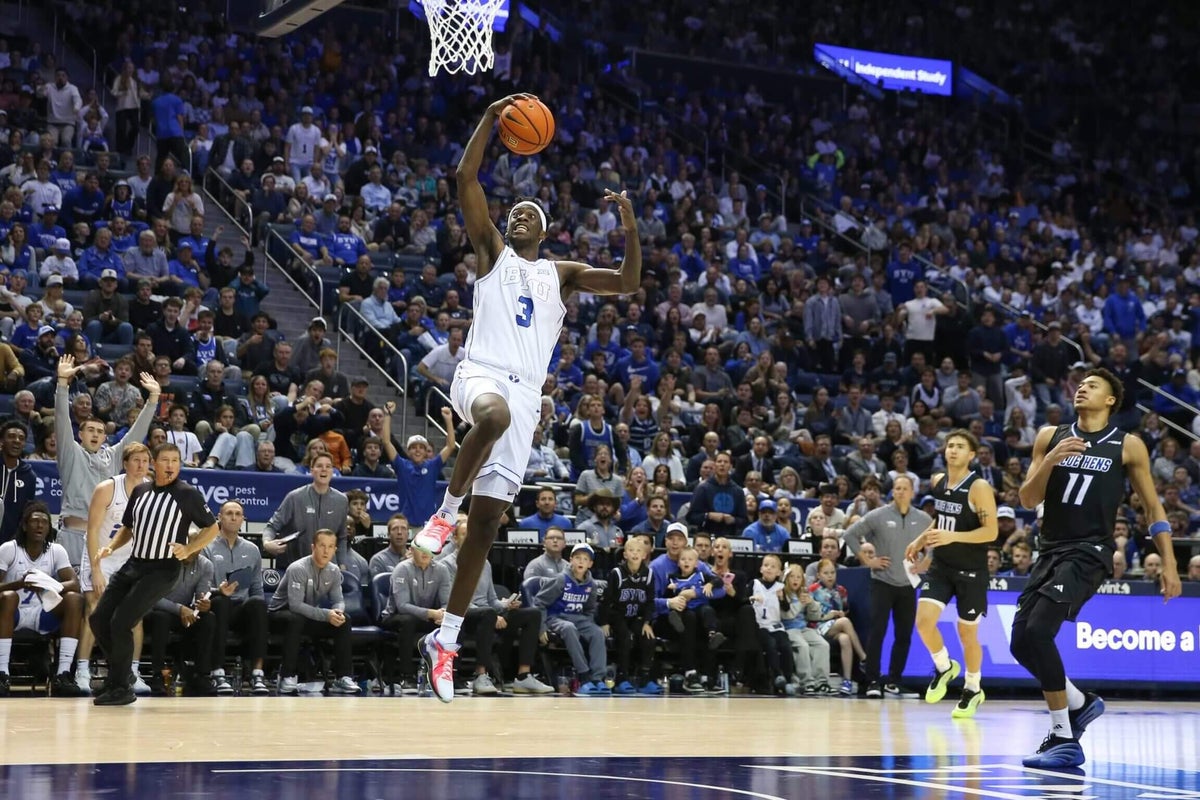
But it is through these changes that the sport has discovered its salvation. Three years since my existential panic about college hoops, the sport has superstar players, vibrant personalities and innovative gameplay while still maintaining the basic structure and foundation that makes it so unique and its fans so passionate. I do not know if I’ve ever had more fun watching college basketball than I have this year.
I’m telling you: This sport is great right now. And the reason is obvious: We’re paying the players. Because of that simple (and long overdue) fix, there are stars everywhere. And we at last know who they are.
The Atlanta Hawks drafted Zaccharie Risacher with the first pick two years ago. If Hawks fans wanted to be excited about the pick, they simply had to take it on faith: Almost no one had actually seen Risacher play. The same was true for fellow top-10 picks Alex Sarr, Tidjane Salaün and Matas Buzelis, all of whom had played only overseas or in the G League before being picked.
2023 was the same way: Scoot Henderson, Amen and Ausar Thompson and Bilal Coulibaly were all total strangers to any American sports fan. (Victor Wembanyama is the obvious exception.) Those players didn’t play college basketball because there was no reason for them to. They couldn’t get paid.
In a world, though, where college basketball players are not only paid but also paid at highly competitive rates — in many instances, more than they would get paid as an NBA benchwarmer or second-round pick — suddenly, the next generation of NBA stars are in college for the entire world to see. Thirteen of the top 14 picks in Sam Vecenie’s most recent mock draft will all play in this year’s tournament, and the only one who won’t, North Carolina’s Caleb Wilson, is because of injury. (There’s only one player in Vecenie’s first round, the New Zealand Breakers’ Karim Lopez, who did not play college basketball in 2025-26.)
But this doesn’t mean college basketball has become a feeder league for the NBA. Players who might have risked leaving college early for the draft despite only a second-round projection can stay and make money, which leads to the sort of traditional college star we’d lost for nearly a decade: a guy who sticks around for years (just maybe not on your preferred team), excelling in the sport despite not quite being NBA caliber, populating rosters everywhere. Michigan’s Yaxel Lendeborg, a first-team All-American, is precisely the sort of player college basketball traditionally loses, a projected mid-to-late-first-round pick who, because of NIL, stayed and ended up powering a fantastic Michigan team to a No. 1 seed while being one of the more magnetic personalities you’ll see in this tournament.
You’ve got high school recruits flocking to campus again, established stars sticking around, and you’ve got international players realizing American college teams are a logical (and financially lucrative) place to build your brand and play in front of roaring crowds. This is ultimately advantageous to the NBA as well; these players are now pre-branded, already in the public consciousness of the average sports fan. The NBA won’t have to explain to us who Darryn Peterson or Darius Acuff Jr. is.
This wide variety of players has also allowed college basketball to have stylistic differences that, frankly, not even the NBA has. Some teams play five-out with shooters everywhere; some teams play traditional post-up, back-to-the-basket; some teams run like mad; some teams are molasses, Tony Bennett-slow. We’ll see all these teams in the tournament. What does Braden Smith look like playing against AJ Dybantsa? The bigs of Michigan against Nate Oats’ run-and-gun at Alabama? This is the week we find all that out.
And, of course, there is this week, this tournament, the trump card college basketball always has available to play. Because everything you love about college basketball is still, in fact, here. The brackets. The plucky underdogs. The hipster upsets. Eccentric personalities, from the McNeese student manager or the random former top recruit who suddenly goes nuts and scores 44 points for Penn to St. Louis folk hero Robbie Avila, the goggled man of a million nicknames. (I’m a “Cream Abdul-Jabbar” guy myself.) Moments you’ll never forget from teams you didn’t know existed before. There’s even the nostalgia that comes with watching this tournament your entire life: Did you know Speedy Claxton, Rod Strickland and Gerry McNamara are all coaching in this tournament? I swear those guys were just playing!
Look: I know college basketball isn’t the way it once was. I once exchanged Econ 105 notes with Illinois point guard Matt Heldman at his dorm after practice, and that’s probably not happening today. I know players transfer constantly, and they might not have the deep-seated connection to the university you do or would like them to. (Bad news: The latter has always been true.) I know a large part of the appeal of college basketball to a lot of people is a sort of purity, a supposed altruistic innocence that was never really there, but we pretended it was.
And you’re right. It’s not the same sport. I have watched college basketball since I was old enough to watch anything. This is as good as it has been. College basketball, remarkably, almost by accident, finds itself not just limping along, a relic of a past age, but in fact thriving. Come back to it. Let it in. You won’t regret it.
First
Round
Second
Round
Sweet 16
Elite
Eight
Final
Four
Final
Four
Elite
Eight
Sweet 16
Second
Round
First
Round