
MANALAPAN, Fla. — You know it’s an obscure rule when Colin Campbell, the head of the NHL’s hockey operations department, hadn’t even heard of it.
But last week, Nicole Shirman, “a future physician with a chronic case of being an Islanders fan” according to her bio on X, posted on X, “Today I learned that if the officials don’t show up to an NHL game for whatever reason and nobody can agree on replacements, both teams just … pick a player. The player from the home team acts as referee while the visiting player gets to be a linesman. This is an actual NHL rule.”
She then posted a screen grab of Rule 31.11, which indeed reads, “If, through misadventure or sickness, the Referees and Linespersons appointed are prevented from appearing, the League will make every attempt to find suitable replacement officials, otherwise, the Managers or Coaches of the two Clubs shall agree on Referee(s) and Linesperson(s). If they are unable to agree, they shall appoint a player from each side who shall act as Referee and Linesperson; the player of the home Club acting as Referee and the player of the visiting Club as Linesperson.
If the regularly appointed officials appear during the progress of the game, they shall at once replace the temporary officials.”
The tweet went viral with many hockey fans, unaware of the nearly 100-year NHL rule, astonished that it was real.
The Athletic gave Campbell a copy of the rule, which he read aloud. Carolina Hurricanes GM Eric Tulsky, standing there and listening to the conversation with the biggest grin on his face, laughed out loud when Campbell joked that the GMs would never agree on two players.
Campbell, 73, was shocked by the rule. Remember again, Campbell has been the NHL’s senior executive VP of hockey ops since 1998. He also coached in the NHL from 1985-98 and played from 1974-85. There’s little he doesn’t know.
But that’s when the lightbulb went off in Campbell’s head: “I don’t know if it was when I was coaching or playing, but I think this happened. Two officials didn’t make a game because of a snowstorm and I think two players were the linesmen.”
And he’s right.
According to NHL Stats, on Jan. 15, 1983, in a game between the Hartford Whalers and New Jersey Devils at the Hartford Civic Center, a blizzard caused the late arrival of referee Ron Fournier and linesman Dan Marouelli.
It was decided that Whalers defenseman Mickey Volcan and Devils forward Garry Howatt would serve as linesmen. And that’s what they did until Fournier and Marouelli arrived in the second period.
Linesman Ron Foyt, who did make the game on time, served as referee until moving back to linesman once Fournier suited up.
Foyt has been an NHL video goal judge assigned to Minnesota Wild games since the organization’s inception in 2000. Before that, he served in the same role at North Stars home games.
Foyt flew into Hartford the night before the game. Fournier and Marouelli were coming from Boston. Foyt said he was sitting in a “very lonely” officials’ room before the game, expecting Fournier and Marouelli to walk in.
“There were no cellphones in those days, so I didn’t know where they are,” Foyt recalled. “So I’m sitting in the referee room by myself and the time is ticking, ticking, ticking. I figured, well, they’re not going to get here. So I dusted off the rulebook to see what we’re supposed to do and it says, ‘Just ask each team to supply a player to be a linesman,’ and I would be the referee.”
Foyt went to both teams and asked, “OK, it’s not my call, it’s your call. Do you want to play the game or pick two players? But it was a rivalry and a big game and both coaches wanted to play.”
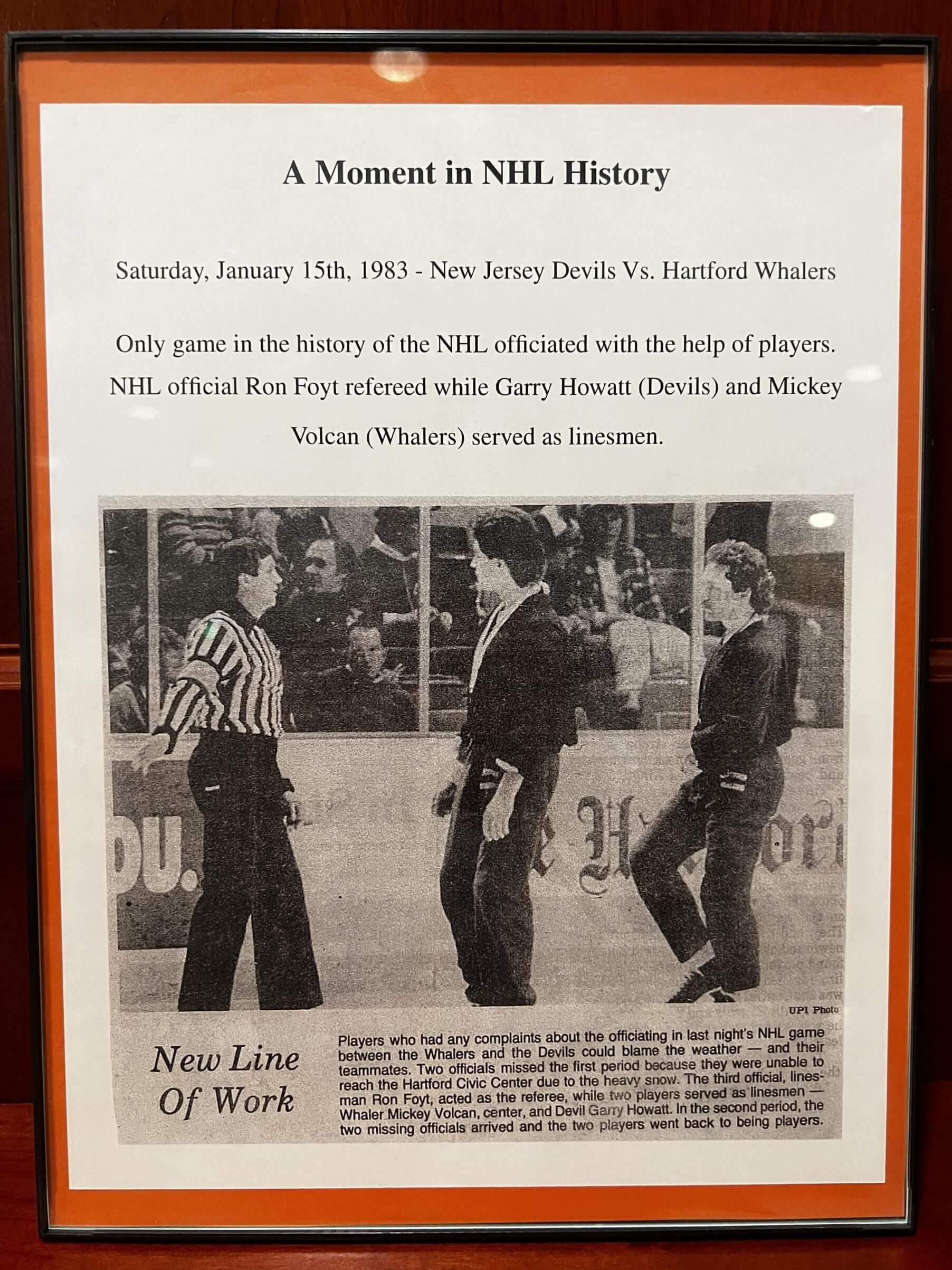
An image commemorating the time Garry Howatt and Mickey Volcan served as linesmen in a Devils-Whalers game is displayed in the Wild’s NHL alumni room. (Michael Russo for The Athletic)
“So I put arm bands on,” Foyt said. “(Then-director of officiating) Bryan Lewis asked me the next day, ‘Why the hell did you put arm bands on?’ I said, ‘Because I’m a linesman. It’s the only chance I’ll ever have to put arm bands on and referee an NHL game.’”
Foyt held a little pregame meeting with Volcan and Howatt, who wore “sweat tops and green sweatpants.” He asked if they had any questions.
“They had two: ‘How much do we get paid?’ and ‘If we break up a fight and we get punched, can we fight back?’” Foyt said. “I said, ‘No, please don’t do that. That’s not a good thing to do and you make a helluva lot more playing than you do as a linesman.’ But that literally was their only two questions. I figured they’d ask, ‘When do I call an icing, when do I call an offsides, what are the faceoff rules?’
“So we went on the ice and the crowd was like, ‘What’s going on here?’ And Gordie Howe was playing for Hartford and came up to me and said, ‘You’ll never see this again,’ which was true.”
The big thing Foyt wanted to figure out was which line each player should cover.
“Should they cover their home attacking blue line or should they cover the opponent’s attacking blue line?” Foyt said. “I couldn’t figure it out in my head, which would be less controversial. I don’t know how I figured it out, but they had no questions except for those two. That was it. They said, ‘This can’t be hard.’ They dropped the puck fine and they moved around the rink OK. And the game was … the players played the game a little more mild-mannered. We only had one scuffle, which wasn’t a big deal, but the two guys that they picked were tough guys on their teams. Instead of picking guys that were Lady Byng winners, they picked two tough guys. Finally, Fournier and Marouelli showed up halfway through the second period.”
When Campbell was told what the NHL’s research department unearthed, he said, “Howatt was a tough little guy. That’s why I remember.”
Stephen Walkom, the NHL’s executive vice president of officiating and a former NHL ref, said the rule has been in every version of the rulebook he has read since the 1980s. Well, NHL Stats told The Athletic that the rule actually appears in the 1928-29 rulebook — the oldest rulebook the NHL has on file. The league does possess the Pacific Coast League rulebook from 1923-24 and this rule or any kind of variation of it does not appear in there.
So somewhere along the line, something must have happened to necessitate a compromise if officials didn’t make the game.
“I would think that it would be a rare moment where we wouldn’t be able to get officials to a game or they wouldn’t be able to agree on allowing someone else to go in and do the games,” Walkom said. “Someone from the American Hockey League that would be affiliated with us, someone that was on our staff that we knew that we could trust to manage a hockey game, would be the ones chosen.”
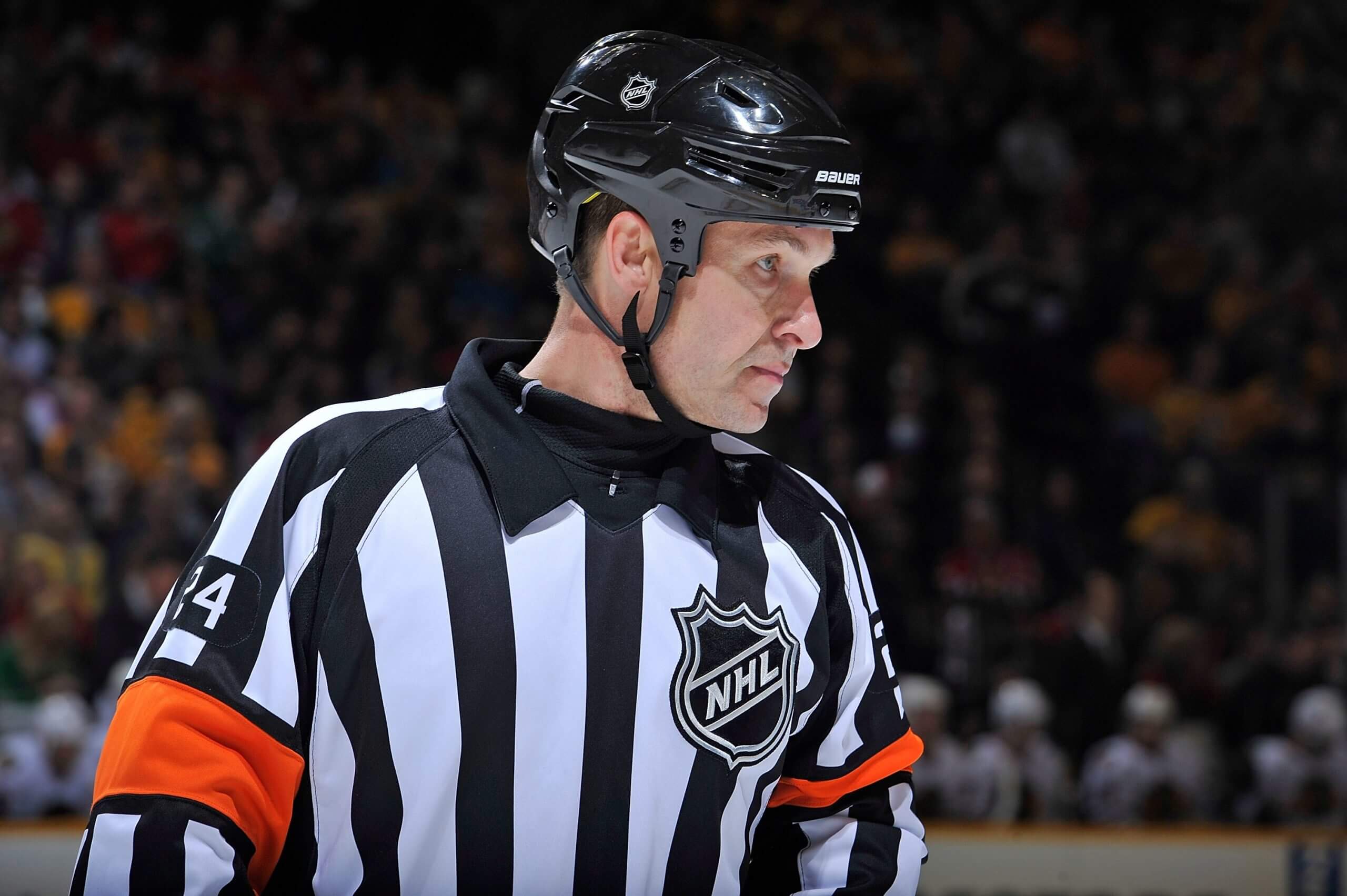
NHL executive vice president of officiating Stephen Walkom, pictured working an NHL game in 2013, can’t envision a scenario where the league actually pulls the trigger on rule 31.11. (Frederick Breedon / Getty Images)
What are the chances, but immediately after this rule was discovered by Shirman in her avid NHL rulebook sleuthing, the league actually ran into some travel logistics for officials.
A blizzard slammed Minnesota on Saturday and Sunday and veteran Chris Lee, who lives in a Twin Cities suburb, was called upon to officiate weekend Wild games against the Rangers and Maple Leafs because refs couldn’t make it into town. Referee Brandon Schrader, who called Saturday’s game with Lee, acted as a linesman in Sunday’s Wild-Maple Leafs game because he was stranded in Minnesota at the same time the NHL couldn’t get a linesman in due to one getting hurt the night before in the Wild-Rangers game.
Tuesday night, travel issues caused one of the refs assigned to a Jets-Predators game to not make it to Winnipeg. So the league decided that, coincidentally, Schrader — the other ref assigned — would officiate the game solo with two linesmen like the old days.
“What people don’t realize is during the year, we have a lot of changes,” Walkom said. “We make a lot of changes for injury or illness. A lot of things happen during the season. Our guys are flying commercial flights, they’re taking trains, they’re sometimes driving. We’ve been sort of fortunate over the years. But an official might get injured in the first period. We know how to run the system with three men. We know how to run it with two people as well. So we make a lot of changes at the last minute. There’s a lot of fill-ins, but over 1,312 games, it’s remarkable how all the guys get to their workplace. They figure it out.
“But years and years ago, if you got to the point where you wouldn’t have anybody there because of misadventure and they couldn’t agree on who was to do it, they would want the game to go on. And to do that, they would want to appoint players from their team to do it.”
Walkom can’t envision a scenario where the league would actually pull the trigger on the rule.
“Obviously we can assign who we think was capable of doing the game, but we never want to put our players in jeopardy and not put officials on the ice that we don’t think are competent and qualified to work the hockey game,” Walkom said. “Like I said, it’s a rare thing, but I think at some point in time, in the NHL, through misadventure, weather, sickness, something, you must have had a time where GMs didn’t agree on who to put on the ice because of officials not showing up and they had to put a remedy in place in the book to account for having the game covered.”
We queried a dozen or so GMs during this week’s GM meetings in Florida, and most had never heard of the rule.
That also means they’re not on social media, which we envy.
“What?” Colorado Avalanche GM Chris MacFarland said when told the rule by The Athletic.
“Huh?” said Minnesota’s Bill Guerin.
“You’re kidding?” said Philadelphia’s Daniel Brière.
The few who did know of the rule — Winnipeg’s Kevin Cheveldayoff, Dallas’ Jim Nill and the Islanders’ Mathieu Darche — knew from social media or the fact their team’s social media crew latched onto the “story” and had some fun determining which of their team’s players would make the best refs and the best linesmen.
“Our social media team dove right into it, and they picked Eric Comrie, and that’s probably a good one for our organization,” Cheveldayoff said. “He takes things very seriously but keeps things very light. So I could see him really taking to a role of being that person that arbitrarily adjudicates a game down the middle.”
We asked some GMs who they’d pick to be a referee or linesman if they ever had that uncomfortable yet fun opportunity.
“Travis Konecny seems to have a lot of opinions,” Brière said. “Linesman? I’d go with one of my centers because they deal with the linesmen on faceoffs, so let’s go Sean Couturier.”
“Sasha (Barkov),” said Florida’s Bill Zito. “Sasha’s the best at everything, and he’d also be the fairest.”
“Esa Lindell as ref,” said Nill. “He’s got the most even demeanor. Miro Heiskanen as linesman. He’s the best skater.”
“Pavel Buchnevich,” Blues GM Doug Armstrong said. “He makes all the calls already.”
“I’d pick Zuccy (Mats Zuccarello), but he’s too opinionated,” said Guerin. “Brodes (Jonas Brodin) is one of the best skaters in the league, so he’d be the best linesman, and Spurge (Jared Spurgeon) would be the best ref because he’s the most level-headed.”
“I’d go Gabriel Landeskog as ref because he’s got a really good feel for the temperature of games,” MacFarland said, “and Josh Manson as linesman because you’ve got to have size to break up the scuffles.”
Darche picked Adam Pelech “because he’s so honest and would probably call penalties on us he’s so honest” and Jean-Gabriel Pageau as linesman “because nothing rattles that guy. He’d have no problem blowing a play down on a close offside.
“I’d pick Matthew Schaefer, but he’s too young and already gets too much attention.”
Tulsky didn’t want to pick a player: “I love all my children equally.”
Walkom said being chosen as a ref or linesman would probably be a dream for any player.
“It wouldn’t take them long to catch on,” Walkom said. “They’ve been reffing from the bench since they had a stick in their hands. They’ve been officiating since they were like probably U10, and not doing it in an abusive way, but if you’re playing hockey, you’re calling offside, you’re calling icing, you’re calling penalties. You’re officiating within the game. ‘I got hooked. He tripped on his own. That was a high-stick.’ All of that goes on every single night in every single game. These guys don’t realize, but they’ve been refereeing their whole life. And if you weren’t reffing, the coach behind you was reffing. Or your mom was reffing, or your dad was reffing, or whoever. At home, your sisters and brothers were reffing when they said it was offside on the goal or whatever.
“So it would be fun. But I can’t see it happening.”